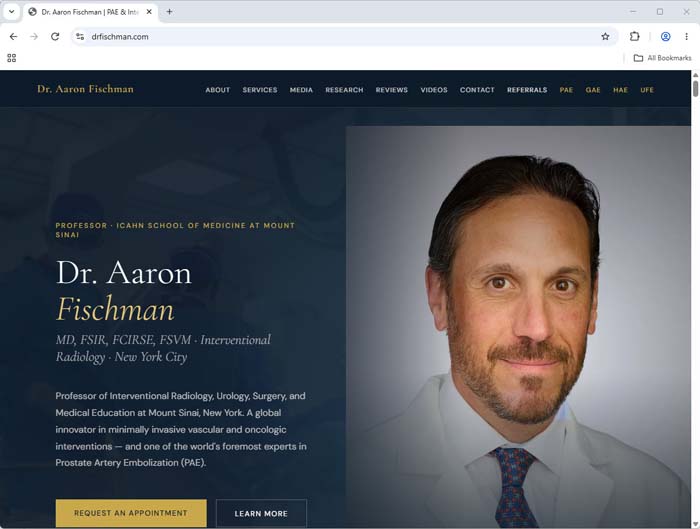
Dr. Aaron Fischman [00:00:00]:
Like, I think the number one thing ultimately is that most men think that the only thing that can happen to their prostate is cancer, which is actually not true. The most common thing that people really experience with their prostate is what we call benign prostatic hyperplasia, which is also known as BPH.
Mike Capuzzi [00:00:17]:
This is Unstoppable After 50, the podcast for men who refuse to slow down. Each week I share smart strategies and expert insights to help you stay strong, healthy, and unstoppable in the second half of life. Welcome back to Unstoppable After 50. This week's guest is Dr. Aaron Fishman, an interventional radiologist, and today's conversation is a very interesting one because it's focused on the health of our prostate. Uh, most men are going to experience prostate enlargement as they get older, and as you're going to find out here in today's conversation, Dr. Fishman has specialized in a procedure that is an alternative to either medicine as a solution to enlarged prostates or the traditional surgeries, which can have all kinds of issues. So stay tuned for a very interesting conversation on a topic that all of us men need to know about with Dr.
Mike Capuzzi [00:01:16]:
Aaron Fishman. Dr. Fishman, welcome to the show.
Dr. Aaron Fischman [00:01:20]:
Thanks for having me, Mike. Really looking forward to this discussion.
Mike Capuzzi [00:01:22]:
Well, Aaron, I was too, because obviously this is a topic that It is important to all of us men. And, you know, I have my own questions. And, uh, you know, I want to kind of keep this conversation— at least we'll start out at a pretty high level, keep it simple, because I still think even though there's so much information out there, I still think a lot of guys, there's confusion. Do I only have to worry about my PSA and I'm good? So let's start there, if you don't mind. I get my PSA tested twice a year. I'm very proactive with my blood work. Is that all I need to worry about? I just turned 60. Is that all I need to worry about?
Dr. Aaron Fischman [00:01:59]:
Well, you know, I love the name of your podcast because it's Unstoppable After 50, and the reality is that if you're 50 years old, approximately 40 to 50% of men will have BPH. Now, does it always cause symptoms? Not always. There are some early warning signs that people should think about: getting up more than once at night to pee, having a weaker Urinary stream than you had 10 years ago, you know, maybe waiting for it to start, stopping, starting, dribbling at the end, feeling like you never fully empty. Some men will get sudden urgency where they are driving or they are on the golf course, etc. Men will often write each one off on its own, but together they are a pattern that is worth a visit to a doctor, and most people default to a urologist, which makes a lot of sense. sense, or their primary doctor. I have actually been able to develop a practice where men can come to me directly, which has always been a little bit unusual in the interventional radiology world, but that is the way that I practice. That is the way that men should really be given all the options, and I think 2 things that you should never wait on, and just to keep it very clear, if you get blood in your urine, that is definitely more serious, or not being able to pee at all, which absolutely can happen.
Dr. Aaron Fischman [00:03:13]:
As you get older. So those are sort of the red flags.
Mike Capuzzi [00:03:16]:
Okay, so I just want to make sure I understand those. I mean, there's, there's ones that you hear about as a guy. So those couple that you rattled off early on, you know, peeing more than once at night, you know, having difficulty, all that— I mean, I guess a lot of guys, if that happens, starts happening, they sort of just brush it off. Is it something like, as soon as it happens, doctor, I should worry about this? Or do you give it some time? Like, how do you know it's just not something that's just happening versus this is a real issue, or is it a real issue from the get-go?
Dr. Aaron Fischman [00:03:52]:
Well, there's lots of ways to think about it, right? These are what we call lower urinary tract symptoms, L-U-T-S, or LUTS. There's lots of reasons why you would get them. The most common reason is BPH, as I mentioned, but there's many other reasons. So you should at some point get evaluated so somebody, whether it's an interventional radiologist, a urologist, or a primary doctor, can make the determination of what's causing it. The most common reason is BPH, as I mentioned, but there is a cost to ignoring it. So there is a quality of life issue, and we all sort of want to improve our quality of life, particularly as we start living longer. But most guys assume that peeing more at night is just aging, and that can be the case, but it's rarely just those bathroom trips. I mean, I think you know this better than anybody.
Dr. Aaron Fischman [00:04:38]:
You lose sleep, that wrecks your energy, mood, You're focused the next day. Some men stop traveling because they can't sit through a plane flight the way that they used to. Sometimes they miss a round of golf because they can't really figure out where the bathrooms are. There's lots of things that men do to sort of adjust their quality of life, and I think that's actually a pretty, you know, pretty negative impact. And a lot of men will quietly avoid intimacy. That happens too. That's not just aging. This is a treatable condition, so just white-knuckling it, I don't think, is the best answer.
Dr. Aaron Fischman [00:05:09]:
There is an actual medical reason to not wait. The longer you let the prostate sort of create a blockage for the bladder, the bladder can get overworked, and the bladder is a muscle, so if the muscle in the bladder gets overworked, it could decompensate as time goes on, and if you have damage to your bladder muscle, that can become permanent, which sometimes doesn't resolve even after you remove the blockage.
Mike Capuzzi [00:05:32]:
So if you don't mind, Doctor, just again, take a step back. BPH, just go into— again, you've shared already, but just go a Go a little deeper if you don't mind, at a practical level for guys, right? They're watching or listening to us right now. Give them a little bit more background of, you know, what that is and why it's so, you know, important for them to be aware of. Quick pause. If you're not getting my Unstoppable After 50 Playbook, you're missing out. Every week I send a 1-page playbook with my key interview takeaways and simple actions to help you stay strong and in control. Get it free each week at unstoppableafter50.com. Now, back to the show.
Dr. Aaron Fischman [00:06:12]:
Yeah, so, you know, the prostate is a fertility organ, and, and, and it, it provides a lot of the seminal fluid. It deals with hormonal changes, uh, in the blood. Um, but as you get older, the prostate starts to enlarge. We call that, you know, prostate growth or histologic growth or hyperplasia. The problem is that when the prostate enlarges— and this is not cancerous enlargement, this is benign enlargement, just to keep that in mind, but as it grows, if you imagine a tube that runs down from the bladder to the penis, that's called the urethra, the prostate urethra, the prostatic urethra. As the prostate grows, it actually squeezes the urethra, and as that happens, that's what causes all those symptoms that I described. So it may make you feel blocked, it may make you feel like you have to pee more often, and it also doesn't allow you to completely empty your bladder, and so a very common thing that happens is you go to the bathroom, And if you did an ultrasound, and we do this all the time in the office, your bladder is still full or mostly full. And so you empty a little bit, but not completely.
Dr. Aaron Fischman [00:07:15]:
So mechanically, it's a problem. It's just a plumbing issue, right? The tube that goes from the bladder to the penis is squeezed from the outside.
Mike Capuzzi [00:07:24]:
Does getting my PSA tested, does that, as long as I'm watching that number, does that tell me what I need to know? Or is it, you know, is it—
Dr. Aaron Fischman [00:07:31]:
Yeah, that's a great question, actually. The PSA is a great screening test for for cancer, for cancer. The problem with the PSA is the PSA can go up for other reasons. And so, if you have an elevated PSA, oftentimes you'll end up seeing a urologist and you'll possibly get a biopsy of your prostate to make sure there's not cancer. You may get an imaging study like an MRI, which can also exclude cancer in a lot of cases. But oftentimes those biopsies and those MRIs are negative, and so you still have an elevated PSA. Now, having an elevated PSA is not dangerous in and of itself. It's just an indication that There's a lot of prostate tissue.
Dr. Aaron Fischman [00:08:08]:
And so typically an elevated PSA in somebody who has a negative MRI or a negative biopsy is just BPH. It's just the prostate has more tissue than it did years ago. That's the best way to think about it.
Mike Capuzzi [00:08:20]:
All right. So just again, in my simple mind here, PSA screening for prostate cancer, but then there's this whole other thing that's going on with potentially with guys, which is the enlarged prostate affecting quality of life, et cetera. So there's these 2 distinct issues. All right, very interesting. So, and that's, it's kind of coming back to my, my dad who's in his 80s had major prostate. He put it off for years and years and years, and it was so large that, and this was probably 6, 7 years ago, he had a pretty rad— it was a radical, some sort of radical, uh, surgery that he had to get done. And, and it's unfortunately he's had some, you know, real repercussions from it. But, um,
Dr. Aaron Fischman [00:08:59]:
I hear that all the time actually. Right. Very common. Yeah.
Mike Capuzzi [00:09:02]:
Right, right. So I mean, are all guys going to develop an enlarged prostate? Is that just a given? No matter what I do, no matter how hard I exercise, what the good food I eat, all that stuff, is it going to happen to all of us pretty much?
Dr. Aaron Fischman [00:09:15]:
Well, you know, the prostate was developed, or embryologically it was created, to not really last 80, 90 years. You know, I think that's really what it comes down to. It's sort of an error in our, in our evolution, in our embryology, because it, you know, it's in a weird spot, right? Like, why would we put a prostate, uh, you know, you know, right next to the, you know, the important plumbing that men need as they get older? And so it's sort of a design flaw, right? I mean, if a contractor came to your house and said, I'm gonna, you know, design something around, you know, around, you know, the pipes in your house, that makes no sense. It's sort of, it's sort of like that. I, I think of it like that. Uh, but yeah, 80% of men that are 80 are going to have BPH, which is a staggering number, right?
Mike Capuzzi [00:09:56]:
Jeez.
Dr. Aaron Fischman [00:09:56]:
So you live long enough, you're gonna have some issue or some BPH to a degree. Now, does it always cause a major issue? No, but as you can imagine, if 80% of 80-year-olds have this problem and they've ignored it their entire life, they may have issues. And so this is why I came on this podcast because I think a lot of people don't really talk to their doctor about that.
Mike Capuzzi [00:10:21]:
Yeah, for sure, for sure. All right, so another novice question. Again, this is very helpful even just to me. When you go into your general physician and he does a rectal exam, so he's there, that is just checking for an enlarged prostate, is that correct?
Dr. Aaron Fischman [00:10:39]:
Yes and no. I mean, you can feel the prostate from the rectal side for sure, and that's a good way to sort of make sure that there's no lumps or bumps, and the prostate has a lot of different parts to it, and so there's the outside or the core or the shell of the prostate. We call that the peripheral zone, That's where most prostate cancers arise from. So if you put your finger back there, you can sometimes feel a cancer. The difference with BPH is that it's on the inside of the prostate. It's right around where the tube runs through, the urethra. So when you have BPH, typically the middle part of the prostate, or the transitional part we call that, grows. And so you could have a big middle part and a smaller shell, or you could have a bigger shell and a smaller middle part.
Dr. Aaron Fischman [00:11:17]:
And so you could actually determine, you know, what part of your prostate is bigger or smaller, but BPH is the middle part. Cancer typically grows on the outside. So, putting your finger in the rectum and feeling the prostate on the backside doesn't necessarily tell you if it's enlarged or not, it just tells you if it's smooth or nodular.
Mike Capuzzi [00:11:35]:
Got you. Alright, okay. So, with the understanding that most men are going to have an enlarged prostate as we age, I know from reading on your website, there's been typically 2 options offered, right? medicine, lifelong medicine, I suppose, and then, um, you know, surgery. But there's a third option. So let's, if you would, let's talk about those just too briefly, like sort of where it's been before we talk about where things are kind of going.
Dr. Aaron Fischman [00:12:08]:
So, you know, most doctors will start with medication because medication's what we, what we would call minimally invasive. There's 3 categories of medications that men can take. One is, is called an alpha blocker. The most common is something called Flomax or Tempsil. And it sort of just relaxes the tissue in the prostate and allows the urine to flow a little bit better. So you do get some improvement from that. Problem with those medications is they do cause side effects in a lot of men. One of the side effects that's most common is what we call retrograde ejaculation or dry ejaculation, which is not dangerous, but it can be disconcerting to some men.
Dr. Aaron Fischman [00:12:41]:
So you ejaculate, but nothing comes out. It actually goes back into your bladder, which is not— like I said, not dangerous, but sometimes it's alarming to some men. And that makes them stop taking it. You can also get a little dizzy in some scenarios, and so a lot of men don't really love that medication. There's another medication called finasteride, which some men will take also for hair loss, which you may have— may be aware of. That actually decreases some of the potent testosterone in the prostate and allows the prostate to shrink a little bit. That medication causes even more side effects, unfortunately— sexual side effects, including decreased libido, Oftentimes it causes erectile dysfunction, so that's not a great medication for most men, particularly men on the younger side in their 50s, as an example. But I have lots of patients that come to me and they say, you know what, these medications are terrible.
Dr. Aaron Fischman [00:13:30]:
I don't care if they work or not. I'm just not taking them. And that's super common. You know, classically, for many years, the alternative after medications was major surgery. And so you mentioned a surgery before, which was called— I think what you were referring to was what we call removal of the prostate or prostatectomy. That's a, that's a surgical procedure that a urologist will do. They'll go in there and they'll take the entire prostate out. But the prostate's in a bad spot.
Dr. Aaron Fischman [00:13:56]:
There's a lot of things, a lot of important things around it, a lot of nerves, blood vessels. And so that surgery is actually very challenging and it has some risk. It's often done for people that have cancer, which makes sense. You want to remove the cancer, but for benign causes, removing a benign organ is probably not the best way to go, particularly if there's a lot of risk to it. And so, you know, if you fast forward some years, there's a procedure called a TURP that urologists offer to patients. That's what's known as transurethral resection of some of the prostate. And so they go in with a scope, a cystoscope, and they actually remove some of the material that's encroaching on the urethra, sort of like if you took an apple corer and you sort of scrape the inside of the urethra to remove that tissue. Or, you know, like, I guess that's sort of the best analogy I can come up with.
Dr. Aaron Fischman [00:14:51]:
The problem with that procedure is it also has risk, bleeding risk, and it almost always, if it's done well, it can cause retrograde ejaculation as well. And so a lot of men are not interested in that. So, urologists developed many different procedures that they refer to as minimally invasive surgical therapies, which are still transurethral, but they don't necessarily remove tissue the same way. Some of them use steam, like the Rezum procedure or the Urolift procedure, where they put staples to try to push the tissue away. There's a new procedure, relatively new procedure called OptiLume, which involves using a balloon. There's also a procedure called Aquablation, which puts sort of like a power washer, sprays water jets on the tissue to remove some of the tissue. All of these procedures that urologists will offer patients, unfortunately, are still transurethral or through the penis. And so most men, when they're thinking about what they should do, they sort of think, well, I think I'll just live with it.
Dr. Aaron Fischman [00:15:48]:
I don't really want to go through something like that. That's why this procedure that we do in interventional radiology is so game-changing. It's called prostate artery embolization, or PAE. And so it's a completely different approach, and we can talk about that in a second.
Mike Capuzzi [00:16:02]:
Just so we're all getting this, and I guess, you know, a lot of guys probably are familiar, at least are going through it, or aware of this. But the urology-based sort of solutions to this has been through the penis, that, that, that kind of surgery is through the penis. Is that what I heard?
Dr. Aaron Fischman [00:16:17]:
Yeah, you got to get to the prostate through the penis, and that's sort of the, you know, the, the way that, uh, the way that they do it. Yeah, that's the only way that a urologist can get to the prostate is to either open it up completely or go through the penis and do transurethral resection or one of those other procedures that I just mentioned.
Mike Capuzzi [00:16:34]:
So then there's an expert like yourself and PAE. So let's, let's focus on that. So let's start again at a high level and give my audience sort of a, a general picture of what's involved and then go a little deeper, if you don't mind.
Dr. Aaron Fischman [00:16:48]:
Absolutely. So, uh, you know, this is a mechanical problem and removing tissue makes sense, but we have— we sort of developed a technique to approach this completely differently. So interventional radiologists are sort of like the plumbers of the body. We can get through arteries and veins And we can fix all different types of problems throughout, throughout the body. We can open up blood vessels, we can clog blood vessels, we can remove blood clots, different things like that. The way PAE works, or prostate artery embolization, is that we, we look for the blood vessels that feed blood to the prostate. So, just like any other organ, the kidney has blood vessels, the brain has blood vessels, the heart has its own blood vessels. So, what we're doing is we're looking for those blood vessels.
Dr. Aaron Fischman [00:17:28]:
If we can actually put a little tube in that blood vessel, we can clog the artery that feeds the blood to the prostate. So, if you imagine a prostate that's getting very big, it's growing because it's got a lot of blood going to it. We can interrupt that blood supply, and so as we do that, the prostate will shrink in size, and as the prostate shrinks in size, it actually removes. some of that obstruction that's happening or squeezing that urethra that's passing through the prostate. Another good analogy, I think, is if you take a— let's say you had a sponge, right, and it was waterlogged. You squeezed all the water out of it, right? I think that's sort of the best way I think about it. The prostate's still there, but it's not as boggy, it's not as heavy, and it's much more flexible, much more pliable, so it allows the urine to pass through it a lot better. But a lot of men after a procedure like that will get dramatic improvement because the prostate can shrink, you know, in some cases almost in half in size, and so if you start out with a 100cc prostate, I have a lot of patients where at the end of the— at the end, you know, many weeks after the procedure, their prostate might be closer to 60 or 50 in some cases.
Dr. Aaron Fischman [00:18:44]:
But the majority of people We'll, we'll get maybe, let's say, a 20% shrinkage. But, you know, the most important thing is, well, how do you feel? Did your quality of life improve? And in 85% of patients that have this procedure, their quality of life improves dramatically. So how did we do the procedure? Is
Mike Capuzzi [00:19:00]:
that your next question? Yes, it was.
Dr. Aaron Fischman [00:19:03]:
So, uh, we have to get into the, into the artery, right? So we, we take— we make a little, little puncture right in the artery in the wrist, which is called the radial artery. So we use ultrasound, we find that artery. You can feel your pulse right there. If you feel it, that's the artery we go into. We put a tiny little 1 or 2 millimeter tube inside the artery. Once we do that, we can use the X-ray. We have very fancy X-ray equipment. We call these fluoroscopy suites or fluoroscopy units, and we can use X-ray to navigate little tiny wires and catheters and tubes.
Dr. Aaron Fischman [00:19:38]:
Catheters are basically tubes. Little hollow tubes, 1 or 2 millimeters in diameter, and we can navigate that with a wire all the way down through the blood system into the artery that feeds the prostate. And once we find the prostate artery, we cut off that blood supply like I mentioned. There's no incisions that we're making. There's no general anesthesia. You go home the same day, and when we're done with the procedure, we take that tube out and we put a little Band-Aid right here. Okay. You can go back to your normal activities pretty much right away.
Dr. Aaron Fischman [00:20:10]:
The procedure is much more gentle on your sexual function than any surgery would be. That's sort of, I think, the, you know, the most common reason men seek out this procedure. And really, you don't have to choose between fixing the problem and protecting your quality of life, if that makes sense. So, you know, previously, men would say, you know what, I think I'll just live with it because they didn't have or didn't know about these minimally invasive options, or specifically prostate artery embolization.
Mike Capuzzi [00:20:37]:
Is any guy that has this going on, doctor, is he, is he a potential candidate for this, or are there certain criteria?
Dr. Aaron Fischman [00:20:46]:
Well, there are criteria, and there's some, some people that are better candidates than others, which is why, why myself and other interventional radiologists always evaluate patients and make those decisions. in conjunction sometimes with urology. Now, there are some people that practice very closely with urologists and some that don't. My practice is both. I see a lot of patients that come to me directly, and I do full evaluations in people that haven't seen a urologist. And I have lots of urology colleagues that say, you know what, this patient is a great candidate for embolization. I really want you to see them, and they send them over. And so it can go both ways.
Dr. Aaron Fischman [00:21:25]:
Um, you know, the urologists in general, since they don't do this procedure, there are scenarios where they may not mention it to patients, which is really the reason why, you know, I'm on this podcast, because I want to get the word out. Obviously,
Mike Capuzzi [00:21:38]:
if, if a guy has a prostate that's enlarged to a certain size, or like a certain— if he's— can he be too far gone for a PAE?
Dr. Aaron Fischman [00:21:46]:
Well, that's a great question too. I don't think it's really size related because we do prostates that are— that have grown to enormous sizes and, and You would be probably surprised how big the prostate can get, size of a grapefruit in some cases. And you wouldn't know. Um, but really, what's probably more important is how well your bladder functions, because you could remove an obstruction. If the bladder doesn't have any muscle tone, it's not going to get the urine out of your bladder. And that's why treating this earlier rather than waiting until you're 80 or 90 when you can't pee at all. is a better way to do it, uh, because the bladder function is really the most important predictor of whether somebody responds or not. It's not the size of their prostate, because we can always embolize a prostate whether it's on the smaller side or the larger side, because it has a blood vessel.
Dr. Aaron Fischman [00:22:33]:
We typically can, can navigate into those blood vessels, but the bladder function is probably the most important thing.
Mike Capuzzi [00:22:40]:
Is it done in your office, doctor, or do I have to go to a, you know, do the whole rigmarole and go into the hospital and such?
Dr. Aaron Fischman [00:22:46]:
Well, it's an outpatient procedure, so you come in, you go home the same day. The procedure itself in my lab will take about 45 minutes to an hour. The whole process, you know, start to finish, getting set up, getting recovered, maybe 4 hours as an example. I do them, you know, I do them in a hospital outpatient environment, but many people can do them in an office setting or an ambulatory surgery center. There's lots of options. You can do it with local anesthesia, or you can get more deep sedation. Some people elect to have what we call moderate sedation, which is a mixture of fentanyl and Versed, so you feel a little more relaxed. Some people even get more colonoscopy-type sedation, like a propofol drip or something like that.
Dr. Aaron Fischman [00:23:30]:
And so there's lots of options. It can be done in an office, it can be done in ambulatory surgery, and it can be done in a hospital outpatient, but you don't stay overnight in the hospital. That's probably the most important thing. And, the other thing that's very important, I think men sort of ask this to me all the time, do I have to get a catheter before I leave?
Mike Capuzzi [00:23:46]:
Yeah.
Dr. Aaron Fischman [00:23:48]:
And, most of the time, I would say 95% of the time, the answer is no, you don't have to leave with a catheter in your penis and you can pee on your own. And, that's really, I think, a great advantage of this procedure compared to others.
Mike Capuzzi [00:24:00]:
Yeah. I mean, again, going back to my dad, that was a major issue. And, yeah. Okay, and is this, doctor, is this one and done or is it something that we're monitoring? Do I get a second procedure if my prostate's still getting large? Tell me more about that.
Dr. Aaron Fischman [00:24:20]:
Yeah, so we've been doing this procedure for close to 15 years now. It started in— really, it started in 2 areas, in Brazil and in Portugal. Uh, by 2 very well-known interventional radiologists at the time. Um, I actually spent a lot of time early on learning, learning how to do it from, uh, Dr. Carnevale in Brazil. This was back in 2011, 2012. Um, so we've, we've actually had a lot of data on this procedure and how well it works. And if you look at the data that Dr.
Dr. Aaron Fischman [00:24:54]:
Carnevale published a few years ago, probably 3, 4 years ago, on 10 years of patients, The recurrence rate after embolization is probably, or was at least in his experience, about 23%, which, you know, doesn't sound terrible, but obviously this is a, uh, it's an, it's, it's a, it's a significant issue because we don't want to have to do procedures again. Um, so, you know, one of the areas of, you know, that I've been focusing on is, well, how can we reduce that recurrence rate? So if you look at patients that are 5 years after embolization, they had a great response. About 20% of them will tell you, I'm starting to feel those symptoms again. Why is that? And the answer is, or it may be, because the material that we use to block the artery doesn't always block the artery completely. And, and the— and I'll give you a little bit more detail on that. So the materials that we first started using when we did embolization were these little gelatin-like microspheres or beads, if you think of them like little marbles but very small. And so we just push them into the artery under X-ray, and then when the artery looks like there's no blood flow left, we take the catheter out and we're done. What we've learned over the years is that when we, when we look at the arteries, when people come back for repeat interventions, some of those arteries are actually— most of the time those arteries are open again.
Dr. Aaron Fischman [00:26:12]:
And so why is that? The body will figure out ways to what we call recanalize or reperfuse the prostate. This can happen through the artery that you embolized, or it can happen through other blood vessels that are in the pelvis. And so, blood vessels that go to the penis, blood vessels that go to the bladder or the rectum can then supply the prostate, even though you've already clogged them. And so, my research in the last 5 years has focused on some newer embolic agents that so far we've seen lower recurrence rates on the order of 5 or 10%, closer to, you know, 4 years now, 4 and a half years. Um, and the, the material that we're using is something called, uh, NVCA, or cyanoacrylate. Essentially, it's a medical-grade crazy glue. Um, yeah, and so the idea is that once we inject this material into the artery, the artery cannot open up again. And we think that that's going to give patients longer-lasting results, which are going to be more in line with any of the surgical interventions that we mentioned.
Mike Capuzzi [00:27:12]:
Very, very interesting. So, I mean, like you said, now I'm kind of like you said early on, this is why I'm on this podcast. This is, you know, good news for a lot of guys if they want to further explore it and find out, hey, is this right for me? So, Aaron, if you would, if a guy's listening or watching to this and they're experiencing the, you know, some of the things we've discussed, what should they do next? Is it talk to their general physician? What What is the next step and what are the next steps for seeing if this is potentially the right solution for him?
Dr. Aaron Fischman [00:27:50]:
Well, absolutely talk to your doctor. That's probably number one. But say, you know, hey, what are the options for BPH? And a lot of general practitioners or internal medicine doctors don't necessarily know about this procedure. So they may say, go see this urologist and they'll talk to you about different options. And you may go see the urologist and the urologist will We'll give you all sorts of options on how to treat this. But many times, and I hear this every day, the urologist will not mention PAE because they don't perform that procedure. And so there are scenarios where they just may not hear about it. So my advice would be to educate yourself, go online, read about embolization, try to determine whether you have these symptoms, and reach out to a number of people.
Dr. Aaron Fischman [00:28:36]:
I personally get calls from patients every day, and they reach out to me directly through my website, drfishman.com. They, they Google search, they use AI, they, they go on Instagram, they go on Facebook. There's lots of things that men can do to get information. I would caution people, though, to try to find accurate information, and I think the only way you can get truly accurate information is to have a consultation with an interventional radiologist. And I see patients all over the country, and I know lots of people all over the country that do this procedure and do it exceedingly well. Um, so I'm happy to, to speak to anybody and, and we can go from there. But yeah, ask your doctor about it. Um, you know, definitely try to do that if you can.
Mike Capuzzi [00:29:17]:
Okay. And as far as working with yourself, for example, that initial consultation, that could be with anybody anywhere in the world, I assume, correct? Or do they— are they flying into New York?
Dr. Aaron Fischman [00:29:27]:
Well, um, I mean, I, I do video consults all the time, but yeah, I mean, we would obviously need you to be physically here for the procedure, but the consultation, you could be I do them all the time remotely, and that's, that's one of the reasons, because there's a lot of people from all over the country that want this procedure, and they, they're looking for specific things. And some, some of the unique things that we talked about, where we go through the artery in the wrist and we use this type of glue, is a little bit different than what other interventional radiologists do. And so I see a lot of patients that are looking specifically for those things, which are not done everywhere. But there's people all over the country that do this procedure and do it well. Uh, but I, but I think it's really important to emphasize that this is a, you know, it sounds simple maybe, but it's actually a technically demanding procedure. Um, and so there's a lot of people that do it, but I think as with anything, you do need to find an operator, an interventional radiologist that focuses on this and does this procedure all the time because it is technically pretty challenging to do, particularly if you're not super experienced doing it.
Mike Capuzzi [00:30:29]:
Yeah, I mean, it's just the way you described it early on definitely sounds like it's, you know, technically challenging. And before we wrap up here, is there— I mean, obviously it's a medical procedure, there's always potential issues. Is there any downside to this procedure?
Dr. Aaron Fischman [00:30:45]:
Well, I mean, I can't— I'm not gonna, I'm not gonna, you know, sit here and say there's no complications that we— that can occur. There's, you know, when we think about sexual function, there's, there's a lot of scenarios where, uh, men actually can get improved erectile function, and we've seen that in, in a number of patients, a minority of patients. But I think the biggest advantage of this procedure is that the risk to your sexual function is close to zero. It's not exactly zero, but it's close to zero, which is way better than all the other, other treatments. Now, yes, can you get, um, injury to the blood vessels on the way in down to the prostate? Sure. Can you get what we call non-target or areas of some of that material that go outside the prostate into the rectum or the penis or the bladder? Yes. Does that cause a long-term problem for patients that can't be rectified? Typically, absolutely not. But, you know, this is a surgical procedure.
Dr. Aaron Fischman [00:31:39]:
It's done in an operating room, or what we call an interventional suite. So it's similar to an operating room. But when you look at the safety data and you look at the long-term complication risk, it's so much less than what you would see or read in other transurethral procedures. That's why it's so attractive to patients.
Mike Capuzzi [00:32:00]:
Very interesting, Aaron. Really interesting and definitely eye-opening. So thank you. Thank you for sharing. So you mentioned your website. Just if you don't mind, again, mention your website. Where can my audience connect with you, learn more about you?
Dr. Aaron Fischman [00:32:14]:
Yeah. So, so drfishman.com, D-R-F-I-S-C-H-M-A-N dot com. There's a lot of good information about PAE on there and how to reach our office in New York. I think you also just ask your doctor about all the options and specifically mention, you know, is PAE a good option for me? And I think that they may be able to get you to the right person. I'm happy to talk to anybody that has any question or concern about this. Very
Mike Capuzzi [00:32:42]:
good. Well, that's Jennerson. Thank you very much. So, well, Aaron, before we wrap up, I have my Unstoppable After 50 trifecta— 3 quick questions, 3 quick answers— and I'm going to tailor them to men and the prostate, if you don't mind. Uh, so what's one hard truth men over 50 need to hear about their prostate?
Dr. Aaron Fischman [00:33:00]:
Well, I think your body tells you something, uh, something's wrong long before you're willing to admit it. So I think waiting Doesn't make the decision easier. I think it just narrows your options.
Mike Capuzzi [00:33:11]:
What's one thing guys are doing that's unfortunately, you know, having a negative effect on their prostate?
Dr. Aaron Fischman [00:33:19]:
Well, I think treating some of these embarrassing symptoms as a private problem to manage instead of a medical one that you could potentially solve. I think that's probably the number one thing. Silence doesn't protect you. I think it costs, costs you years of quality, quality of life that you can't get back.
Mike Capuzzi [00:33:39]:
Yeah, amen to that. And finally, Doctor, what's one thing every guy can do this week to be unstoppable?
Dr. Aaron Fischman [00:33:48]:
I think ask your doctor the question that you've been avoiding, right? Whatever it is. For a lot of men, it's prostate problems, um, and I think the control of those problems starts with, uh, Aaron,
Mike Capuzzi [00:34:02]:
again, thank you very much. Very, very interesting. And I definitely appreciate the effort you are making, 'cause it's a big effort doing what you're doing. It's not like you have time just to jump on podcasts and preach this, but it's an important thing. So I appreciate it and thank you for your time today.
Dr. Aaron Fischman [00:34:21]:
Thank you, Mike. The pleasure's mine. Thank you.
Mike Capuzzi [00:34:24]:
Hey, I hope you enjoyed that conversation with Dr. Aaron Fishman. I hope you found it eye-opening. I know I did. I learned a lot. I even prepared for this conversation with him and thought I knew, and I learned even more. I think it's, again, it's always good to know your options. It's always good to know what questions to ask, and I really think Dr.
Mike Capuzzi [00:34:45]:
Fishman helped us all there. If you're having prostate-related issues, by all means, look into PAE and see if that might be a solution for your, for your own specific issues. And if you like what I'm doing here with Unstoppable After 50, please make sure you like and subscribe to the show. Go check out the YouTube channel. Appreciate you subscribing there. And also make sure you check out unstoppableafter50.com and sign up for my weekly playbook. Every week I send a recap to my group of men who've asked for it, a PDF that's designed to be printed and saved. And it's a recap of that previous week's episode.
Mike Capuzzi [00:35:27]:
So check out unstoppableafter50.com.


 Apple Podcasts
 Spotify
 Amazon Music
 YouTube
 iHeartRadio
 CastBox
 PocketCasts
 Deezer
 Podcast Addict
 Listen Notes
 Podchaser
 Player.fm
 Castro
 Goodpods
 RSS