Karen Bigman [00:00:00]:
Absolutely is the answer to your question. However, the caveat is that they have to understand that it changes. And I think that's the misconception. We think sex is always going to be the way it was in the beginning. And so understanding that our bodies change, we change, our relationship changes. And given all those factors, we can definitely continue to have an amazing sex life.
Mike Capuzzi [00:00:21]:
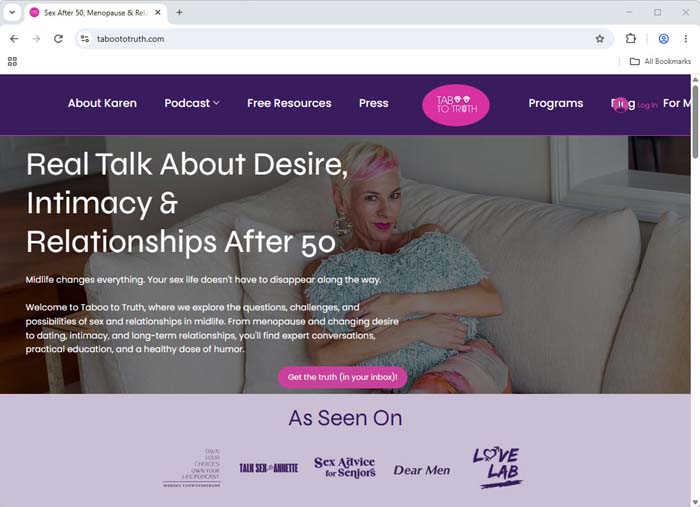
This is Unstoppable After 50, the podcast for men who refuse to slow down. Each week, I share smart strategies and expert insights to help you stay strong, healthy, and unstoppable. Welcome back to Unstoppable After 50. My guest today is Karen Bigman. Karen is a midlife intimacy coach for men. This means she's helping men and women navigate the path of what sexuality and what their sex life looks like in their 50s and beyond. She's the host of the Taboo to Truth podcast. That's right.
Mike Capuzzi [00:00:58]:
podcast. She brings a ton of experience, information, and advice for people who find themselves in a, what she calls, sexless marriage. So stay tuned for a very interesting conversation with Karen Bigman. Hey, Karen, welcome to the show.
Karen Bigman [00:01:18]:
Thanks for having me.
Mike Capuzzi [00:01:20]:
Yeah, listen, I was looking forward to this. You bring a very interesting background perspective on a topic that is important to all of us, all guys that are watching or listening to us right now. Oftentimes, as you and I both know, it's not something most men are probably super comfortable discussing. So, the work that you are doing today is very important. So, before we jump into this, Karen, I'd love for you to share with my audience a bit of your background and how you ended up to where you are today in helping guys with the topic we're talking about today.
Karen Bigman [00:01:56]:
Yes, definitely. So it's kind of a— the story changes every time I tell it because I, I sort of not sure exactly how I ended up here sometimes as well. Um, but, but it— the— I started a podcast about life and sex after 50 as I was turning 60, and there was a lot of noise around me about, um, menopause particularly was starting to become something that people were talking about, which had not been the case for many years for a lot of reasons, which I won't go into all of that now. Um, And as I started to do this work and talk more and more about it, what I realized is there was a lot of shame, particularly in our generation of baby boomers and whatever the next one is, millennials. And it— there was an image of sex being something that younger people did, and that once you, you know, once you got to a certain age, it wasn't going to happen anymore. And fortunately for me, my experience was not that. And yes, there were people that were in that situation. But what I was finding is that there were a lot of people who were still having sex or they wanted to, but things were not working.
Karen Bigman [00:02:57]:
And as I started to do the work more and more, what was super interesting to me is I started to talk more about the sex and aging as opposed to just the menopause. I started to talk about male sexual dysfunction, interviewing all sorts of people in various aspects of sexual wellness and sexual sex work even. Um, and I realized that, um, men— men have a lot of shame. They also have a lot of frustration, um, and they don't tend to talk about it. Where women, we talk to our friends about it. And so I learned to talk about it because of my own challenges with menopause that affected my ability to orgasm. And so I was going to a practice that was both a nurse practitioner and a sex therapist. So every time I went to the doctor, I'd have a conversation about what was actually physically going on and then mentally going on.
Karen Bigman [00:03:47]:
At the time, I was relatively newly single and I was dating a lot. And so those conversations just became so easy for me. And I'm like, well, can't everybody talk about this? And so as the more I, Then as time went on and I started the podcast, I just got more and more comfortable and found that when I'd go out places or I'd meet somebody, as soon as I started talking, you've got the people who only wanna talk about menopause because they don't wanna talk about sex because that's too embarrassing. But often the men, especially when I'd meet a guy alone, and especially when he was married, he'd confess to me. I just had this happen the other day. I was walking, I live at the beach, and I was walking by the beach and there was a guy out there doing it. Really interesting. He was doing a listening project and we just started to talk and— I told him what I did, and he said, can I tell you something? And I'm like, absolutely, you can tell me anything.
Karen Bigman [00:04:36]:
And he's like, my wife decided 2 years ago she didn't want to have sex. And I'm like, people will tell me that. They won't tell anybody else. They won't even admit it to themselves how upset they are about it. And I just feel like this is, like, this is something that we shouldn't— your sex span should equal your lifespan. There is no reason why we shouldn't be having sex at any age, as long as we understand that it's not going to look like it looked like in our 20s and 30s.
Mike Capuzzi [00:05:00]:
And that goes with everything, right? I mean, I talk often on this podcast about weightlifting, for example, or strength training, right? And, you know, typically my guest is a guy, you know, we're talking to guys. So we all know what it was like to lift weights when you were in your 20s, right? And then you're in your 50s, 60s, and beyond, and you sure as heck aren't lifting the way you lifted then. And even that mental shift is, you know, a big jump for a lot of guys, myself included. But then yes, when it comes to sex, and I'm sure a lot of guys, you know, there's a certain memory memory they have in their head as they age of what it used to be like and what they used to be like. And I could see where that frustration, even that, you know, God forbid they're in that situation where the wife says, or this, you know, the significant other says, I don't want to have sex anymore. Like, where does a guy turn? I mean, you know, the, the, the, the avenues of porn or an affair or something like that, I mean, you know, I don't think a lot of guys want to go down those roads, but Why do you think this is, Karen? Like, what is happening as we age? So if you could, you know, look at it from the viewpoint of a woman, first of all, as she's aging, what's going on? But then, you know, the man's alongside her. What's happening there? Quick pause. If you're not getting my Unstoppable After 50 Playbook, you're missing out.
Mike Capuzzi [00:06:21]:
Every week I send a one-page playbook with my key interview takeaways and simple actions to help you stay strong, and in control. Get it free each week at unstoppableafter50.com. Now back to the show.
Karen Bigman [00:06:34]:
Well, I think part of the problem is he's beside her, but he's not necessarily with her because he's not understanding what she's going through. And I'm just going to use— so let me back up a little bit. I have a framework that I use to help people understand like what, what's going on. And it's a 4-part framework because sex is a symptom. Not having sex is a symptom. There are components of every— of everything. And the major components that I have seen are, I call it like body awareness, the physical changes, emotional grounding, what's going on in your relationship, how you're feeling, how you're dealing in the world, is there stress, etc., your communication skills, and then your definition— I call it pleasure over performance— your definition of sex. So, when we think— what do we think about sex, especially heterosexual couples? You know the script, right? You kiss, you make, you know, maybe a little, you know, touching, a little oral sex, and then he's going to penetrate her, he's going to ejaculate, and that's sex.
Karen Bigman [00:07:29]:
Now we've had sex. But it doesn't always work that way as you get older. So if you're always focused on that one thing— and I don't blame men and I don't blame women because that's what you're taught. Like, it's a performance. Men have to— like, the, the, the goal is to end, end the event when a man ejaculates, generally. I'm not saying every man is solely focused on himself, but that's what you were most likely— the script that you learned as a kid. And so now you've got— that doesn't work the same way anymore. The, the instant feeling of, um, of desire, which we call— there's spontaneous desire, which one would argue whether it's truly spontaneous, but that feeling of, oh, I just wanna, I just wanna have sex right now, versus the responsive part, which takes a little longer to get there.
Karen Bigman [00:08:12]:
So, you've got that going on. The desire is changing, and particularly for women, and particularly over time, as it's less interesting to just jump into bed. Now, I need to get there. I need to put my mind in it. I've got so many things going on. I got all the tabs open in my brain, and now you want me to get into bed with you? Like, Like, no, I'm not going to do that. I got to worry about, you know, lunch tomorrow for the kids, or I got to worry about my mom who's, you know, banging me, you know, driving me crazy, like, what are we going to do for the holidays? Like, I can't actually get into bed with you. And then, here comes menopause, which is this just like crazy— can last for 10 years.
Karen Bigman [00:08:47]:
And, oh, by the way, it's starting earlier and earlier for women now. And, your hormones, it's not like PMS where like, okay, I know on day 24 of her cycle, she's going to be a hot mess for 2 days, she's going to be crying and screaming, but then she's going to be fine. It's like one day, here, one day you're here, one day you're here in the morning, you're here in the afternoon, and you're way down here at the end of the day. So you can't even control what's going on in your own body. And I mean, my girlfriend yesterday, she just said to me, like, I just blew up at my husband on Friday and like for no reason. And he's like, you know, we end up not going out. And I'm like, yeah, because you don't know why you're doing that. And he's pissed off that you're behaving that way to him.
Karen Bigman [00:09:22]:
And of course you're not going to end up in the bedroom or anywhere at that point. So there's just so many things going on and we think it's like just so simple as like, oh well, honey, like I just want to have sex. And then the other part that's really hard is that— so I just— this is something I've learned recently which I, which I really love. It really helps explain it. Men have sex to connect. Women need to connect first, then they'll have sex. So you've got these 2 competing ways that your brain is working as well. And so how do you bridge that gap is really the challenge.
Karen Bigman [00:09:53]:
And sometimes it's bridgeable and sometimes it's not. And sometimes it's simply an understanding like, oh shit, like, I didn't know that you were going through all this. Why didn't you tell me? Like, I, I feel for you. I want to be close to you. And if we just like cuddle or kiss or hug or hold hands, I'm okay with it. And like, maybe it'll turn into sex and maybe it won't, but I'm not gonna— that's not what I'm looking for from you. I'm really looking to connect with you. Where she's thinking all he wants is to get off, but that's not really what you're thinking, right?
Mike Capuzzi [00:10:22]:
Yeah, yeah. I
Karen Bigman [00:10:23]:
mean, it's a long answer.
Mike Capuzzi [00:10:24]:
No, no, listen, it was a great, great insights. And it's You know, I would think a lot of guys probably feel like, and again, I'm going to ask for your input here. You know, while physically things may have changed, slowed down, et cetera, in their head, they're probably still thinking like they were when they were 18 in a lot of ways, right? Like they still, you know, their, their desire hasn't left them. They still want to, you know, have sex, et cetera. And their partner is now in a different space than when maybe when they first met them and married or started a relationship. That frustration, and here's the question, to me is a compounding effect. He gets frustrated, she starts getting frustrated, and things don't get better, they get worse. What's your— what are your thoughts about that?
Karen Bigman [00:11:13]:
And oh, by the way, add that when her hormones shift, a lot of times her libido altogether is gone. So she really doesn't think she ever wants sex again. So that's like the, the, the whole other, um, so sorry, ask me the question one more time.
Mike Capuzzi [00:11:28]:
Well, this idea that when frustration compounds, you know, know how it is, right? We're not— when there's lack of communication, we all kind of go in our own corners. She's not gonna have sex with me? Fine, I'm gonna be a jerk to her. Oh, he's gonna be a jerk to me? You know, it just keeps building, you know. And I just didn't know what your thoughts were. Is that what you see? Is that something you help people through?
Karen Bigman [00:11:48]:
No, absolutely. That's exactly what you see. And he will either get pissed off, resentful, and then contempt will come in, which is, if you know anything about John Gottman's research, that is the number one indicator of relationship dissolution is contempt, or he just gets really quiet and just, like, accepts his fate, which neither one is right— is the right answer. And so, like, I think in an ideal world, couples will go to a good relationship therapist or sex therapist or someone to learn how to communicate better. But that sometimes that takes more of a catalytic event to get people into, into couples counseling. But I think it's a— to back up, like, what is the sex really about? And what is going on in our relationship? And this isn't about just sex. Like, how do we have a conversation that says we used to be so connected? We used to, you know, okay, yes, we used to not be able to keep our hands off each other, but forget that. We used to— I mean, like, I would just say I was married for 20, 26 years by the time we got divorced, around 24 years we separated.
Karen Bigman [00:12:49]:
And I mean, I remember like moments where like I just try to grab his hand because we hadn't even held hands in so long. And we used to be very like cutesy and kibitzey. And, and when we finally like told the kids we were were getting divorced, I remember my son said, like, I knew you guys weren't really like lovey-dovey, but I didn't think anything was wrong. Like, it's sort of this like slow, slow burn of, you know, like, what is it, death by a thousand cuts? Like little, little things start to happen. And all of a sudden, you're like, wait, I don't touch you anymore. I don't hug you anymore. I don't kiss you anymore. Like, we just exist functioning in whether for work, for kids, for parents, for life, for ourselves, for workouts, like all the things we're doing, but we don't do anything for each other.
Karen Bigman [00:13:31]:
So it's trying to find a way that you can Get back and it can't be big. It's just like any, you know, if somebody's never worked out or they've put on 1,000 pounds and they want to go back and like, you're not going to tell them to go start lifting 300 pounds. You're going to say, okay, like, start going to the gym. Like, let's first get you in the gym, then start walking on the treadmill for 10 minutes, then start walking for 20. It's the same kind of thing. So, I have something and I have a download on my website with this too. I can— let the audience know, but I call them sex snacks. Like, start with little intimacy bites.
Karen Bigman [00:14:07]:
And it's, it's made just simple, like, can I hold your hand? Or, um, if you— according to research, if you kiss somebody for 6 seconds or hug them for 20 seconds— and I'm not sure if it's 20 or 30, but let's call it 20 to make it easy— you start to release the oxytocin. So just say, come home from work at the end of the day, or wake up in the morning, and just give each other like a long kiss. Just start to remember, start to connect again. And you may, like, hate each other so much and it might— you might have to force it. But it's— you have to start somewhere or you're never going to get back.
Mike Capuzzi [00:14:41]:
Throughout your work that I was— when I was researching and learning more about you, I mean, obviously, you talk about this concept of a sexless marriage. And that paints a very vivid picture, which I want to talk more about and what it means to you in that. I'm gonna ask you what you mean by that first, Karen, but also, is it not fair that if a guy is in a sexless marriage, that there should be an expectation? He's gotta do his part to somehow, you know, get beyond it, but his spouse, partner has to do her part. And is that not a fair expectation when a guy's in that situation?
Karen Bigman [00:15:18]:
I think it's absolutely fair. You know, I just put out a post the other day, and the point of the post was to help men in sexless marriages like show up differently. And I got most comments. I think it's the most viral post I've ever had. And a good percentage of them were, well, of course you're blaming the man. And under no circumstances am I blaming the man. The man gets blamed because he's the one that's asking for it and she's the one saying no. But she's— it takes two to tango.
Karen Bigman [00:15:45]:
So I absolutely— Again, I think it goes back a little bit to that men have sex to connect, and women need to connect to have sex. And I don't think women really understand it, and I don't think men really necessarily understand that that's what they're looking for either. And so it's, it's trying to build that. I mean, I married you, I love you, you were the person that I wanted to be with and spend the rest of my life with, and the only person that I wanted to have sex with. So there's something between us that we seem to have lost. So how— but we both lost it. And whether you lost it because your hormones are a mess, or you lost it because We're fighting like cat and dog and I just don't like you anymore. Or, oh, by the way, the one thing I did not mention is what if the sex was lousy? Like, you know, I may not— I don't know if you saw the movie Baby Girl.
Karen Bigman [00:16:35]:
It's with Nicole Kidman and Antonio Banderas. And the movie starts out where they've been married for 19 years and they're having like wild passionate sex and she fakes an orgasm and she waits till he falls asleep and goes next door, puts on porn and masturbates. that like blew up in my community of sex educators because it's such a true story. So many women are— they don't want to talk, but they're too ashamed to say like, you know that thing you've been doing for the last 20 years? Like, it really doesn't feel good, you know? Like, if you blew my mind every time we got into bed, I would be in there waiting for you. And I'm sure it's the same for a guy. So it might just be like, okay, like, what will it take for us to really have good sex? Like, how is the sex? And it's— you gotta listen to You know what, honey, I haven't had an orgasm in 20 years, which would hurt your ego something fierce. But you got to say, okay, well, let's not make the next 20 years the same way. You know, that's, that's kind of— it's, it's a two— it's definitely a two-way street though.
Karen Bigman [00:17:31]:
But it pisses me off when women say, I don't want sex anymore. Like, like, I want to smack them around.
Mike Capuzzi [00:17:38]:
I mean, listen, it's definitely, you know, thank God I'm not in that situation. But it's, it's like, I would feel like it's not fair, right? It's not fair, um, in, in, in that The whole point of marriage is to be together. Like you said, you chose each other. And yes, again, we know things are changing, but it's not fair just to close the book because one party says to close the book. Now that's again taking into account, you know, all the different things that could have happened in the relationship. But in a, you know, in a relationship where things are good, and this is the, you know, one of the areas, you know, that's they're they're having this sexless marriage. I don't know. It just it's.
Mike Capuzzi [00:18:16]:
It bothers me too, because I have met couples where I know that is the situation. And I think it's— I just think it's very unfair. I don't know all the details. But I think for someone to just close the book and sort of wash their hands of it, you know, that's no— that's not a way to be. So.
Karen Bigman [00:18:33]:
And it's part of a healthy relationship. Absolutely a component. And if you, you know, I mean, like, I'm not religious. And I, you know, like, I have my questions about marriage is a contract, but you did sign up in a relationship. Sex was part of what you signed up for. And I understand, you know, the hormonal shift that says I don't want it anymore. And women who go on— like, I know there's hormone therapy for women that are going through menopause, which is— it's a whole other episode. But, um, one of the hormones which we also lose in addition to estrogen and progesterone, which are the ones that to get depleted fastest when we go through menopause is testosterone.
Karen Bigman [00:19:12]:
Testosterone is what contributes to libido and to orgasm intensity and ability. And so it may mean that she just gets a little testosterone from her doctor. And that, like, I know for me that was a huge shift. And so I'm not saying, you know, like, go out and ask and get your wife— give— never give your wife your testosterone, by the way, because it's way too high a dose. But sometimes that's, that's all it takes is a little shift in hormones. I mean, I have a close friend who— she's my age, I'm 63, and they've been having sex their whole lives. They've been married for 40 years. And she, like, called me a couple months ago and she's like, my husband made me call you.
Karen Bigman [00:19:51]:
Um, they're very Catholic, you know, but yet they've been, they've been together, they've been totally faithful, they've had this great sex life. She's like, I could care less if I ever have sex again. And it was only because he made her call me. And I said, okay, well, first of all, you know, like, here's how desire works. Second of all, like, you need to get on hormone therapy. She's never been on it. And fortunately now they will put you on it over, over 60. Mm-hmm.
Karen Bigman [00:20:10]:
And then And here's some toys. I literally— they came to visit and I'm like, here's a vibrator for you and here's some cock rings for you. And like, let's start to play. You guys have been doing probably the same thing for 40 years. Let's have some fun. Like, do things differently, introduce something different. And fortunately, like, she was willing to do that, but she could have walked away if he would have said okay. She would have said, all right, we're done.
Mike Capuzzi [00:20:32]:
So many people— and it could be— it's definitely both sides. Like, we can fill our lives with such meaningless crap. Whether it's social media scrolling at night, watching TV in different rooms, you know, there's just— it's, it's, it's, it's sad. And I think it's only getting worse in society these days. But you're right, there's, you know, to your point of your friend there, I mean, at least she was open. And that's the point of this podcast, at least from the guy's point of view. I mean, if you want to be unstoppable, you've got to do things that most people aren't willing to do, whether it's eating right, exercising right, intimacy, whatever it might be. And, you know, it's work.
Mike Capuzzi [00:21:11]:
It's not meant to be, you know, it's not easy. And it's, you know, you've got to put through the effort.
Karen Bigman [00:21:16]:
So— What is it? It's simple, but it's not easy, right? Yeah. And I think I'm sure that there's a lot of audience members saying like, screw you, Karen. Like, yeah, sure. I'm just, my wife's gonna smack me across the face if I come near her with, you know, with a hug. So it's not an easy thing if you haven't, you know, I've met people who've gone years without having sex. So the official definition of a sexless marriage is less than 10 times a year. But, your definition of a sexless marriage may be very different than mine. If we were having sex 3 times a week and now we're having it once a month, that may be sexless to me, right? So, it's how you approach.
Karen Bigman [00:21:48]:
So, if you approach your partner saying, we never have sex anymore, or, you don't want me, or she's saying, all you want is sex, that conversation is going to shut down pretty quickly. So, it's how do you get back in, just open this teeny little door. And, it's really— Yeah. The sex is the symptom. I want to be connected to you. I want you and I to, to be together. I mean, I love when I see like older couples, you know, older being older than me, in their 80s, um, holding hands. Yeah.
Karen Bigman [00:22:17]:
Like, it's such a beautiful thing. Now, are they, pardon the expression, fucking their brains out on the weekends? Doubtful. But they might have a different kind of intimacy because they've managed to keep the connection. And that's the part that, that, that once you have that, the sex will come.
Mike Capuzzi [00:22:32]:
I know in your work, and you probably already have covered a few of them, but I wouldn't mind just kind of like bulletizing them. You've— I've heard you discuss 5 reasons why marriages and long-term relationships become sexless. Can you share those again?
Karen Bigman [00:22:46]:
Oh gosh, I don't remember.
Mike Capuzzi [00:22:49]:
Well, what are some of the top reasons? Well,
Karen Bigman [00:22:51]:
I would say like the number one reason, and this is true of everything that goes wrong in a marriage, is that you stop communicating or you don't communicate properly. Stress, enters the marriage and, you know, stress overrides every pleasure chemical in your body. Physical, you know, physical changes clearly on both sides. I think sometimes trauma that's happened early in life starts to come out later. You finally stop, you know, like the kids leave or whatever. You're finally like at a place where it just bubbles up. And that's— maybe there's shame around talking about that. Maybe you get triggered and something happens in the media or whatever, and like it causes shame on both sides.
Karen Bigman [00:23:32]:
And I don't know what number 5 is.
Mike Capuzzi [00:23:34]:
That's all right. That's okay. There's something else, again, going through some of your content. And I can remember, so I'm 60, I can remember being in, I think it was 7th grade health class. So middle school. And the topic came up of male menopause. And if I remember, whatever it was, 50 years ago, The teacher saying there was such a thing as male menopause. That's not the same as female menopause.
Mike Capuzzi [00:24:05]:
But when I was going through some of your content, I saw you talking about that. So is there such a thing as male menopause?
Karen Bigman [00:24:13]:
Well, first of all, the fact that your teacher even mentioned the word menopause when you were in 7th grade, it was pretty much a miracle. So kudos to your teacher. There's— it's andropause, is, I guess, the technical name for it. And I'm not a doctor, so I, you know, but But the difference is that women's hormones tend to drop drastically, where men tend to lose testosterone gradually. And so one could say when they lose testosterone, that would be andropause. And men lose testosterone about 10% a decade. And, in fact, in general, in the population, testosterone has been going down for men. So that's, like, a whole issue to begin with.
Karen Bigman [00:24:51]:
But say you're in our generation, chances are you have a lot less testosterone than you used to. What's super interesting that I've learned in the last couple years is that the symptoms of testosterone decline are very similar to the symptoms that women suffer in menopause, but they may not be as dramatic. So you might not be sleeping as well, you might not be able to lift as much weight, you might get a, you know, a ring around your belly like that you never had before. So, you know, I had a friend that was saying like, I have this malaise, and I'm like, you know, have you had your testosterone checked? So that definitely has a is a factor. And, I think there's also the midlife crisis both men and women have. I think there's this sort of also a reckoning of like, shit, I'm 50-something or 60-something. I've lived more of my life than I'm going to live. It's real.
Karen Bigman [00:25:38]:
I think we all go through our own identity shifts.
Mike Capuzzi [00:25:43]:
So, Karen, if someone's watching or listening to us, a guy right now is watching or listening to us and he finds himself kind of nodding to himself, yeah, that's kind of where I'm finding myself, my marriage, my relationship. First of all, what hope would you give him? Is there hope, first of all? And then what are some things you would instruct him or encourage him to do starting right away?
Karen Bigman [00:26:10]:
I mean, I'm launching this course and I'm still like working out the content, but I think the first part is to figure out what's the issue? Is it one issue? Is it several issues? You know, those 4 components. Is it, is it a physical change in one or both of you? Is it the relationship? We just don't communicate, or we're fighting all the time, or we don't talk about anything but logistical stuff. Is it that, um, you're having emotional challenges in your own identity or whatever? And how is our sex? So like trying to figure out like, what do I think the problem is? And if I really don't know what the problem is, which is, which is probably the case in most, in most It's really— you gotta talk to your partner and see if they're willing to, to give a little. Because if you don't— I mean, the issue is with your partner. So if you just are in your head all the time and not saying anything and just, just holding it all to yourself, like, it's never going to get better. So I would encourage you to at least start a conversation with your partner and say, like, this is important to me. I was listening to this podcast today. I'm realizing it's not necessarily just about the sex.
Karen Bigman [00:27:15]:
Maybe we can have a better conversation about what's really going on here because I don't feel connected to you anymore. I mean, if somebody responds negatively to I love you and I want to feel more connected to you, well then that's kind of telling too. I mean, not every relationship is meant to go the distance, you know. Like, I, I get people that, you know, you got to fight for it, you got to do it. And yes, I, you know, I, I do think if you are going to leave the relationship. I do not encourage betrayal or cheating. I don't think that's a, that's a solution unless it's consensual. Sometimes couples say, okay, look, I have a friend, you know, she doesn't want sex anymore.
Karen Bigman [00:27:49]:
She's fine. He can do whatever he wants. They have certain guidelines and boundaries with consent. Like, that's, that's a choice that some people make. But it's also like, if you're not willing to meet me any place in this relationship together, then maybe this relationship isn't, isn't meant to be. And let's, let's exit gracefully if we can.
Mike Capuzzi [00:28:09]:
What about the step of whether— I don't know if it's a marriage counselor, I don't know if it's someone like yourself, I don't know if you offer specific services like this. But, you know, before some couple were to give up, I mean, there's only so much you can get from a course or a book or something you watch. Sometimes there needs to be a mediator, you know, asking good questions and giving some sort of objective feedback. Any insights there? Like, for example, do you do that work or not?
Karen Bigman [00:28:37]:
I don't do that work one-on-one. Like I said, I'm launching a group program for men, and I'll talk about that in a minute in terms of community, 'cause I think that's something that's really hard for men is they don't have— women tend to talk with each other about these things, and men don't have a community to talk about it in, and it's real. So I think that's, you know, having an outlet that's not your partner to be able to talk about things is really important. There are, you know, there are relationship therapists, marriage counselors, there are sex therapists, sex therapists. One of the things that you want to make sure when you do— there's sex coaches, there's relationship coaches, there's all sorts of different people out there. You want to find somebody that, if you're going to go with your partner, that is not going to be biased one way or another. Because I've heard a lot of couples say, well, she's defending her, or he's defending him, or vice versa. And I feel, you know, that they're accusing me of everything.
Karen Bigman [00:29:29]:
So it's got to be a very good relationship counselor. And then And a lot of times, therapists who aren't trained in talking about sex will not bring it— not be comfortable in their own right working with a couple. So I would encourage someone who is also a sex therapist, or just a sex therapist that's trained as a relationship therapist, and then they, they probably learn more about different types of lifestyles and things like that. So maybe much more open to talking about sex and helping you talk about sex. There's some great, you know, I mean, I certainly have enough people in my roster. I don't tend to work with people one-on-one, just it's a time thing. I'd rather do to a larger audience through the podcast. But it's, it's, there are many people out there, and sometimes people don't even want to go to a counselor like that.
Karen Bigman [00:30:16]:
And, and if your partner doesn't want to go, go by yourself, because it will help you decide for yourself, like, what, what do you want to do? Like, is this the life you want to continue? You want to live in a sexless Non-communicative, unconnected relationship for the rest of your life. Life is long.
Mike Capuzzi [00:30:32]:
And it's also short, right? So it's also short. Exactly. And wasting time where you say, if that's where it's at, and it's not meant to be, then, you know, by all means, make that decision. But Karen, before I do, I'm going to ask you to share your podcast and your course and all that in a moment here. Before I do, is there anything else, either a question I didn't ask you, or just something you think is important for my audience to hear from, you know, the wealth of information you bring?
Karen Bigman [00:30:59]:
I think that when I start talking about community, I think that men need community, that I don't— they don't necessarily feel comfortable talking to their best friend about anything rather other than sports. And I think the thing that I've learned most is that once the conversation starts, the other person's going to say something very similar. Maybe it's not that I'm in a sexless marriage, but like, Hey man, I feel you. Like, just having— just getting it off your chest to somebody. There's— there are a lot of men's communities that are starting to, to crop up. I, you know, I certainly— whether it would be my upcoming course or somebody else, I have plenty of resources out there where men are transformed by being amongst other men and learning how to communicate and be vulnerable and face what's going on, because it's, it's hard shit. It's hard and you're not used to it and you weren't taught. You were taught to shut it down, keep those feelings, don't cry, you know, perform, always be the one, you know, be the champion, make the money, take care of the family.
Karen Bigman [00:31:59]:
You know, she's your woman to, you know, you're the breadwinner. Like that's a, that's a tough, a tough definition to overcome. But once you can, like you'll just live such a happier life.
Mike Capuzzi [00:32:11]:
So Karen, please share your podcast cuz we didn't talk about that. Uh, the name of it, where they can find, where my audience can find it. And then yeah, by all means, how else they can connect with you, learn more about what it is you do.
Karen Bigman [00:32:23]:
My podcast is called Taboo to Truth: Life and Sex After 50, and I'm a little over 200 episodes. I put out a solo and a guest every week. I've interviewed everything from every kind of sexual medicine doctor to people in the kink community to— I have a tantra expert I'm interviewing this afternoon. I do all different aspects, and my goal is really to help people hear and talk about it and know things that are different than what they know. So really, and, and to let go of the shame, because we should not be— we should be able to talk about sex like anything else. We talk about our cholesterol, but we can't talk about our sex life. I mean, every date I go on, the first, you know, half an hour is like, how many knee replacements have you had? What's your blood pressure? What's your cholesterol? Right? Like, what— like, how's your sex life? Should be part of that as well. So Taboo to Truth, um, on— I'm @TabooToTruth on all the social media, with the exception of YouTube, which is, um, Taboo to Truth podcast.
Karen Bigman [00:33:17]:
And then, I am launching a sort of a new branch of my business called The Midlife Man or it's midlifemancoach.com. And, my first program is going to be the— excuse me— the Sexless Marriage Reset, which will be coming in the late fall, early next year. And, I have a waitlist for that right now.
Mike Capuzzi [00:33:35]:
That's awesome. Is that something that the trainings will be live or is it a course you're buying and you're just getting it downloaded at one
Karen Bigman [00:33:43]:
No, it's going to be a group, men's coaching group, 12 weeks, probably starting in January. I'm starting a very small 8 to 10 men. And really just to, to build the community, to share, to understand what's happening without shame, to support each other. And then to kind of explain the different phases of like, what is going on physically? What can be going on emotionally? What do you, what do you want? Who do you want to be? And where do you want to go at the end of this? Like, what do you want to do?
Mike Capuzzi [00:34:09]:
Very good. And for them to learn more about that, where should they go or how do they—
Karen Bigman [00:34:13]:
So my website right now is taboototruth.com and there's a sign-up for the waitlist. The Midlife Man Coach is up. It's not fully finished yet. That should be ready to go early November to start to do interviews to see if the courses or the group rather will be right for people. But I mean, I have so much content out there in the meantime that's free that you don't need to pay for. I'm on, like I said, every platform. So, you can just— just by listening to a few episodes, you might get enough information to help you move forward in some way. And I have a bunch of free downloads also on the website.
Mike Capuzzi [00:34:47]:
Very good. Well, good luck with that. And I'm sure you have the potential to help a ton of guys and hopefully a ton of relationships. So, Karen, before we go, I have my Unstoppable After 50 trifecta. It's 3 quick questions, 3 quick answers. You know, you've shared a lot, but what is one other cold, hard truth that men over 50 need to hear from you?
Karen Bigman [00:35:09]:
You can't wish it away. She should know, and he should know, is, is they don't. Sometimes you just gotta look, look it right in the eye and, and talk about it.
Mike Capuzzi [00:35:20]:
What do you think something most men are doing right now that's quietly wrecking their future?
Karen Bigman [00:35:26]:
They're hiding, they're being silent, and that leads to— and they're suffering. It leads to anger, content, and then ultimately contempt, which is not the— it's going to end the relationship anyway.
Mike Capuzzi [00:35:38]:
Yeah, yeah, for sure. And finally, Karen, what's one thing every guy watching or listening to us right now can do this week to be unstoppable?
Karen Bigman [00:35:47]:
I'm going to go back to my sex snacks. Just try a little teeny weeny thing to reach out to your partner to see if you can get things started again.
Mike Capuzzi [00:35:56]:
Awesome. Well, Karen, thank you very much. A very insightful conversation, a very important conversation to your point. I love that, like, we talk about cholesterol every day. You're 100% right there. So, love the insight and love what you're doing. So thank you.
Karen Bigman [00:36:11]:
Thanks for having me.
Mike Capuzzi [00:36:12]:
Hey, I hope you enjoyed that conversation with Karen. And by all means, if what we discussed today is something you can relate to, check out her podcast, Taboo to Truth. Check out her group coaching program. She's going to be launching soon. Maybe it's something that you might want to consider and learn more about what she's doing. And if you like what I'm doing here with Unstoppable After 50, please make sure you like and subscribe to the show. Go check out the YouTube channel. Appreciate you subscribing there.
Mike Capuzzi [00:36:42]:
And also make sure you check out unstoppableafter50.com and sign up for my weekly playbook. Every week I send a recap to to my group of men who've asked for it, a PDF that's designed to be printed and saved, and it's a recap of that previous week's episode. So check out unstoppableafter50.com.

 Apple Podcasts
 Spotify
 Amazon Music
 YouTube
 iHeartRadio
 CastBox
 PocketCasts
 Deezer
 Podcast Addict
 Listen Notes
 Podchaser
 Player.fm
 Castro
 Goodpods
 RSS