Kyle Hulsebus [00:00:00]:
The biggest thing I see when we get over, well, over 40, but also over 50, is there's, there's really a cloudy purpose. I wouldn't say lack of, but definitely a cloudy sort of objective in a majority of people, majority of men.
Mike Capuzzi [00:00:18]:
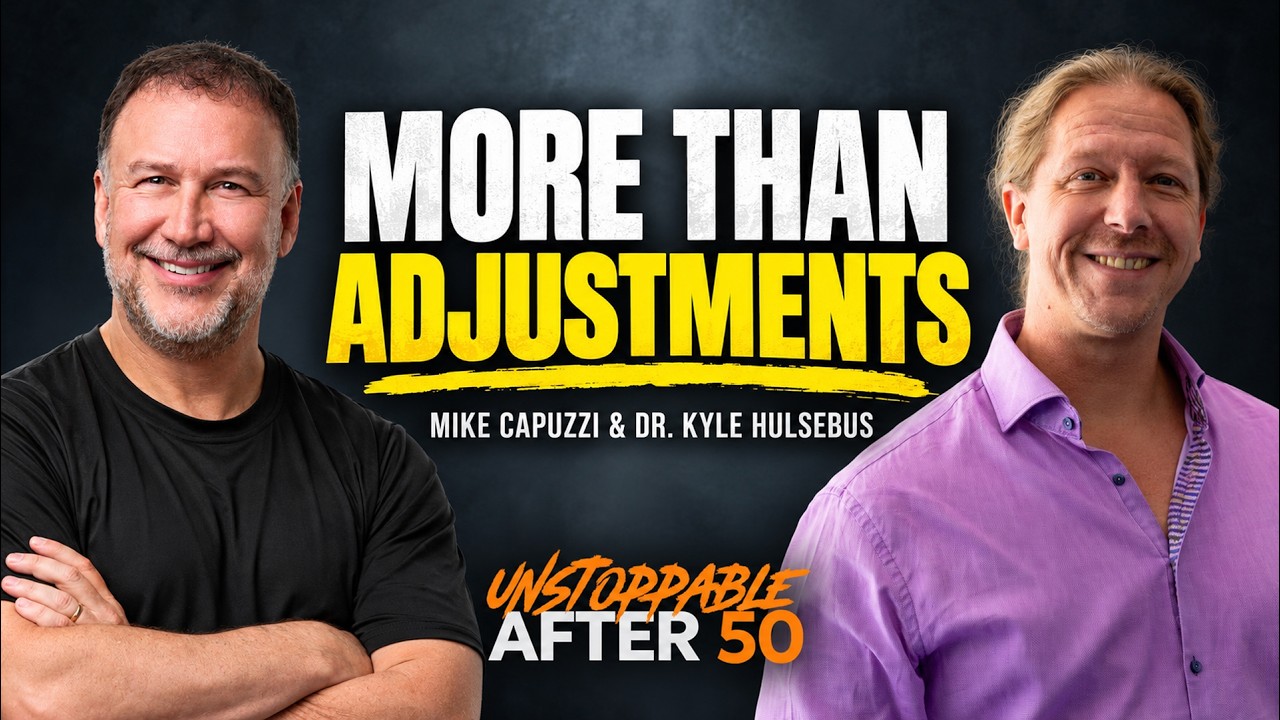
This is Unstoppable After 50, the podcast for men who refuse to slow down. Each week I share smart strategies and expert insights to help you stay strong, healthy, and unstoppable in the second half of life. Welcome back to Unstoppable After 50. This week, my guest is Dr. Kyle Holsebus, a third-generation chiropractor in Illinois. Now, I didn't have Kyle on today because he is a chiropractor. However, our conversation went down that road for a little bit because I was so interested in what he does and how he serves others in his chiropractic practice. I also brought Kyle on because he has a framework that's very important for guys like you and me.
Mike [00:00:59]:
He calls it his 40 Over 40 framework. And we discuss that on this episode. So stay tuned for a very interesting conversation with Dr. Kyle. Kyle, welcome to the show.
Kyle Hulsebus [00:01:11]:
Thanks for having me, Mike. Thanks for giving me the opportunity to share some of my expertise.
Mike Capuzzi [00:01:16]:
Yeah, and you definitely have some expertise, Kyle, that I want to share with my audience. Now, your focus is typically men and women around 40 and above. Obviously, we're talking just to men over 50, but I think it's still the same. Kyle, before we jump into our conversation, I just learned something about you I thought was very cool. Very unique. Can you share a little bit about your local business and who you work with?
Kyle Hulsebus [00:01:40]:
Okay, so, well, I'm, I'm a third-generation chiropractor, and that's— Grandpa started the business in 1949. Um, it's expanded. He had 3 boys. All 3 of them became chiropractors. Uh, in each one of those families, there are chiropractors. In mine, we have the most. My dad had 4 boys. 2 of us are chiropractors.
Kyle Hulsebus [00:02:01]:
I married a chiropractor in school. So, and we all work together. So I work with my wife, which, you know, funny, men after 50, sometimes that, that could be a challenge for some guys. But that's the, the biggest question I get. We have another associate in the office. And even on top of that, my youngest brother, while he's not a chiropractor, he helps run and manage a lot of the different aspects of the business. So we, we're very much a family business and we're like a big part of the community around here too.
Mike [00:02:31]:
Like I said, when you said that to me, I think it's so unique and it's really a testament to that dynamic that you guys have been able to create. Now, just out of curiosity, is it going to be a 4th generation anywhere along the line?
Kyle Hulsebus [00:02:43]:
It's looking like it. My brother has 3 boys and one of them is certainly interested in being— yeah, my youngest brother just had a girl last year. That's the first girl. So she's spoiled. But yeah, we're working on the 4th generation for sure.
Mike [00:02:58]:
That's very cool. And just if you don't mind, share with my audience where your practice is located, just in case someone is watching or listening and they say, hey, I need to check these guys out.
Kyle Hulsebus [00:03:07]:
No doubt. I mean, we're, we're, you know, you look us up, there's a few clinics. Mine specifically is Holcimis Chiropractic Clinic of McChesney Park. We're in northern Illinois. We're about 90 miles from Chicago. I can see Wisconsin from my house is what I tell people. We're right up there. I actually do have people that come in to see me from all over the world.
Kyle Hulsebus [00:03:26]:
So we've had patients come from London, from Italy. We've had people from Vietnam that come up from Texas and Arizona and all over the country. So, you know, people that just kind of want to know what's going on, the, the view and the look we have, we're certainly always open to answering questions about health in that aspect.
Mike [00:03:43]:
Well, let's dive in a little deeper because that's, that's pretty unique for a, what I would consider a local, you know, business, if you will, local practice. Why are they coming from all around the world to see you? Like, what is it that they're coming to Dr. Kyle for?
Kyle Hulsebus [00:04:00]:
Effectively, they're coming for our insight and our advice, where the biggest challenge we have in referring people to other local chiropractic offices is there's many, many different ways to practice chiropractic. And some people have different viewpoints, perhaps because I've got the unique perspective of being raised by a philosopher of chiropractic. Uh, who is sort of a master of the art of chiropractic and the science of it. And I got to be around him and we get that insight when we've spoken. It's as small as the town is, it's a very international community around here, uh, because of manufacturing. So when we've spoken at different places, people are like, do you think you can help my cousin? I go, maybe send them in. They go, well, you know, they live overseas. And I go, well, I'll get on a Zoom call and talk to people, but I need to see people in person and really know what's going on and look at x-rays and that.
Kyle Hulsebus [00:04:54]:
And, and then different events my wife and I have been to that were all over the world speaking and attending things, we meet people and they say, you know, if we come into Chicago, can we come over and get looked at by you? I'd really like your opinion, uh, and then your help finding somebody to help us when we get back home. And we've done that. Uh, my one good friend down in Houston, he ends up up here because he's tried like 18 chiropractors. He doesn't think any of them are to the quality that he gets from me. So he comes up and sees me.
Mike [00:05:22]:
I want to focus our conversation on 2 things that I've— as I was researching, you know, what you're about and what you're putting out there as far as content to help others. One is going to be your 40 Over 40 framework, and the other is this angle that you have about, you know, for the sake of this conversation, as men start aging and over 50, how their purpose sort of ebbs and flows. But before we do that, Kyle, I wouldn't mind, just because I have visited chiropractors in the past, not consistently. I'll jack something up, I'll go to a chiropractor, get a recommendation. And I know a lot of folks see chiropractors on a regular basis. I guess at one point I was seeing somebody on a fairly consistent basis. I was doing a lot of kettlebell work and always hurting myself. But if you don't mind, I wouldn't mind just asking, if someone wants to seek out a chiropractor, like, what are some smart either questions to ask or what should they be looking for? You know, is it obviously based on what's going on with them? Like, can you just give some high-level tips on seeking out a, you know, chiropractor? Quick pause.
Mike [00:06:34]:
If you're a man over 50 who wants to stay strong, healthy, and independent, I wrote Resilience Rituals for you. It shares 50 simple rituals I personally use to be resilient and unstoppable. Get your copy at 50rituals.com. Now back to the show.
Kyle Hulsebus [00:06:49]:
I'll give you what I give everybody all around the world to look for. So, you know, number one, there, you know, as I said, there's many different ways people seem to practice, and which is fine. We get that in all healthcare. But, you know, you obviously want somebody that's going to sit down and talk to you and say, what's going on with you? That's number one. If they're just, you know, let's come over here and get you adjusted and not even find out, you know, where you're having an issue, already you're in the wrong place. But I would tell you to seek out individuals, doctors that are going to say, let's go x-ray your spine and see what the health of your spine looks like. We x-ray everybody that we take care of, except pregnant women. But the other thing is somebody is going to do a very comprehensive exam.
Kyle Hulsebus [00:07:34]:
And the third thing is somebody is going to go, here's your issue. They're going to talk to you through it. Here's a plan of care we have in order to help your spine get healthy, not just get over your problem, but help you get healthy. And that's, that's the biggest thing. I tell other people when they come in, they go, hey, I don't want to do all this long-term care and all these. I said, that's fine. I'm still going to work to help you. And I'm always still going to give you advice and things that are going to go beyond just coming in to see me a lot, but also have the understanding that If, if they're able to take time and they have some type of educational thing, not the way I say it is, is not so much, uh, here, buy my, buy my care plan, uh, sales thing, which some guys seem to do.
Kyle Hulsebus [00:08:18]:
But like, we, we, we haven't in recent years, but, uh, we used to always do a class for all our new patients, sit down and say, we need to teach you about your spine and how it's healthy for you and how you can take control of that health. Not just being and seeing us all the time like Advil. So, you know, people that are going to sort of provide that, because when you come in regularly to see me, it's the same as you're going to your dentist to get your teeth checked, not to prevent all problems, make sure you're keeping it as healthy as you can. That's the type of places that I say to seek out. And also family practices that have great reputations like that, that, oh, my grandparents came and I came and I'm bringing my kids. Usually those are good places to go to because they're interested in the health of the body, not just getting you out of symptom, but really teaching you how to take care of it and really transform your life.
Mike [00:09:10]:
Is chiropractic something that, you know, I think of like massage therapy. And again, at one point in my life, I was going to, it was the wife of a friend of mine who was a professional massage therapist. And I would go to her on a regular basis. You know, it was my treat to myself to just feel really good. And then, you know, we moved and it just became a challenge. Is chiropractic something that should be sort of a consistent— is it just when you injure yourself or can it be this ritual, if you will, that you just maintain?
Kyle Hulsebus [00:09:48]:
Well, I see newborn babies. And I don't see them because they have back pain. And I don't see them because they injured themselves working out. Uh, parents and people ask, they go, why would you see a newborn baby? I go, well, there's trauma in birth, you know, especially C-section births. And if you need to do, you know, episiotomies and just different things, even strain on the mother. But we see them for general health. We're just checking to make sure that, that there's nothing interfering with the communication system in the body, that the brain is communicating through everything and the body's expressing healthy.
Mike [00:10:20]:
Yeah.
Kyle Hulsebus [00:10:21]:
We also find that, as I tell some parents, I go, well, if you find you're worried about something and maybe you can't get into your pediatrician for 3 days, I take walk-ins so I can see you in 10 minutes. I use an otoscope and I check kids' ears and I check throats and we can sort of assess them and I can get your pediatrician on the phone and call and say, I need these guys to come over there right now and get seen. People think there's a war, but, you know, really we work with a lot of the providers in the area, uh, pretty complementary because we're all out for people's health. So it can be, uh, I injured myself because we see auto accidents. But like the oldest patient we had in the office was 104 when she passed away. She started to see my grandfather in 1973. She didn't come because she had back pain every week. She came because same reason that a lot of high-profile athletes, all the Olympic athletes see chiropractors.
Kyle Hulsebus [00:11:15]:
Not for pain, but for performance. And, and there you're doing it. It's, it's sort of that ritual of this is another piece in the puzzle of how I am maintaining my overall health and expression of life, you know. And after 50, on my 40 Over 40, it's, it's, uh, tip 19: take care of your spine.
Mike [00:11:36]:
Yep. So here's another question. Don't, don't share this with your wife, please. Um, I was at, the last time I was at a chiropractor, it was a new, a new one in my area. I researched a lot of recommendations and it was a young guy. He was a young guy. He was really fit looking. And he, it was himself and a woman who was also a chiropractor in the office.
Mike [00:11:58]:
And when they, when I called and I'm, this is my own head trash. And I'm going to ask, you know, why am I wrong? You know where I'm going with this. I'm thinking, okay, I'm a guy. Uh, I, I need a guy working on me because he's going to be able to really, you know, do the manipulations for me better than a woman. Is that accurate?
Kyle Hulsebus [00:12:17]:
No, uh, it's not. Because, you know, an adjustment, a specific chiropractic adjustment, you know, all the training we do, there's a lot of leverage. It's not a brute force technique. Sometimes, sometimes you, you know, you get people that are rigid and you're like, you know, I'm gonna lay into it a little bit, but Ah, you know, my, my wife adjusts me because I joke around. I said I married a chiropractor so that I can always have my chiropractor with me whenever I travel, and vice versa. But one of my instructors— this is, and, and it's kind of sad, she just passed away— uh, one of my instructors was a lady named Dr. Susan Hilliker. She, she practiced for many, many years.
Kyle Hulsebus [00:12:55]:
She was about like 5-foot-nothing. And I don't know if she even weighed 100 pounds. And she did what they call cervical chair adjusting. So she adjusted your neck when you're in a seated position in a chair, a specific chair made for that purpose. Not only that, she could adjust me down to about my 3rd and 4th thoracic. And she'd get on a stool behind you and she'd lean in and she'd move it. And she could probably adjust me a little firmer and harder than my father. And but it was smooth.
Kyle Hulsebus [00:13:25]:
It was finesse. So it's, it's the same if you've ever studied a martial art. Aikido, you almost have an advantage if you're smaller because it's a leverage thing. So you, you can, you can learn many different ways, but you might go in too, and some, some people might look at you and go, dude, Mike, you're a big guy, I'm, I'm gonna give you the big guy to take care of you because he's going to move you better. But no, you— if my wife, uh, if you saw my wife, she'd get you adjusted though.
Mike [00:13:52]:
I'm sure, I'm sure, you know. Um, and before we leave this part of the conversation, just— I could have focused our whole conversation on this because it's, it's one of those things that I'm not super familiar with, but I know it has value and I know I enjoyed it and I know I benefit from it. What would you say is like the biggest misconception that you think a lot of guys over 50 probably have about chiropractic?
Kyle Hulsebus [00:14:15]:
That they're too, too old. Hmm. I mean, I, I get people come in and go, well, but I should have done that when I was 20. You know, my, my doctor said I got arthritis. It's too late. And I go, no, no. I have new patients that have never seen a chiropractor in their 90s. And we can still help these people.
Kyle Hulsebus [00:14:32]:
And yeah, you got limitations in that, but they also think the, the number 2 thing then, as far as that, to add to it, is people think that our main focus is like neck pain, back pain, and headaches. The first chiropractic adjustment helped a guy restore his hearing in his right ear that had been deaf for 17 years. Uh, we see over 1,000 health conditions in my clinic all the time. So there's some, you know, certain conditions with men that certainly they'd like to take care of that they never talk about in public. So we help with that too.
Mike [00:15:04]:
And that's even another interesting part of this. So let me go again. I've got to ask another question. There is this whole, I don't know what the right word is, systemic, right? I've learned enough about chiropractic to know that it can benefit things. It's not just about a jacked up shoulder or a rib or whatever it might be, right? What is happening in the— and I know chiropractors tend to take a very holistic approach.
Kyle Hulsebus [00:15:28]:
Absolutely.
Mike [00:15:29]:
What's happening in the body and how should I— how would someone know, like, maybe they should go to a chiropractor for— I'm guessing, thinking you're suggesting potentially ED, for example. That's, that's typically what a guy thinks.
Kyle Hulsebus [00:15:43]:
Yeah. So, you know, the thing is, is your brain, your brain's controlling everything in your body. So your brain's job is it's, it's got a communication system called a nervous system where it can control and coordinate every thing going on in your body all the time. So if I lift my arm, in fact, while we're talking here, in order to produce vocals, my brain is telling a whole bunch of stuff in my body, including my lungs and my throat and that, how to work. If I have some type of interference on that communication system, then it's, it's not going to lose immediately, but it's going to start to break down. It's not going to restore and, and keep that, that working as well as possible. Uh, very simple thing is If I suddenly cover up my microphone, I can get a little bit louder and you can hear me, but it's probably a lot easier if I don't interfere with that signal, correct? So your spinal column protects your spinal cord and the nerves that come out. And that's the easiest place in the body for us to have a misalignment that's going to put some type of interference on that nerve.
Kyle Hulsebus [00:16:46]:
Easiest way to think about it is a pinched nerve. It's not a literal physical constant pinch, but there's some type of impingement in there. And suddenly that signal, it doesn't take a lot of weight on a nerve to cut off the communication. That signal starts to cut down. One of the best analogies I give people is I go, imagine you're on the highway. I tell them around here, if I go from where I'm at in Northern Illinois and I'm gonna drive 90 miles to Chicago, there's a lot of exits as we go. If I shut down the interstate, I can still get to Chicago, but I gotta take back roads. I gotta take side streets.
Kyle Hulsebus [00:17:22]:
I'm still gonna get there, but it's not efficient, and so I'm going to lose time and energy and my car is going to get worn down. What's happening is suddenly the brain takes over these secondary areas. Well, to make it kind of relevant, if, if I cut off the brain's ability to communicate to the heart and the heart needs that communication to survive, the heart's not going to be doing real good. If we just tone it down, it's not going to restore, and so it slowly breaks down. That's how I say When, when you start to get heart problems later in life, and they're even studying it now, they go, these things started when we were young. These are things going on. So it's, it's, it's in there. If I get guys that have like ED, I go, well, somewhere your brain can't tell that part of your body how to work properly.
Kyle Hulsebus [00:18:10]:
It's the same when we take care of a lot of women that can't get pregnant. And, and we work with them. I take care of my— in fact, my grandmother was one. She couldn't have children until she saw a chiropractor. I've had many men that were having, you know, ED problems and they don't. It's not a failsafe. It's not an absolute. But I would tell anybody, you know, when should you— I go, I go right away.
Kyle Hulsebus [00:18:33]:
What's— it's not going to hurt you to go get the opinion and the evaluation.
Mike [00:18:38]:
You know, you're probably a very— I might— I mean, I'm guessing you're very unique in that you're really approach— I mean, you're approaching this, you're seeing it that way. I don't know. I know a lot of chiropractors, they again, think very holistically. But I can already tell just in the passion of your voice, sure, you know, this is— you're going much deeper. So it goes to that, who do I go to? How do I discern a good chiropractor versus someone who's just out there trying to sell me, you know, services?
Kyle Hulsebus [00:19:04]:
And a majority are going to be good chiropractors, but they're, they're, you know, honestly, you're, you're just going to get some that are going to say, well, I give you this package. And I go, that's great. I know people that do that and they still help you. But, you know, that's also— you ask, how do people end up flying around the world to see us? Well, then maybe that's why.
Mike [00:19:21]:
Yeah. Okay. Very interesting. Well, a little bit of a longer detour than I expected, but again, I think it's a very interesting topic even for myself. Now, you know, as far as your work and the work you've done, you've developed this framework called— you call it the 40/40 framework. And I like that. I'm an engineer by degree. I have a business degree from years ago, so I like things like frameworks, right? So it instantly resonates with me.
Mike [00:19:46]:
Let's talk about that a little bit, Kyle, in the context of men over 50. Can you describe what you've, what you've been seeing as you work with men and why this framework is so applicable?
Kyle Hulsebus [00:19:59]:
Well, here, let me, I'll give you a little history because it was, it was me and my buddy throwing ideas around, uh, you know, as one does. And we, we kind of took a riff on the 30 Under 30. By Forbes where we looked and they're like— and they're fantastic people and individuals to follow, but they're outliers. And we said, what's the average? So he asked me, he said, what's the average age of patients that come into your office not just to get their symptom taken care of but really want to do something for their health, for their life in the long term? And we, we pulled, pulled up thousands of people and kind of looked at it and go, you know, it's probably anywhere from like 42, 43 to early 50s. So that, and then 40 Over 40 worked really well. And so that, that I look at that and even, even looking at it with, with men and individuals after 50, that's, that's about the time in the life I go, that's, you know, psychologically they go, this is midlife crisis decade, right? This is, oh my God, what, what have I been doing with my life and what am I going to do? And So we started to look at that and I go, well, why is it? Why is it that we're doing it around that 40 to 50-year-old point? And what are things we can do? The framework I've got put together, these 40 ways, it's not so much take this framework and it will change your life. It's take this framework and explore it and see what you can do to get out of your sort of 50 years, your 40 years of Well, no, everybody told me this is the way life's supposed to be. And let's see if we can give you little tips, little habits, little things that you can try.
Kyle Hulsebus [00:21:42]:
It's not for everybody on everything. And get your head out into some other headspace and start to say, wow, I didn't realize I could do it that way. And then we're not Lester from American Beauty, you know, 25 years ago where he flips out and quits his job and goes and works at McDonald's or whatever. More— it's more, all right, where, where am I? Where have I been? And where can I go? And how do I make use of every single thing I've got around me? That's, that's where we came from. That's how I jumped into that. And then I started to look and say, how do I cover all aspects of life and health, not just the physical?
Mike [00:22:23]:
Now, is this— this is— is— this is not like a book or something you've written, has it, yet?
Kyle Hulsebus [00:22:27]:
No, no, these are— well, we're, we're going to turn it into something like that. What it is, is it's, it's 40 videos And they're all about 4 to 6 minutes long because I know, you know, especially when you're in your 40s and 50s, we're working, we're doing stuff, we're moving all the time still. And most, but not all of us are financially free and retired, unfortunately. But the— I wanted to make it fairly simply consumable, and I wanted to give every, every little thing on there is very simple and applicable and easy to do right away today. If you want to deep dive on it, there's abilities to go deep dive, but I didn't want to do that on this. And it's not so much a do step 1 and go to step 40. It's look at all 40, see which ones resonate. But more importantly, what I tell people is look at the ones that don't resonate and try those first, because it's usually the challenging ones that'll change you the most.
Mike [00:23:23]:
It's funny, I would just— to the point, and you'll appreciate this as a chiropractor, I injured really badly years ago, volleyball accident. My ankle, right? Really bad. I was on crutches for I think like eight weeks, and that was thirty, forty years ago. And it still bothers me, right? I can like when it was raining, I can tell, and it it really affects. I try to work out on a consistent basis, and it really affects my lunges. I'm really bad at lunges. Like lunges are really challenging to me because I'm just my ankle. I just you know, and my default would be.
Mike [00:23:56]:
And I just wrote about this. My default in my brain is don't do lunges. I'm not good at them. I'm awkward. But to your point, like, I'm like, no, I need to do them. I need to work on this. I still look pretty bad at it, but I'm working at it. So can you share, Kyle, a couple of these ideas from your framework that might be applicable to men, you know, just to give them some actionable ideas they may not be Well, I'm going to start with number one because I give that in every talk I give.
Kyle Hulsebus [00:24:28]:
Actually, let me even jump before then. Let me make certain before you go in, because I'm doing this for health and longevity. Let me define health really briefly. Okay? I'm big on words. Health is an Old English word. It's 1,500 years old. It hasn't really changed much even as the language has changed. And it quite literally means, when we translate it, a state of or condition of Wholeness.
Kyle Hulsebus [00:24:52]:
So you called me a holistic doctor. It's because I deal in health, because health literally is wholeness. And, and the old Merriam-Webster dictionary definition of health was a state of wholeness in which all the organs of the body function together at 100%, 100% of the time. And when we teach that in my office, it means in order to have health, you need 2 things. You need 100% parts and you need 100% function. Or in chiropractic philosophy, we call that intelligence. You go into everything. So health is very simple, and you can notice it doesn't have anything to do with ease or disease, doesn't have anything to do with symptoms.
Kyle Hulsebus [00:25:28]:
It doesn't have— and it kind of covers and encompasses everything. The modern definition is a state of mental, physical, social, and emotional well-being. Great. I like that too. But well-being is from wealth. So I start there when I, when I look at health. People say, how do you end up getting beyond the body? I go, because health is beyond the body. It's about having parts and function in all areas.
Kyle Hulsebus [00:25:51]:
So I use 7 areas. I use the spiritual, I use the mental learning, uh, uh, you know, your mental database here. I use your vocational, your job, your financial, your social, your family and relationships, and your physical. That when I created these 40, I come from all of that. And so some people go, how does that relate? Part of your health. So the first tip I give everybody is breathe. And because we all breathe, and I've never seen a healthy person that didn't breathe, but none of us, none of us, for the majority of us, we don't really think about breathing. And if you've been to any type of workshop, if you've been to any type of, you know, martial art or physical or sports, they take you through breathing and they want abdominal breathing.
Kyle Hulsebus [00:26:39]:
And I find this is one of the great skills for humankind, for us to utilize. And certainly after 50, especially when you start to kind of look around and go, okay, where are we going here? Taking 3 deep breaths and sort of grounding yourself in your own body and just getting all the crap out. That's great for longevity. That's great for health because Just stopping for that moment, especially in the United States where we go 100 miles an hour all day, especially if you're over 50 and you're in corporate life, you know, it's probably life or death some days. That, that taking— stopping and taking those 3 deep breaths, that, that can change your entire day. I give the example in the video: if you're in traffic commuting, you're not moving anyway, take 3 deep breaths. Stop worrying about the guy next to you who's You know, probably in the same boat as you. So, and that's a reset.
Kyle Hulsebus [00:27:37]:
That's one of the more important ones. And that's the reason I made it number 1. One of the more important ones on there, and if you look at a lot of statistics, in the first 10, I put in learn about money. And if you've ever looked at it, when I speak to groups and corporations, usually around the holidays, I speak on the 2 greatest stresses that affect companies during the holidays and employees of companies. And the 2 stresses are family and finances, typically in that order. And it's because first you got to deal with family and then you got to buy everything. And learning about money, if you look at the statistics in the United States, especially over 50 right now, you know, the average like savings account is something like $5,000.
Mike [00:28:27]:
Wow.
Kyle Hulsebus [00:28:29]:
And people would go, oh, it's too late. And I think it's never too late. You might have to change some stuff and, you know, make something. But the first thing you have control over is educating yourself. So I tell everybody, learn something about money. You can be 80 and start to try to turn that around. That's, that's, that's, it's more difficult as you keep going, but it's there. Uh, one of my other favorite ones that I throw out that, that kind of is a challenging one for people, I think, is actually go people watching.
Kyle Hulsebus [00:29:03]:
People say, what does that have to do with your health? And I say, go in and go somewhere. You know, you can go to a mall if malls still exist in your area. They don't everywhere. Uh, but go to a place where people gather. Go to, go to a square in town. Go to a coffee shop. Go to, you know, go out to a park. It doesn't really matter where.
Kyle Hulsebus [00:29:22]:
Go to a place where you can just kind of sit back and relax and just start to watch and observe all the people. And, and just, just kind of casually. And the main point of that is do it without judgment. Don't sit there and go, ah, look at him. How hard is that? Instead of saying it that way, go, oh, that's interesting. You know, oh, look at the, the way he parked. He must be in a hurry. And just start to notice Little details.
Kyle Hulsebus [00:29:50]:
This is something I got from being in the theater years ago, is is going out and observing people and just seeing what we can learn about people. Because the the universal law of reflection states that everybody's our reflection, and then we're also the mirror for all the people around us. So if you see a lot of chaotic people around you and it's bothering you, it's it's one of those. Well, why are you reflecting that then? So it, to me, it's more a matter of sort of getting in touch with yourself and also realizing you're part of all that. And there's a certain social health because I think one of the, and a couple of my tips are turning off your phone, turning off the news, staying out of internet arguments, things like that. And they're on the same line. It's realizing that you're part of all this and they're just like you. And I think when you suddenly get into that, it's that old thing from high school, right?
Mike [00:30:44]:
Yeah.
Kyle Hulsebus [00:30:44]:
You know, the kids in high school, that everybody's laughing at me and everything. No, everybody's too stuck in their own head to really care about you. And, and it's still true after 50.
Mike [00:30:54]:
Yeah, for sure, for sure. And Kyle, where can my audience— where can they learn more about your framework? I'm sure— is this something they can get access to?
Kyle Hulsebus [00:31:04]:
So this is a product we got. It's, uh, the— there's a little bit of construction going on in the online store still, but If you go to 40over40.com, that's 40over40.com, you can get on there and you can actually get on the early access list with a little freebie on there called 7 Signs Your Life Is Giving You That You're Getting Too Far Off Purpose. And as soon as you're on it, if you're on the early access, we'll be able to give you a discount on it overall when we get it fully launched. And plus, you'll get some free fun little things that go on on there. Very cool.
Mike [00:31:40]:
And I did want to— unfortunately, we're running out of time, but I wanted to, you know, part of the reason I wanted to bring you on was to talk about purpose. Maybe I'll have to have you come back on for another interview. But if someone also wants to learn more about your chiropractic practice, is there— what's the website for that?
Kyle Hulsebus [00:31:58]:
That is, that is M as in Mary, P as in Paul, Chiropractic, MP Chiropractic, or I'm sorry, MP Holcibus. We changed the site. And I know my name's a little confusing, but we'll make sure we give it to you in the show notes. mpholcibus.com. You can get on my office's website. You can see some contact information there. If you actually have questions about your healthcare and anything, you can contact me through there or my staff, and they'll get it to me if you've really got questions. And I do have people that come out to get evaluations from all over.
Kyle Hulsebus [00:32:32]:
If you're interested in that, we're certainly able to, to do that or give you some advice on how to find a chiropractor near you.
Mike [00:32:39]:
Very good. Well, I appreciate you allowing me to take that detour. I think it's going to be important not only for myself, I think, you know, my audience will appreciate what we were talking about early on. But I also appreciate this framework that you're creating. And yes, getting access to that will be definitely an advantage for a lot of us. So thank you for sharing that. Kyle, before we go, I have my Unstoppable After 50 trifecta. It's 3 quick questions, 3 quick answers.
Mike [00:33:03]:
So what is one cold hard truth you think men over 50 need to hear from you?
Kyle Hulsebus [00:33:09]:
Uh, that they— it's, it's— there is no going back. The past is the past. So there's no sense in regretting what you have done or haven't done. You're here now.
Mike [00:33:19]:
What's something guys are doing right now that's quietly wrecking their future?
Kyle Hulsebus [00:33:24]:
As you said, we'd love to talk about purpose. The greatest thing they're not doing, I would say, rather than doing, is they're not looking at where they can be in 10, 20, 30, 50 years.
Mike [00:33:36]:
And finally, Kyle, what is something a guy can do this week to be unstoppable?
Kyle Hulsebus [00:33:42]:
Well, besides getting my 40 Over 40 and learning that, the biggest thing I think you can take away from this and write down right away, even though we didn't get to cover purpose so much, Mike, Is sit down with yourself, take 3 deep breaths, look at where you've been through your life, look at where you are today, and start to think about where you would love to be. Because you may have 10, 20, 30, 40 years. Write down, get a little goofy. Don't be foolish, but get a little goofy and say, what would I love to do in the next 10, 20, 30 years based on what I have and where I am and where I can go? And do that. And that'll start to get your gears and your brain turning. And then I'll start to change some stuff.
Mike [00:34:23]:
Well, Kyle, thank you very much. I appreciate the wisdom and appreciate all that you shared today.
Kyle Hulsebus [00:34:28]:
I appreciate you giving me the opportunity to share, Mike. Thank you.
Mike [00:34:31]:
I hope you enjoyed that conversation with Dr. Kyle. And more importantly, I hope you took away a nugget or two that you can immediately apply to your life. And by all means, go check out his website, get on his early access list for the 40 Over 40 framework. And if you like what I'm doing here with Unstoppable After 50, please make sure You like and subscribe to the show. Go check out the YouTube channel. Appreciate you subscribing there. And also make sure you check out unstoppableafter50.com and sign up for my weekly playbook.
Mike [00:35:01]:
Every week I send a recap to my group of men who've asked for it, a PDF that's designed to be printed and saved. And it's a recap of that previous week's episode. So check out unstoppableafter50.com.

 Apple Podcasts
 Spotify
 Amazon Music
 YouTube
 iHeartRadio
 CastBox
 PocketCasts
 Deezer
 Podcast Addict
 Listen Notes
 Podchaser
 Player.fm
 Castro
 Goodpods
 RSS