Dr. Chris Allen [00:00:00]:
The thing is, you can get great sleep over 50 if you do 2 things: prioritize sleep, and then 2, ask about your sleep and take it seriously.
Mike Capuzzi [00:00:12]:
This is Unstoppable After 50, the podcast for men who refuse to slow down. Each week I share smart strategies and expert insights to help you stay strong, healthy, and unstoppable in the second half of life. Welcome back to Unstoppable After 50. This week my guest is Dr. Chris Allen, a sleep physician whose expertise is in helping people and men over 50 get better sleep. This is a topic— this is not the first sleep expert I've had on this podcast. It's not going to be the last because this is such an important topic for all of us, and we all need better sleep. So stay tuned for a critical conversation with Dr.
Mike Capuzzi [00:00:52]:
Chris Allen. Dr. Allen, welcome to the show.
Dr. Chris Allen [00:00:56]:
Uh, thank you for having me. And yeah, I, I appreciate what you're doing. I appreciate the audience that you have, because I have my own practice. And this is my special audience, men over 50. Because I'm like, all right, you know, these are the ones I love. Because sometimes we go head to head. And I'm like, you know what, I'm always going to tell you the why. And that's why— and that's hopefully I can do that today is tell you the why.
Mike Capuzzi [00:01:22]:
Great. Well, listen, and you're— we're talking about the why of something, no matter how healthy we are, how much we exercise, and how much, you know, we eat well. Sleep is one of those topics. It's something that— it's my Achilles heel. It's still right now, it's my Achilles heel. You know, I've got other things dialed in, doctor, but my sleep— and I just turned 60 this year, so it's changing and I'm fighting it. So let's have a conversation and hopefully help some guys sleep better after it. Dr.
Mike Capuzzi [00:01:53]:
Allen, what does the current research show that men need? I hear 8 to 10 hours. I hear, hey, you know, 6 hours is fine. In your experience, what should we be getting on a consistent basis?
Dr. Chris Allen [00:02:08]:
So any adult that is falling asleep— and I always tell people, Mr. Sandman wants his money. And how do you pay him? You pay him by sleeping. You need anywhere from 7 to 9 hours. And when you start getting into like 55 and 60, it goes from 7 to 8 hours. And so, you know, everyone remembers that magic number of 8. But then you need really either, like I said, 7 to 9, and when you get a little bit older, 7 to 8. And a lot of people, when they hear that number, you can't help but to think to yourself, like, wait a second, how many hours am I getting? But you need that because, like I said, Mr.
Dr. Chris Allen [00:02:45]:
Sandman wants his money. And there's many reasons why that happened. One of the reasons, when you're falling asleep and you're sleeping overnight, of course your body's recharging and it's trying to get everything together. But one of the things that it also does, it clears out the toxins in your brain. So, for example, imagine if you're washing dishes and I told you it takes 7 hours to wash these dishes. You're like, well, I feel like I can do it in 5, or I feel perfectly fine in about 4. If you do that, what are you going to have left over? Dirty dishes. And of course, you don't have dirty dishes left over, but in your brain, there's these toxins that if they stick around, Years after years, they can affect your brain.
Dr. Chris Allen [00:03:27]:
It can lead to dementia. It can lead to Alzheimer's disease. And especially around this age, the older you get, you know, when you're younger, we always think about how we can bounce back, or it's like, look, I only have 3 hours, but you can go through. But it affects you even more, especially around this age. And so that's how much you need it. And so if you're not getting that, I always ask— I always tell my patients to ask 2 questions. One, Why? So we can figure out why it's going on. And then 2, what's happening when you're sleeping? Because the hardest part about my job, I got to talk to you about things that happen when you're unconscious.
Mike Capuzzi [00:04:02]:
So you hear these stories, and I'm not one of these guys, but you hear guys, and it's almost like a badge of honor. I only need 5 hours of sleep, or I only need 4 hours of sleep. I go to bed at 11, I wake up at 4, et cetera, et cetera. I mean, are they outliers, or are they actually just doing— are they damaging themselves without even realizing it?
Dr. Chris Allen [00:04:21]:
So the thing is, is that there's this condition called short sleepers. Everyone thinks they are. That's like 1 to 2% of the population. So more than likely, there's a 98 to 99% chance you're wrong. And so I always tell people like, yeah, I believe you. I think you feel that way, but your body will tell you something different. And so when people are dealing with high blood pressure, diabetes, erectile dysfunction, Like, those things are happening. And so I always tell people, listen to your body.
Dr. Chris Allen [00:04:53]:
I know what you think. It's like facts over feelings. Like, you might feel a certain way, but like, look at the facts of that. And what the facts is, if you don't get that amount of sleep, you can have things that can lead to certain disorders. And as I talked about earlier, it can lead to like dementia or Alzheimer's.
Mike Capuzzi [00:05:10]:
You know, I think up until recently, probably maybe in the last 10 or 15 years, most of us, you know, we'd go to sleep, we'd you know, go to bed, whatever, 10, 11 o'clock, we'd wake up 6, 7 o'clock, whatever it is, and we'd say that's sort of, oh, we slept 7 or 8 hours. Now, a lot of us, I don't know about you, doctor, but, you know, we have our wearables, right? And it's a good— it's sort of a yin-yang thing. It's a good thing, bad thing, right? Um, what are you— first of all, what are your thoughts on wearables for tracking sleep? So let's start there. What are your thoughts at a high level, good or bad? Quick pause. If you're not getting my Unstoppable After 50 Playbook, you're missing out. Every week I send a one-page playbook with my key interview takeaways and simple actions to help you stay strong and in control. Get it free each week at unstoppableafter50.com. Now back to the show.
Dr. Chris Allen [00:06:04]:
You know, well, so for that, honestly, I think it's a good thing because it makes you talk about your sleep. Like in the last 5 to 6 years, I've been having patients come in sharing their reports actually wanting to know about their sleep. It's like, no, look at my watch, let me get the app out, and they'll show it. Now, with that being said, I always tell people 2 things, and it's funny, shameless plug, because I have like, you know, Sleep Dr. Chris, like I have it on YouTube where I talk about— I did a video about wearable devices. And the good thing about it, it starts the conversation, but, you know, it's only monitoring like blood flow, and there's still a ways for it to go for it to get better. So for example, it'll break down how you're sleeping and like what stage of sleep, like are you in your deep sleep, are you in your stage R or REM sleep? And those percentage, they can be off. And so I think it's good information to start your conversation.
Dr. Chris Allen [00:07:00]:
And then the second thing I tell them is that listen to yourself. So if you wake up and you feel great and you're going through your day, but then you look at your watch or your phone, you're like, 50%, and then you're feeling bad, it's like, you know, listen to yourself. So if you feel that you're good going through that, that's fine. Now, of course, if there's things where it's being concerned about, like, you know, your oxygen or your heart rate, that's when you bring it to your provider and we find ways to look at it. That's not the end-all be-all. And there's literally a term they coined, like orthosomnia. It's these people that are like obsessed with the wearable devices. I've had patients that will lay in bed So their number can look good.
Dr. Chris Allen [00:07:41]:
They're not even tired. They're like, nope, I'm gonna lay still. I want my 80%. Or like not even go out. It's like, no, I'm not gonna mess up my perfect score. I'm not messing up my streak. You know, I need to get my rings. So, you know, there's good for wearable devices.
Dr. Chris Allen [00:07:57]:
I love how it talks about it. But at the end of the day, you gotta listen to yourself and how you feel and bring like more objective data to it.
Mike Capuzzi [00:08:04]:
I love it because for a couple things. First of all, you're right. Like my 84-year-old dad, I gave him a Fitbit a couple years ago and now he's obsessed with it. Every time I talk to him, oh, I gotta set it. 70 last night. Like, Dad, relax. Like, he's— it's— he's in his head now with it, right? He's— it's like, it's, it's doing the opposite of what he's trying to achieve with it. Um, ironically, just last night I felt like I slept great.
Mike Capuzzi [00:08:24]:
I think I got more hours, like over 8 hours, which is unusual for me. And I woke up and I felt good. And I looked, you know, right away I look at my, at my app on my phone and it was like 60. Instead, I was awake during the night. I'm like, I wasn't awake last night. So I felt like last night was an anomaly, and that it at best is just an estimation, right? It's not really, you know, doing like sleep lab data.
Dr. Chris Allen [00:08:48]:
Right. And they've shown studies on that. It's really good to say like if you're sleeping, period, the percentage of that is like in the upper like 80s. But when it says that you wake up in the middle of the night, that's like lower than 70%. And they've shown studies from that. Now they are trying to get better with it. But I always tell people, take it with a grain of salt and think about how you feel. You feel good.
Dr. Chris Allen [00:09:07]:
You know, I don't care what something says, like, you feel good, you know, with it. Now you can take some of that information because some of it, you know, it makes you want to ask a question. It's like, wait a second, like, something's wrong with my heart? Well, let me talk to my doctor about that. Or it says my oxygen is going down, then we can find better tools to get that big answer on it. You're like, you don't want it to, you know, be the end-all be-all. And honestly, if it's bringing more harm than it is good, and you're perseverating over and over about those numbers, I tell people, I was like, look, don't sleep with it on. You can take it off, you can put it on, see how it's going through a day. If you feel like it's a lot, you know, give yourself a wearable cleanse.
Dr. Chris Allen [00:09:47]:
And, um, like, and even with the apps, I'm like, plug it in across the room because you wake up, you're just picking up your phone, you're like, okay, what, like, all right, what's my number, what's my number? And that's when it becomes more hurtful than helpful.
Mike Capuzzi [00:10:00]:
Yeah. Yeah. That's funny. Um, yes. Yep. You're kind of speaking to me a little bit there, but, um, you know, another, another sort of thing I think a lot of guys, especially in the past, I think it's probably getting better these days is my guess, but using the use of alcohol. So for those guys that do partake in a, uh, a wine, a bourbon, a, you know, beer, whatever it is, and, and Using alcohol as a way to relax, which I understand, but also using it as sort of a sleep aid. I know you have some thoughts on that.
Mike Capuzzi [00:10:35]:
What are those, Doctor?
Dr. Chris Allen [00:10:37]:
You know, when I think about this, you know, and I tell, you know, out of transparency, I like a good drink. But it's when you have that drink. And a lot of people think that like, okay, well, Doc, you don't understand, I have a drink, it knocks me out. And I agree, sometimes it can knock you out. But what it's doing, it's breaking up the quality of your actual sleep. When you're going to sleep, it's like a roller coaster where you go through different sleep stages. And what happens when you have alcohol, it takes like a knife and chops it up. And so you're not getting that good, restful, restorative sleep that you need with it.
Dr. Chris Allen [00:11:15]:
So I always tell people, and I say this with a grain of salt, like your last drink should be at least about 2 Maybe 3 hours before you go to bed, especially if you're having problems. Now, I understand, you know, there's parties and you might use it to unwind. Use it to unwind, but unwind a little bit later. When I tell people, when you're going to bed, I am a big believer in unwinding, but more so it's mentally. It's not like with, you know, a drink and your body is trying to close loops before it goes down. So, for example, if you're going to bed, I think of it like when you're landing a plane. So if you're flying a plane, when a plane lands, it just doesn't land as soon as it goes down. That's literally crashing.
Dr. Chris Allen [00:11:56]:
So I like people going to bed instead of falling asleep. So about 2 to 3 hours before, get a wind-down routine, you know, start getting away from the, the screens, you know, give yourself time to wind down. If you feel like your mind is racing, you know, these thoughts of what I need to do, or you have a business— now I'm talking about me— where you have to think about certain things. Get a piece of paper and write down what you're thinking. And journaling is helpful, but just write down one word: tired, family, wife, whatever it is, right? Wife, make sure to scratch it out afterwards because then she'll look at it. But then fold it up, put it under your pillow. That's telling your mind like, look, we're thinking about this, but we're saving it for another time.
Mike Capuzzi [00:12:40]:
Just to wrap up the conversation on alcohol, so this notion that it knocks me out And that is really— it's, it's a facade, if you will, because the actual sleep is being damaged. Therefore, all the good stuff that happens while you sleep is not happening, even though you think you're sleeping, or you are sleeping, but just not sleeping well. That, that would— that's a— that's an eye-opening, you know, that's an eye-opening reality.
Dr. Chris Allen [00:13:07]:
Yeah. And then honestly, people might go to sleep, but my question is, how do you feel in the morning after that? And if you take a look at that, you know, you'll take a look at that, you can see what's happening. And also, when you're falling asleep, alcohol is a muscle relaxant. So if you're already snoring, which we'll talk about what can happen, that makes snoring even louder. So then talk to your bed partner like you'd like, I think I slept fine. And then your bed partner is looking at you like, mm-hmm. Like you were snoring so loud, I had to, like, you know, elbow you a couple of times because I'm like, look, You gotta make sure you're sleeping well. And the funny thing about it is that I always tell people, your body, you know, if men treated their body like they treated their cars, oh my goodness, like you will be, you'll be up.
Dr. Chris Allen [00:13:58]:
Let, let you, let you go 5,000 over getting your oil change or let the tire pressure be like at least like low, like in the low like 20s. Like, whoa, what's happening? So that's the mindset I tell people to have. I mean, especially men. Treat your body, treat your sleep like you treat your car.
Mike Capuzzi [00:14:17]:
First of all, I got to take a quick tangent here. Have you ever— have you written a book yet?
Dr. Chris Allen [00:14:22]:
Huh? Have I
Mike Capuzzi [00:14:23]:
written a book?
Dr. Chris Allen [00:14:25]:
Oh, you know what's funny? I have a shameless plug. I have a children's book that talks about my personal story about obstructive sleep apnea. And stay tuned. There's some— there's some things that might be coming in '27 with the book.
Mike Capuzzi [00:14:37]:
That's awesome. Well, I just— that idea of, you know, a book for men's health, Treat Your Body Like You Treat Your Car. Like, as soon as you said that, doctor, I instantly got it. Yeah, because I'm out there detailing on the weekends. And, you
Dr. Chris Allen [00:14:51]:
know, we make sure it's washed, detailed. We, you know, the— we make sure it's the finest model. We, we keep better records of our cars than our own medical records.
Mike Capuzzi [00:15:02]:
Yeah, it's probably true for a lot of men. It's probably— that's, that's a good book idea. Anyway, so let's get back to Let's get back to sleep. So are there any— you know, there's a plethora. Oh gosh, you can't go on Amazon, you can't watch TV at night without hearing some sort of supplement or pharmaceutical, whether it's over-the-counter or a prescription. And this is a big, kind of a big broad question with a big broad answer. Are there— is there anything that you like, uh, in any of those categories that at least men should be researching if Good quality sleep is a challenge.
Dr. Chris Allen [00:15:42]:
So when quality sleep is a challenge, you know, I have patients that, for example, they'll take melatonin, and I do that personally because I guide them. And so to me, I have a love-hate relationship with melatonin. I love melatonin for my patients when I'm working with them. When they work by themselves, a lot of people take the wrong dose at the wrong time. And this is what I mean. We already make melatonin in our body. And what melatonin is, it's not a sedative, it's a signal. It tells your body like, look, it's time to go to bed.
Dr. Chris Allen [00:16:15]:
And so it takes up to 2 hours and at least 1 milligram to work. But yet there's like 5 milligrams out there. And even on the bottle it'll say take within a half an hour. And so even with that, they're already getting wrong instructions. There's like, you know, Some of them like are not FDA approved and the actual percentage of how many milligrams in it could be off. And so that's why I said like when I use it, but I use it in conjunction like with the partnership between the patient and myself. And if you take the wrong dose at the wrong time, you can actually make your sleep worse. So that I don't like, but I do like using it.
Dr. Chris Allen [00:16:57]:
So like I said, love-hate. And the thing is, is that, you know, there's magnesium. People use that. It's a good relaxant and I'm okay with using that. But my thing is, if you're reaching for something, that's when you need to reach for the sleep doctor to figure out what's happening and talk to your bed partner. Because— and I know I sound like a broken record— what happens when you're sleeping, like, you don't know. And it's funny because the most 2 words I hear when I see my patients in the clinic are these 2 words. my wife, my girlfriend, my spouse, my partner, because they're snoring.
Dr. Chris Allen [00:17:38]:
And I'm giving a little key away. But I always tell people snoring is not normal. But we'll get into that.
Mike Capuzzi [00:17:46]:
Well, let's, let's get, let's get into that. Because I've never heard that snoring is not normal. I know where you're going with that. But to me, it would seem that it is. Are you suggesting that Any level of snoring, doctor, is a cause for concern?
Dr. Chris Allen [00:18:01]:
So I tell people snoring starts the conversation. Now, do you have something wrong if you're snoring? Definitely not. And this is when you get to come in Dr. Allen's office, because one of the things I really am concerned about is something that's called obstructive sleep apnea. So you fall asleep, all the muscles in your body relax— your legs, arms, muscles in the back of your throat. So that's your mouth and it's the back of your throat when you're awake. Airway is open, air's going in and out. But you fall asleep, muscles relax right in the back, it gets small.
Dr. Chris Allen [00:18:30]:
So when you're sleeping and breathing in, that's how the snoring happens. And then it can relax some more, air smaller, oxygen decreasing, and then all of a sudden airway is closed. So no oxygen is going to your heart, your lung, or your brain, but you don't know what's happening back there. So that's when your heart's working harder, lungs are breathing in deeper. Your brain sending stress signals all over your body. Then all of a sudden you wake up. Not you, your body. Sometimes you— then you fall back asleep and happens over and over and over again.
Dr. Chris Allen [00:19:03]:
That's obstructive sleep apnea. Now, everyone that snores doesn't have obstructive sleep apnea. It does mean that airway is closing. Now, is it bothering you? That's why I say snoring is not normal. Because unfortunately, when we watch cartoons when we're little, how do you know when people are sleeping? You see the little Z's. And, and people will look at other people like, okay, wow, you're sleeping really heavy. There could be a sleep disorder. And as I said earlier, the hardest part about my job, I talk to people about what happens when you are unconscious.
Dr. Chris Allen [00:19:36]:
So even though you've been told that you snore, you don't know if you're pausing and breathing. So that's why it starts the conversation. So it doesn't mean you have it. It just means snoring, ask other questions. And I have a 3-strike rule because there's this list that I have in my clinic and it's objective and subjective. So some of the things you'll answer and some of the things, it's just the way that it is. So for example, your weight, your neck circumference, your age, your sex, those are things you, you can't change. And so if you get 3 strikes from part of that and the other stuff you answer, Then it's a high chance that, like, well, there's a high chance that you have a sleep disorder will lead to a sleep study.
Mike Capuzzi [00:20:17]:
I've not personally experienced that to this level or anything like that. So I'm fortunate. I've had friends that have CPAP machines. I had a client that he— that was— that was— he was a dentist, and he was doing a lot of work with CPAP machines. I've got to believe technology. I mean, when you think of CPAP, you think of those big, you know, space mask things. And I guess that's still a reality. But what is the current— what's happening in the world of technology for people that have this affliction?
Dr. Chris Allen [00:20:48]:
And the funny thing is, is that that's why it's very exciting in the world that I'm in. Because 2 things. One, to find out how you have obstructive sleep apnea, you have to go into a sleep lab. Now you can do it from home. There's home sleep apnea tests where you can get your answer sometimes quicker to get you to treatment. And even with CPAP therapy, CPAP is like a little over 40 years old, and there's been so many technological advances where if there's a problem, all I got to do is get on my computer and then I can fix it in real time. Or it's like, this pressure is too much. Well, let me turn it down.
Dr. Chris Allen [00:21:21]:
And then even people like, they know CPAP, but they know the mask. I have people that will call it the mask, and there's over 200 different types of masks. And so it's kind of like shoe fitting. You got to find the right fit for you. So you find the right fit, then it works for you. And the part I love about it, and I always tell people this, my job is not for you to use CPAP therapy. My job is to make sure your obstructive sleep apnea is treated. And there's so many different ways depending on your severity.
Dr. Chris Allen [00:21:49]:
There's mouthpieces you can put in your mouth that opens up your airway, not the one from the 800 number, but like there's one that you can actually like do with a sleep doctor and a sleep dentist collaboration together. There's devices. You probably saw the commercial. It was like, get rid of the mask. Where it's a hypoglossal nerve stimulator and it's called the Inspire device. Moves your tongue forward, opens up your airway. There's different modes of CPAP therapy, which stands for continuous positive airway pressure. And that last word is the most important part.
Dr. Chris Allen [00:22:17]:
You wear a mask, keeps your airway open. And I always tell people that before we do something, you got to get the why. And unfortunately, I'm at a part where I have like colleagues that say, if you have sleep apnea, here's your CPAP. And they're like, whoa, what's happening? So you're always confused. You don't know what's happening. My thing is, I tell you, like, this is— this might happen. When it happens, okay, this is happening. Let's bring you in to go over this and then figure out what we need to do to get you to sleep better.
Mike Capuzzi [00:22:43]:
So, Doctor, if a guy's listening to this right now and he knows there's probably something going on, all right, so let's— if you would, let's— at a— not at a medical doctor level, but just a guy over 50 who's watching or listening to us right now, what are some criteria that he should be concerned about? I think you've mentioned a couple already. And then what does he do next? Does he go on to Google? Like, I think this is probably something a lot of— and does he talk to his general physician? Like, what are some— what's a good pathway? Does he reach out to someone like yourself? Now that they can be— it sounds like it can almost be done virtual. I don't know. But just give me some ideas for guys that might be experiencing some issues.
Dr. Chris Allen [00:23:24]:
So if you're feeling this, the first question, like, what do you look for? The bottom line is, when you go to bed, we already talked about how much sleep you need, 7 to 9 hours. Say if you're getting that and you wake up and you still feel tired. And you feel like, I don't— I'm trying to sleep and I still don't feel like I'm alert. That's only one caveat to it because you can still feel okay and it's happening. So that's one part. Then the other thing is, is that personally, are you waking up with a dry mouth? Or a sore throat? How many times are you going to the bathroom? Are you going more than twice? And those are where it starts to lead to some of those questions where the most important part is talk to your bed partner. So if you don't have a bed partner, you look at that going to the bathroom, waking up frequently, seeing if anyone has ever told you that you snore, or if you go to bed and you wake up and you don't feel like you're restored. But the most important part that's even over that, talk to your bed partner because they know.
Dr. Chris Allen [00:24:20]:
They'll know if you've been snoring. Ask if they notice any pausing and breathing or gasping, if you're flipping around like a fish. That's what you look for. And then after that, what you do, that's when you can talk to your primary provider or even find a sleep doctor like me. And like I said, shameless plug, Sleep Dr. Kurtz. You look for me, we'll find a way to get you the things that you need. And then also, if you go online, you can definitely look at— I'm very fortunate to work with Aeroflow Sleep.
Dr. Chris Allen [00:24:48]:
There's ways that they can get you to make sure that if you have a sleep disorder, make sure that you can get treatment. If you go to the American Academy of Sleep Medicine, if you're in your area, they'll tell you like, these are the doctors that we feel that are good for you to see. So, and as we just said earlier, you might not— you feel like, I'm busy, I don't know if I have time. I've seen patients, I've seen patients in their office Virtually or at home, or if they're truck drivers, they pull over. So there's so many ways that you can do that.
Mike Capuzzi [00:25:21]:
That's good to know. So it doesn't— it's not like you have to go in. I mean, I mean, the traditional sleep lab, and I've seen videos and, you know, things about that, that's a big deal. That does not look fun. So that's good to know there's some alternatives, at least initially, to work with someone like yourself.
Dr. Chris Allen [00:25:39]:
And it's about People asking, not about how you feel, because everyone's like, I feel fine. And then we see the sleep study and they have like severe sleep apnea, and they're like, okay, now I know what fine feels like. So that's why I said you talk about how you feel, but ask other people, and it's all information.
Mike Capuzzi [00:25:56]:
Well, I mean, I think that's— again, I think that's kind of emblematic of guys, right? We kind of always just slough it off. I'm all right, you know, I'm fine. You know, it just— it's just how it is.
Dr. Chris Allen [00:26:03]:
Yeah, but like a car, let that car light come on and we're like, what's going on? You know, you don't be like, you know, it's like, well, I know you're saying it's the catalytic converter, but I feel it's like, no, you're like, change it. How much is it? Here's my warranty.
Mike Capuzzi [00:26:19]:
Yeah, no, it's a great analogy. And again, I just don't think— and I think it's getting better, I believe that, um, with the advent of the access to information. I just don't think so many guys realize how important good sleep is. You could be doing all the other stuff, but if you're not getting good sleep, it's a big, big, uh, you know, big issue.
Dr. Chris Allen [00:26:42]:
Yeah, it's the hindsight. I always tell people, like, you don't know until you get it. I've had guys tell me, it's like, I just don't get it. It's air and I feel great. Like, and the funny thing is, at least high blood pressure, diabetes, stroke, erectile dysfunction, I literally had wives call me saying, thank you. Like, for some reason, like, is the erectile dysfunction gone? I'm like, actually, the reason is sleep apnea is being treated. So there's so many ways out there.
Mike Capuzzi [00:27:09]:
Dr. Allen, how can— you've mentioned it, but again, mention how can my audience learn more about you? How can they follow you? Where can they, you know, read, etc., whatever?
Dr. Chris Allen [00:27:20]:
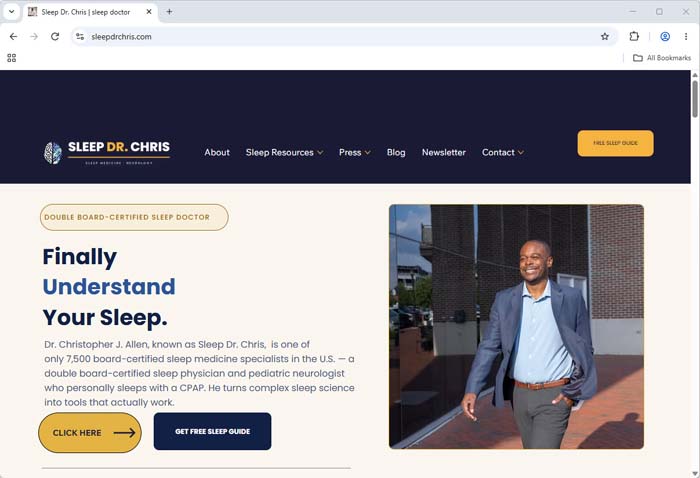
Yeah, I'm a guy that's everywhere. So first of all, I'm the scientific advisor for Airflow Sleep. So if you put in Airflow Sleep And Sleep Dr. Chris, it'll come up. Or just put Sleep Dr. Chris. I'm on YouTube, I'm on Instagram, Facebook, TikTok, LinkedIn. And if you can't remember that, just go to sleepdrchris.com.
Dr. Chris Allen [00:27:41]:
So sleepdrchris.com. And this is the first podcast where I'm actually having this announcement. And Mike, stay tuned because I'm having my own podcast. I'm getting ready to start. Which is brought to you by Airoflow Sleep. So we have a collaboration coming up. This is breaking news because I haven't even told people online for that. So whenever this airs, they get to get this information.
Dr. Chris Allen [00:28:05]:
So if you want to join YouTube, you'll get to hear this. And I'm big on people having information and access to getting care.
Mike Capuzzi [00:28:13]:
That's awesome. And what is that podcast going to be? Is it— has a specific focus?
Dr. Chris Allen [00:28:17]:
Yeah. So it's called Sweet Dreams of Sleep, Dr. Chris. Everyone has dreams, everyone has aspirations, and I always tell people sweet dreams. So it's a double connotation. So bottom line is, is that I want to hear what your, your sweet dream is. But then after that, how did sleep help you, or lack thereof? And so we're going to dig deep into that and looking at that, and I'm going to have some good guys on there and some men on there to tell that story. And I have some close friends and colleagues that have Put that part of the man as like, I've done all of these accomplishments, but as soon as I got better sleep, they saw what was happening.
Mike Capuzzi [00:28:53]:
That's awesome. That's awesome. And Dr. Allen, you have a local practice. Do you mind sharing that just in case someone is in your backyard?
Dr. Chris Allen [00:29:00]:
Yeah. So if you're in the state of Michigan or North Carolina or New York, because I have licenses there as well, if you look up Quality Sleep and Neurology, it's located in Saginaw, Michigan. But again, you put in Sleep Dr. Chris, it comes up too. So it's located there. I have virtual visits, so you can stay in Michigan, come on down, or even come on to the computer because Michigan is a huge state.
Mike Capuzzi [00:29:21]:
Very good. Well, Dr. Allen, before we leave, I've got my Unstoppable After 50 trifecta. It's 3 quick questions, 3 quick answers, and I'm going to tailor these to sleep in men over 50. So what's one cold hard truth that men over 50 need to hear about sleep?
Dr. Chris Allen [00:29:37]:
And we talked about it, but I will say it again. Snoring is not normal. If you're snoring, ask those questions because your sleep and your life can be a whole lot better.
Mike Capuzzi [00:29:48]:
What's one thing most guys are doing right now that's unfortunately wrecking the quality of their sleep?
Dr. Chris Allen [00:29:54]:
The bedroom's only for 3 things. They all start with the letter S. So if you're sick, if you're sleeping, and fellas, we know what that 3rd S is for.
Mike Capuzzi [00:30:04]:
I heard the first, I've heard the 2, now the 3rd. That's right. And sickness was the one I hadn't heard of. So yeah, listen, and it makes sense.
Dr. Chris Allen [00:30:11]:
If you're not doing any of those 3 things, get out of bed. Mind you, I didn't say TV, I didn't say phone, and even reading a book, I would say get a chair and read it outside your bed, especially if you're having a problem.
Mike Capuzzi [00:30:23]:
It sounds so simple, like, okay, really? But it makes a big difference. And finally, what's one thing relative to sleep or just in general, doctor, that What
Dr. Chris Allen [00:30:36]:
you can do to be unstoppable, because a lot of people have problems falling asleep. If you have problems falling asleep, wake up at the same time. Don't sleep in. When you anchor that wake-up time, that'll help you with your sleep time. And as I said, that in combination with talking to your bed partner, because if there's something that you're doing unconscious, it's good to know because you need to get that fixed.
Mike Capuzzi [00:31:03]:
Well, Dr. Allen, thank you very much. Congratulations. I'll have to tune into your podcast. We'll have to stay in touch. Obviously we will, but I'll be interested to hear and see how that goes. And, uh, you know, thank you for just sharing and helping guys. And I know you help more than just guys over 50, but I appreciate all that you shared today.
Dr. Chris Allen [00:31:19]:
Hey, like I said, that's my special— that's, that's my special place because it's like everyone always feels like, no, you don't want him in the office. And I'm like, actually I do, because I, I I know how it is. And so, yeah, thank you for having me on the show. And anyone that's listening, knowing that your sleep doesn't have to be this way. And so, just know that.
Mike Capuzzi [00:31:38]:
Hey, I hope you enjoyed that interview with Dr. Chris Allen. I hope you took away some actionable advice. And by all means, if your sleep is not where it should be, and you kind of resonate with Chris, by all means, reach out to him, check out his new podcast, and just see if he can help you. And if you like what I'm doing here with Unstoppable After 50, please make sure you like and subscribe to the show. Go check out the YouTube channel. Appreciate you subscribing there. And also make sure you check out unstoppableafter50.com and sign up for my weekly playbook.
Mike Capuzzi [00:32:11]:
Every week I send a recap to my group of men who've asked for it, a PDF that's designed to be printed and saved. And it's a recap of that previous week's episode. So check out unstoppableafter50.com.

 Apple Podcasts
 Spotify
 Amazon Music
 YouTube
 iHeartRadio
 CastBox
 PocketCasts
 Deezer
 Podcast Addict
 Listen Notes
 Podchaser
 Player.fm
 Castro
 Goodpods
 RSS