
You want to protect your heart and stay active after 50. But how much do you know about EECP—a therapy that uses inflatable cuffs around your legs to help move blood through your body?
Jack Clifford discovered enhanced external counterpulsation after severe coronary artery blockages left him facing bypass surgery. In this conversation, he shares his experience with the treatment, why he became an advocate for it, and what he wants more people to understand about circulation.
We explore how the equipment works, what treatment involves, and the questions worth asking before deciding whether this approach deserves a closer look.
WATCH OR LISTEN:
 Apple Podcasts
 Spotify
 Amazon Music
 YouTube
 iHeartRadio
 CastBox
 PocketCasts
 Deezer
 Podcast Addict
 Listen Notes
 Podchaser
 Player.fm
 Castro
 Goodpods
 RSS
WHY EECP MATTERS FOR MEN OVER 50:
Heart health is about preserving your ability to keep doing the things that matter. Walking, exercising, traveling, and staying involved with your family all make this subject personal.
Jack’s story starts with a concern many active men can relate to: he wanted to run, but chest pain interrupted his return to exercise. His search for answers eventually introduced him to a treatment he had never heard of.
This conversation offers a patient’s perspective on that discovery. We discuss the equipment, the time commitment, and the practical challenge of finding access.
For men over 50, its usefulness starts with understanding another subject you can discuss with your physician—and knowing which questions to bring.
WHAT YOU'LL DISCOVER:
- How cuffs around your legs synchronize with your heartbeat during treatment.
- Why Jack focuses on blood flow and the inner lining of blood vessels.
- What a typical 35-session course involves, including the time commitment.
- Why his years of continued use matter when interpreting his personal results.
- What to ask about suitability, contraindications, provider training, and access.
WHAT IS EECP AND HOW DOES IT WORK?
EECP stands for enhanced external counterpulsation. During a session, you lie on a treatment bed with inflatable cuffs around your calves, thighs, and hips. A heart monitor helps synchronize the cuffs with your heartbeat.
The cuffs inflate in sequence while the heart relaxes, then deflate before its next contraction. This timed pressure is designed to move blood toward the upper body and support blood flow to the heart.
Jack also discusses the endothelium—the inner lining of blood vessels—and nitric oxide, which helps blood vessels widen. He describes these as central to his understanding of the therapy and its potential effects on circulation.
The treatment does not physically remove an arterial blockage. Jack says his own blockages remain, and he attributes his improved ability to run to the development of smaller vessels carrying blood around them.
WHAT SHOULD YOU ASK BEFORE STARTING EECP THERAPY?
Start with suitability: is this treatment appropriate for your condition and medical history? The interview discusses physician clearance and contraindications, including deep vein thrombosis. Jack’s enthusiasm does not replace an individual assessment by a qualified healthcare professional.
Ask what the proposed course involves. Jack describes a typical schedule of 35 one-hour sessions, commonly spread over seven weeks. Travel, appointment availability, and the total commitment are practical considerations.
Ask which benefits are supported for your particular situation, how improvement would be measured, and what risks apply. The conversation includes Jack’s personal observations and broader claims about circulation; each deserves a clear explanation of the evidence behind it.
Finally, ask about ongoing treatment. Jack reports approximately 700 hours of use over several years. That makes his experience different from completing an initial course and stopping.
KEY MOMENTS YOU’LL WANT TO HEAR:
00:00 Introduction to EECP therapy
05:05 Forgotten circulation therapy rediscovered
06:40 Explaining the EECP process
09:54 How nitric oxide affects blood flow
15:10 Getting access to EECP therapy
16:30 Challenges of offering EECP therapy
19:59 Discussing ED and treatment options
26:00 Morning routine with ECP machine
28:08 Discussing VO2 and FDA clearance
30:23 Discussing healthcare qualification criteria
38:00 Finding and understanding resources
KEY TAKEAWAYS FOR MEN OVER 50:
- Use the conversation to prepare better questions. Ask your physician what role this therapy might have in your care and what outcomes would be realistic.
- Keep personal experience in perspective. Jack’s account explains his advocacy; it does not predict another person’s results.
- Understand what improved function means. Jack reports returning to running while his arterial blockages remain. Feeling better and eliminating a blockage are different outcomes.
- Consider the full commitment. Evaluation, treatment sessions, travel, cost, and any proposed maintenance schedule all belong in the decision.
ABOUT JACK CLIFFORD
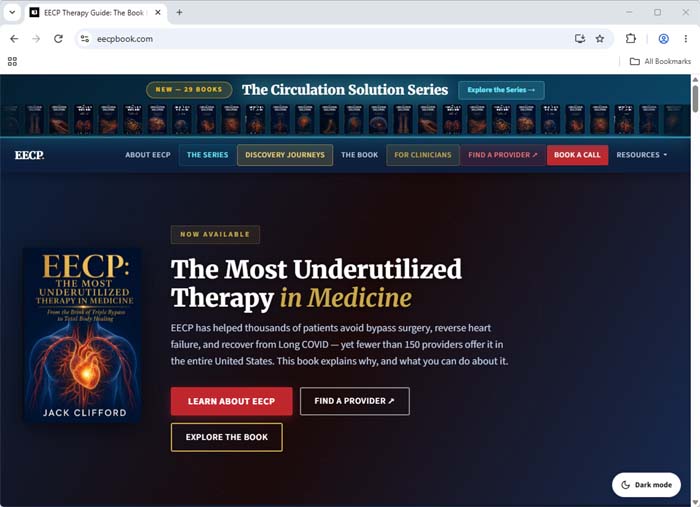
Jack Clifford served 21 years in the military and is the author of EECP: The Most Underutilized Therapy in Medicine. After being offered triple bypass surgery, he pursued treatment with external counterpulsation and became an advocate for greater awareness and access. He now shares his experience through books, educational resources, and efforts to help people locate providers and equipment.
Learn more: https://eecpbook.com
RELATED EPISODES:
Heart Health: How Men Over 50 Can Detect and Beat Heart Disease | Dr. Jeffrey Boone
https://unstoppableafter50.com/heart-health-jeffrey-boone/
Explore early detection and the questions men can ask about identifying heart disease before symptoms appear.
Nitric Oxide Deficiency: The Hidden Threat to Men’s Health Over 50 | Dr. Nathan Bryan
https://unstoppableafter50.com/nathan-bryan/
Continue exploring nitric oxide, blood flow, and vascular function—subjects central to Jack’s discussion.
White Coat Syndrome: Is Your Doctor’s Office Blood Pressure Misleading You? | Dr. Laurence Quinn
https://unstoppableafter50.com/white-coat-syndrome-dr-quinn/
Learn why accurate blood pressure measurement and readings outside the doctor’s office matter when assessing cardiovascular health.
PLEASE SHARE WITH FRIENDS AND FAMILY:
If you found this episode helpful, it would mean the world to me if you shared it and this podcast with your friends and family. Thank you!
YOUR WEEKLY EDGE AFTER 50
Every Monday, I send one high-value Unstoppable After 50 Playbook for men over 50 which is built around the powerful conversation from that week's podcast (click here to see an example). Each Playbook includes key takeaways, a clear challenge, and practical ideas you can use immediately, or file away for future reference. No hype. No filler. Just useful ideas and tips for men who refuse to slow down.
No spam. No nonsense. Unsubscribe anytime
Jack Clifford [00:00:00]:
It's that blood flow is everything. Really comes down to that. I'm as convinced as ever, and this has been an evolution in my thinking. It's documented in the book, but it's everything. It is aging. A lack of blood flow, the degradation of blood flow essentially is what we define as aging. It manifests itself in all kinds of ways. We put labels on them.
Jack Clifford [00:00:24]:
We call those conditions like heart disease or Diabetes or all kinds of other things. But, but really, at the heart of all of those issues is a lack of blood flow.
Mike Capuzzi [00:00:34]:
This is Unstoppable After 50, the podcast for men who refuse to slow down. Each week I share smart strategies and expert insights to help you stay strong, healthy, and unstoppable in the second half of life. Welcome back to Unstoppable After 50. This week my guest is Jack Clifford, author of a brand new book about EECP. Now I guarantee this is probably not something you've heard about. But trust me, and just trust me when I say you're going to want to hear and watch this conversation because this is about a topic— vascular circulation and the health and condition of your vascular system— and a therapy that Jack did not invent, but he is really trying to promote. It's something that's been around for decades. It's very— not really well known, but it has completely turned his life around and helped him with his own condition.
Mike Capuzzi [00:01:26]:
And now he's trying to help others. He just wrote a book about it. So by all means, stay tuned for a very interesting conversation with Jack Clifford. Jack, welcome to the show.
Jack Clifford [00:01:37]:
Thanks, Mike. I'm super happy to be here. Thanks for having me.
Mike Capuzzi [00:01:39]:
Sure, sure. Hey, listen, congratulations on the new book. We're going to focus our conversation today on that. But before we start talking specifically about the book and what you've learned that you shared in the book, Jack, take us back to— I think it was 40— you were about 47. You were a lifelong runner, but all of a sudden, You couldn't exercise without chest pain. What did the doctors ultimately discover was going on with your heart?
Jack Clifford [00:02:08]:
Yeah. And just one clarification, lifelong, you know, as in I was active military for 21 years and, uh, ran quite a bit, but I had taken a break for some reasons. So, um, so when I went back to it, yeah. Um, so I was in the hospital, Mike, um, you know, uh, the doctors were getting ready to, uh, um, offer— well, they weren't getting ready to, they offered me unsentible roughly emergency triple bypass surgery. And that was my only option for what was ailing me at the time. And the real crossroads of my life, a real pivotal kind of like a literal fork in the road, or that's how it feels to me looking back 5 years. I'm so different now from who I was then and what I've done about that sticky situation I was in.
Mike Capuzzi [00:02:54]:
So, you recently wrote— was it your first book?
Jack Clifford [00:02:57]:
Yeah, EECP: The Most Underutilized Therapy in Medicine. Yep.
Mike Capuzzi [00:03:00]:
It's quite a work. So, for a first book, congratulations. So, yes, share the title again because I think I spoke over you. And, tell me, Jack, why you wrote it and who you wrote it for.
Jack Clifford [00:03:14]:
Oh, yeah. Thank you. Excited about answering that question. So, it's called EECP, which stands for external counterpulsation. So, EECP: The Most Underutilized Therapy in Medicine. And I wrote it just like it says in the preface, for anybody that is in the situation I was in 5 years ago, and hopefully has the kind of information that it took me a long time to find and figure out. And I just, I think this is paramount. I'm basically on a, well, it was a one-man mission, and now I've got a lot of support increasingly as we're getting the word out, but to help bring ECP to the people.
Jack Clifford [00:03:54]:
That's, that's really what we're doing. Um, and this book is a big part of that.
Mike Capuzzi [00:03:58]:
Yeah, for sure. And I've got to tell you, you know, you reached out to me, you were kind enough to send me an advance release digital copy, and it was new to me, right? I'm like, what is this about? As a matter of fact, Jack, I shared it with my father who's in Florida, um, 84 years old. Matter of fact, he just had another doctor's appointment with his cardiologist yesterday. They thought they were gonna have to put a couple more stents in his heart. He's had a heart attack, he's got stents, but overall he's still trying to do as well as he can. And he had not heard of this. So let's take a step back because I'm sure you get that all the time. What is EECP again? You shared it, but what is it and why is it relevant to me?
Jack Clifford [00:04:40]:
Yeah, absolutely. Yeah. And it's relevant to your father. And he's in Florida. I can help him if he needs or work with his physicians and so on. Because EECP is, is this 30-year-old— it's really over 30 years old, but for round numbers, 30-year-old medicine. It's been approved by the FDA for— since, since 1995. It's been Medicare reimbursed since 1999.
Jack Clifford [00:05:05]:
Um, so it's, it's antiquated and old, and you would probably think, well, geez, it probably isn't, you know, the latest technology. It probably doesn't do anything. Um, and yet the reality could not be further from the truth. We've had this amazing circulation enhancement therapy stuck in the, basically the dustbin of medicine, um, for, you know, going on 30 years now. I mean, it got, it got popular at the, um, you know, in that initial time frame in the late '90s and early 2000s. And then, uh, stents kind of took over the world, uh, drug-eluting stents specifically, because they got, you know, stent technology got better. Right. And, I document all the history in the book, but there's some really particular reasons why you've never heard of it and why his cardiologist, a cardiologist of all specialties, generally speaking, has not heard of this.
Jack Clifford [00:05:55]:
And, the few that have were around practicing in that timeframe I mentioned when it was starting to gain in popularity to some degree. But, what it is specifically, just so everybody can just quick little like, hey, You lie on a bed. The machine does all the work. You just lie there. They put cuffs, Velcro cuffs around your calves, your thighs, and your hips. And inside those cuffs are these little air bladders. And then they connect you to a 3-lead EKG here, here, and here. And you just lie there and the machine inflates and it goes to the beat of your heart, which is kind of a neat little, you know, it's It's neat to get a biofeedback that tells you how fast your heart is beating, I guess.
Jack Clifford [00:06:40]:
But also, you've got a monitor that tells you what your EKG looks like and what your beats per minute are and some other metrics that are coming in through the machine. But, you just lie there. And, the machine inflates with air pressure and that air pressure increases over one session and over subsequent sessions. So, at first, it just kind of feels like a gentle massage, but then as they start cranking the pressure up, you tolerate it increasingly over, like I said, one session and over multiple sessions. And so, when they get to those higher pressures, what it's doing is it's taking the blood from your lower legs, sending it up into your upper body, and then back around again, but it's doing it in between heartbeats. And a good way to think about it is if your blood is flowing through your body, it's flowing like, in a way, you could think of it as a river where it's going in one direction, right? And here you have EECP, you get on EECP and all of a sudden, that blood is being pushed against the current, right, upstream. And so what happens is you have a phenomenon called shear stress. And shear stress is a measure of impact on your endothelium.
Jack Clifford [00:07:54]:
And your endothelium is the inner lining of your blood vessels. These are one cell layer thick muscles that line your entire vasculature. These are like 60,000 miles worth of vasculature if you were to just literally route all the courses through the little things in your fingers that you can't see it, but if you poke, blood comes out, right? It's that level of— it's systemic, it's just throughout your body, right? So, When you apply shear stress to your endothelium, it's very, very specific exercise for your blood vessels. You can do some of it, like it's akin to running, to cardiovascular exercise, except like I mentioned, the upstream effect, right? The level of shear stress that you're applying to the endothelium is orders of magnitude above anything you could replicate on your own. It also is sequential. So, it's milking. It's a good word. It's milking, right? Milking your legs because it applies that pressure first in nanoseconds of sequentiality to your calves and then to your thighs and then to your hips, all in between heartbeats, all at this kind of therapeutic moment when your heart goes from systole where it's contracting to diastole when it's relaxing.
Jack Clifford [00:09:16]:
There's this kind of therapeutic moment when that pressure comes in, your heart is ready to receive extra blood. And it actually takes the load off of your heart, makes it easier for your heart to work while you're on the machine. And it kind of really effectively gives you 2 heartbeats while you're on the machine. And that's helpful, but that's not really where the magic lies. The magic lies in that endothelial training. Because what your endothelium does, Mike, is it releases nitric oxide. Nitric oxide is this vasodilatory chemical. It's a nanosecond gas, so it's just there and it's gone, but it has all of these downstream chemical cascades that happen.
Jack Clifford [00:09:54]:
So, the first thing that happens with nitric oxide is your blood vessels can dilate and get bigger as they need so they can get more blood to wherever it needs it. And, that's a dynamic thing based on what you're doing and where the blood needs to go. But, as nitric oxide is being released, there's this whole downstream chemical cascade that happens that ends up with a lot of things, one of which is VEGF, or vascular endothelial growth factor. And so you end up with a lot of angiogenesis going on throughout your body where you need it, at these pressure differentials, at the places in your pipes, if you will, where your body senses that it's getting too much shear stress and so it has to grow. So you'll see, think of it like a root system. Because that's really what it looks like if you were to— if you could image it. It's really difficult to image it through standard imaging techniques. But anyhow, um, so like, I'm 100% blocked here, you know.
Jack Clifford [00:10:51]:
This is my widowmaker artery, right? This— that, that left anterior descending, it's 100% blocked. My, my, uh, uh, left is 95 and my right is 80, and nothing's changed. This is 5 years it's been like this, right? Well documented. But I can run a sub-7 mile right now. I can do that because I've grown around all of my blockages with much smaller vessels like the root system, right? But the total volume more than makes up for what's blocked. And so I have no issues, but I've had no stents, I've had no procedures, I'm on no heart meds. And I like to show this off here. See that right there? Temple band.
Jack Clifford [00:11:31]:
I had another one over there. So I grew these over the last 5 years, right, using this machine. And, uh, you know, it, it kind of feeds my brain. And, you know, like, when you get optimized blood flow to every, every cell in your body— I'm talking every organ system, to my brain, to my pelvis, to my heart, to my kidneys, to my liver— some really interesting things start to happen in the body, let me tell you. Um, and, you know, I can document just a few of them for you real quick and say, for one thing, I need half the amount of sleep I used to need. I was always the 8 to 9 hour guy and, and kind of dragging ass. And, my whole life had been like that. And now, I get up at 2:00 in the morning, I start cranking out productive work, and I get some coffee in me and I'm going till about 9:00, 9:30.
Jack Clifford [00:12:15]:
And, it's been like that for years now. It took a couple of years for that transition to happen. It's not like you hop on an ECP and it happens magically. And, one thing is important nuance to point out. So, the typical protocol is 35 hours. And, an ECP could very well be the most well-researched medical device on the planet. it's, it's not a lack of evidence. Like, this is not woo science.
Jack Clifford [00:12:38]:
I mean, it's been published. It literally just got approved in Europe to treat dementia. And when I say treat, so currently you can take a $26,000 a year pill that'll slow the, the progression of dementia down by 30%, and it's going to make your brain bleed. Okay. Um, the study that the approval for EECP was based on in Europe, they actually reversed dementia. And this wasn't like a— this is not the kind of study— there's lots of studies, they come out all the time. This is a study that the European equivalent to the FDA said, you know, this is— this evidence is good enough for us to go ahead and give it this indication. So it's not, you know, we're not talking about like one-off different kind of things.
Jack Clifford [00:13:17]:
We're talking about real science and published in real peer-reviewed journals, you know, high-quality stuff. And, um, it's under consideration. by the FDA right now. You know, I don't know what'll come of it, but, uh, but they're giving it a serious look. And, um, like, anyhow, uh, saying all that to say, like, when I, you know, at the intro I said, I said, you know, uh, blood flow is everything, right? Um, it's aging. You know, aging is a lack of blood flow, and restoring blood flow is really the verse. I often have been referring to this as the closest thing to the Fountain of Youth that actually exists. And I, I mean, I, I'm convinced because I've helped so many other people.
Jack Clifford [00:13:57]:
It's not just me. It's helped my wife. It's helped loads of friends. Now, it's helped people that just come to see us because they want us to help them. And now, I'm helping people get their own machines if they want either through leases or through purchases. And, we are truly bringing ECP to the people. We're not just sort of saying, hey, go see your local cardiologist and try and ask him what he thinks. I mean, they've had Cardiologists had 30 years to figure this thing out and they didn't do anything with it.
Jack Clifford [00:14:28]:
So I figure their time is up. They're going to have to—
Mike Capuzzi [00:14:32]:
Are you like a one-man mission right now, Jack? Is it like— I
Jack Clifford [00:14:35]:
mean, if that's what I have to be, then yeah, I'm really— a lot of people, when they start looking at the evidence themselves, they read the book, but people don't just take my word for it. They go learn about themselves. It's like I haven't met a single person that is like, oh, that doesn't make sense. You know, it makes sense. You just, you just do your looking, you know. So I've got eeclocator.com is my main website, and I built that just to, um, you know, just to document where all the machines were because so hard. Like, I had to drive— I'm in Florida, it's, you know, you know, your dad's down here, it's not a small place. There's a lot, you know, there's a lot of people down in Florida.
Jack Clifford [00:15:10]:
Um, I had to drive 3 hours and stay in a hotel and like basically push my way into a doctor's office and insist that he let me use it. Um, it was like that, and that was after a lot of research and a lot of phone calls and a lot of dead ends. Um, and so, you know, I'm just trying to help make it really easy. What I want, honestly, what I want, Mike, because it's a 35-hour protocol and you have to go 35 times— the normal course is over 7 weeks. It doesn't have to be that way, but that's the normal way people get their EECP hours. And then that 35 is just sort of like a platform. I have 700, you know, because I got my own machine, so I've just kept using it. But, um, uh, like, I, I, I kind of put it this way: we need 6,000 access points for ACP in the United States, and we have about 150.
Jack Clifford [00:15:55]:
Hmm. And I just found out this week— no joke, this is going to blow your mind, man— found out a couple things. One thing last week and one thing this week. My mind keeps getting blown, but one is good and one is bad. So the, the place that I got treated that I document in my book doesn't offer EECP anymore. So that's the bad. Because as a cardiologist— oh, oh, this is the reason, because you can't make doctor money doing EECP. But Mike, you can lose doctor money doing EECP.
Jack Clifford [00:16:30]:
So if you're my patient and I offer you EECP, there's a whole lot of things I'm not gonna be able to do to you later on. But you're gonna tie up one of my rooms for 35 hours and I'm gonna get like, like $100, but I gotta— per hour, but I gotta staff that room, uh, and I gotta pay that person so much, and I gotta pay the overhead, I gotta pay for the power bill. And, you know, I'm gonna probably lose money offering ECP to you just straight up on the, on the 35 hours. But then the fact that, that the 5 stents I was counting on are not coming through because, you know, um, and, and, uh, but you can make like doctor— not doctor, you can make like plumber money doing ECP, or like electrician money. It's not no money, you know. And I'm trying to help people understand that they So, not only can they get these machines and use them for their own benefit, but then they can also help their community, right? And turn it into a nice little business as well, so.
Mike Capuzzi [00:17:25]:
Jack, there's a lot to unpack there. So, I'll probably try, let me, I wanna kind of go back a little bit and understand what's happening in the body. That's, so when you were describing it, and I read through your book, Is it— it almost seems like it's flushing out your, your vascular system. I don't know if that's accurate, but that's how I kind of pictured it as you were describing it. But what this— you're, you know, you're talking somewhat technical. If you could bring it down even a notch, like, what is happening in the body? The shearing, what does that really— what— how does that translate to someone who doesn't even understand?
Jack Clifford [00:18:02]:
Stress is just, you know, the forced opening. So if we're forcing these vessels to open, and they're not opening because of nitric oxide, but they're opening because the flow is overwhelming them, and they're literally being And real
Mike Capuzzi [00:18:12]:
quick, as guys age and people age, that vascular system gets tighter and more restrictive, correct?
Jack Clifford [00:18:20]:
Yes.
Mike Capuzzi [00:18:20]:
That's, that's what's— that's the problem, right? The flow. And this is essentially stretching it, if you will, and making it more pliable.
Jack Clifford [00:18:30]:
Yeah, that's it. I mean, it's stretching your endothelium, you know, the inner lining of your blood vessels systemically. Now, interestingly, it kind of works from the pelvis up in terms of what it benefits first, which is if you think about it, it makes sense because you've got cuffs on your calves, your thighs, and your hips, and it's wrapped around your pelvis, right? So, when the blood gets pushed up, it's got to come back. And so, it comes back towards your legs and then it gets hit by that next wave, right? So, it pools in your pelvis. And, the closer you are to the pelvis, the more the blood flow, it's well documented that You have an 8x, maybe even a 16x at your pelvis, and then you might have a 1.5x in your brain. So, it sort of is that flow. I mean, it also works down. It works great for leg issues too, diabetic foot where these people, the foot swelling.
Jack Clifford [00:19:23]:
I've seen pictures like 15 sessions, the thing that could not heal was like the guy was going to get amputated. I mean, that's pretty normal. in ACP land. But, but I, you know, just because you got a lot of guys in your audience, right? So, you know, guys start getting to certain, you know, certain age, like, you know, certainly into your 40s, definitely into your 50s, increasingly so, right? You know, their, their, uh, their penises stop working as well as they used to, right? And this is an amazing therapy for erectile dysfunction. I wrote a book, a second book, Mike, called, uh, it's— so I've got a whole book series called The Circulation Solution. And book 1 is on 28
Mike Capuzzi [00:19:59]:
books, right?
Jack Clifford [00:19:59]:
I just released them all. I mean, I got to get them on Amazon still, but they'll be on later. And that's just to explore ECP through the lens of Parkinson's or kidney disease or what have you. But from the ED perspective, conceptually for your guys out there, I'd love for you to start thinking about some things here. Like if you go in, I mean, I'm not going to be graphic, but just, I'm going to just call it like it is, right? If you go and like have an erection and you feel your erection actually starts, you know, go below your scrotum and like feel up into your taint, and you're gonna feel your penis, right? You know, deep in your pelvis. Like, it's not just the sticky out part that is your penis. That's your erection, right? It goes deep into your pelvis. And so we have like, you know, uh, needles that you can stick in your penis to make, make it erect.
Jack Clifford [00:20:50]:
We have, you know, PDE5 inhibitors like Cialis and Viagra that can help, and those do help. I think they're actually really good in combination with the ECP to take them, but not just for your erectile dysfunction, it works systemically to help the vasculature grow more. But, if you think about the deep pelvis and how this machine works, it's fixing it from the inside out. That's kind of the main point I'm trying to make with the erectile dysfunction is if you have erectile dysfunction, it gets worse and worse over time. You need more and more Viagra and then pretty soon the Viagra doesn't work and then you got to go to Trimix and then certain points that doesn't work. And then, they're talking about implants. You have a fake penis. And yet, you could do EECP and never have to deal with any of that stuff because EECP literally, it grew my penis an inch and a half.
Jack Clifford [00:21:42]:
I mean, it did. That's straight-up truth. Ask my wife, married 32 years. And, it's not so much that it grew it, but it restored my potential to whatever the max of whatever I could possibly be is. Um, and, uh, but, you know, it works better, you know, from the pelvis up. So kidney disease, fantastic. I, I really think it could keep somebody off of dialysis if they were heading that way. And it— I, I know several people who were in like stage 3 kidney disease, you know, EECP brought them down to 2 or 1.
Jack Clifford [00:22:19]:
Um, and that's just like the 35-hour thing. We're not talking about people that have done 700 hours. And the reason why is because as far as I can tell, I have more hours on EECP than anyone else in the world. And I've been looking, like, I, I challenge people like, hey, I want friends. I want people that can relate to my experience. But, you know—
Mike Capuzzi [00:22:37]:
Well, just out of curiosity, who— now, is there one manufacturer of this machine?
Jack Clifford [00:22:41]:
No, there's actually like, in the world, there's like 6, maybe 7. But in the US, well, there's really only one that does manufacturing in the US, but you can import them. The FDA approves them. These are Class II medical devices. So, you know, there's certain controls on them. But, uh, and also I want to point out too, Mike, real quick, sorry, just, just like the technology has changed. It's not like the, the therapy— the benefit that the therapy provides has been around for a long time. However, the actual machines themselves have evolved a fair amount now because ECP is really popular in China and India and Malaysia and a lot of other countries, not in the US so much.
Jack Clifford [00:23:18]:
But, um, so they have now portable machines that, um, you know, are really, really good. They fit it. I, I took one, I took one to Sarasota, Mike, not, not too far from Venice, right, over the weekend. And I set it up in this person's house and trained him on it and stuff and let him use it for a month. It fits in the back of my Expedition. Um, so, you know, like, they're not— it's 200 pounds, like, it's on wheels. Um, there, there's these machines that are really, really portable and compact and And, uh, EECP historically has been these giant immovable beds that are like an 8 by 4 footprint. And, you know, that's, that's how it's historically been.
Jack Clifford [00:23:58]:
But, but, uh, you know, it doesn't have to be that way.
Mike Capuzzi [00:24:01]:
So, Jack, obviously we're going to encourage, uh, my audience to go check out your book and grab a copy and read it. If they're thinking, hey, this sounds great, but so do a lot of health claims, right? There is— we, you know, right, right, we know what it's like out there, right? We know you can't turn the TV on without seeing stuff, or online. So it's pretty profound, some of the stuff you're sharing. The scientific evidence, do you cover some of that in your book?
Jack Clifford [00:24:27]:
The book, yeah, the book goes into a good deal of it. But also just go to eecplocator.com now, because I've built that site out, you know, I'm constantly iterating on it, making it better and better. And like I mentioned, something good that happened— I was saying the bad, like the, the guy doesn't offer ECP in the town I went to to get it myself. itself. And, but some, some people might be familiar with this lipoprotein little a, which is a part of your lipid panel. And it's a really important one 'cause it describes your heredity for atherogenic, you know, particles. So like my mom had heart issues, my grandfather did, and then I have a high Lp, or I did. But a, a, a study came outta China that I, it came out in April.
Jack Clifford [00:25:05]:
I only became aware of it last week. 35 hours of VETP brought Lp down 13%, which is small, but that was 35 hours. Now, let's take somebody with 700 hours, right? So you got N of 1 here, Jack, Lp of 137, 5+ years ago, Lp of 30 now, brought me down 78%. And I'm not saying it's going to do that for everybody. I can't say. I can say that there's a decent study that says that it did it for a group of folks, and it It was linear. It was cause and effect. 35 hours does this, more hours does this potentially, at least with my situation.
Mike Capuzzi [00:25:55]:
Is it a painful procedure, especially as the pressure starts increasing? Just out of curiosity.
Jack Clifford [00:26:00]:
Wonderful. It's the best part of my day every day I get on it. I only do 15 minutes now in the morning. It's just part of my morning routine. I go work out, I go for a run, Hop on ECP, get in the sauna. That's just kind of my morning routine. But I, on the ECP, I do, I do breathwork, I do meditation because it's a great breathwork trainer because you're lying there, it's pulsing to the beat of your heart, and you learn how to diaphragmatically breathe because it strengthens your, your hips, your lower back, and your core because you're, you're, you know, it's pulsing, it's pushing, it's pushing on your core every, every heartbeat, right? And so your, your body has to resist, and, and so, uh, it strengthens that whole area. And then you can, you can mess with it, you know, so you'll learn how to breathe right, you be— and then the machine will go from this pace to— and you can hold it and keep your heart rate down to like, like, like you can drop like 30 points, you know, for like, like up to 30 seconds.
Jack Clifford [00:26:56]:
And, uh, and, and if you just play with it and you learn that— these are more advanced techniques on EACP, but, you know, it's been neat. I've, I've found that my, my, my— I've found that I've become a, a reflexive parasympathetic breather, meaning that If my wife and I are about to like argue about something, I'll just notice that I'm doing— I'm like, wow, I'm, I'm breathing really well. I should be, you know, heading in a different direction under normal circumstances with my breath.
Mike Capuzzi [00:27:22]:
Is it something, Jack, where like— I'm, I'm guessing you're starting to say this could be something, it could be therapy for anybody, or is it something that you have to have like a situation you had years ago?
Jack Clifford [00:27:33]:
Anybody can do it, and, and here's the reason why. So I'm kind of exploring— I'm like an angles guy, you know. I like, I like legal angles. I always have. Like, I want, I want to, I want to maximize the utility. I'm a utilitarian at the end of the day. I want to maximize the utility of anything and everything that has value, right? Um, and in, in 2015, the FDA approved a new indication. So they'd always approved it for angina and for heart failure, and then all of a sudden in 2015, they approved it for Get this, general circulation in healthy people, an increase in VO2 max.
Jack Clifford [00:28:08]:
Well, it doesn't say max, but they're implying max, an increase in VO2, right? VO2 is your overall utilization, how well your body utilizes oxygen is measured in a VO2 ratio. And, you know, it's just a, it's a good metric for oxygen utilization. And so if the FDA has cleared it for something You know, their standards are incredibly rigorous and rigid and, you know, like, like, so if they approved it for general circulation and VO2, that ought to really say something, right? However, so that takes it, Mike, out of medicine, right? And into wellness. So if you want to get an ECP, we're not treating you for anything. You know, you have to get cleared. You need to get cleared by a physician to make sure that that's an appropriate activity for you, just like if you needed a sports physical when you were a kid, you want to play soccer or track or whatever, you got a sports physical. It's just like that. Once you get that covered, and we can assist with that if people need help, but they can also get it themselves, then now you can get EECP.
Jack Clifford [00:29:13]:
And, we're not treating you for anything, we're just enhancing your circulation. That's it.
Mike Capuzzi [00:29:18]:
So, what are they doing? Are they going— so, obviously, they have the EECP locator, so you're helping them find potentially somebody in their backyard, or—
Jack Clifford [00:29:28]:
Yeah, hopefully. We don't have nearly enough. We only, you know, you can go to Locator and you'll see these huge gaps, and maybe that'll inspire some folks to be like, oh, I might be able to fill one of those gaps, and then I can get this machine that's going to make me some money, and I can use it and, you know, change my life and change a bunch of people's lives all at once. But, um, yeah, that's—
Mike Capuzzi [00:29:45]:
I mean, do they have to be certified? Certainly you have to be a medical practitioner.
Jack Clifford [00:29:48]:
We certify. So we've got, we've got a training program. My wife has got a doctorate in nursing education, and she, you know, has put together This amazing program that helps providers and technicians know how to use EECP, how to think about EECP, how to think about the biology and the physiology and all of that. Now, you have to be a healthcare professional to administer EECP. The FDA does say that. It says it's appropriate for use under the supervision of a healthcare professional. The FDA does not define supervision and it does not define healthcare professional. professional.
Jack Clifford [00:30:23]:
And it says healthy person, which your doctor decides if you're healthy, right? That's, that's a, that's a decision between you and your physician. So, um, anyhow, so that's the criteria. So you can, you can be a basically trained EMT, CNA, you know, other things in your state, whatever your state, you know, licenses issue that would, would make you a healthcare professional meets that criteria. Um, you still need training and, you know, we, we provide that so you can, you can get certified to, you know, to issue it. And then as long as you're doing it in the wellness space and you're not making any claims, um, you know, there's nothing wrong with it. There's lots of people doing this. This is not just— I didn't even— and furthermore, I didn't invent this. Uh, it was shared with me, uh, with a guy in California who figured it out after going to battle with the FDA numerous times because he'd been involved in ECP for 30 years.
Jack Clifford [00:31:14]:
And, um, um, he kind of— and if you can figure it out in California from a regulatory perspective, right, you can probably do this anywhere.
Mike Capuzzi [00:31:22]:
And
Jack Clifford [00:31:23]:
And so, uh, yeah,
Mike Capuzzi [00:31:24]:
so it's not, it's not like your sauna. It's not a device you have at home and you're using on your own. It's not, it's nothing like that.
Jack Clifford [00:31:31]:
I mean, it's not direct-to-consumer in, in the traditional sense, but that doesn't mean that the company that, that is in the US that sells these, um, and, you know, there's, there's lots of companies. I, I, I work with all the manufacturers. I help people get the very, very lowest price points, and you'd probably be surprised how low it can be. But, um, Uh, they'll sell, they'll sell it to individuals. You know, they've, they've only sold 58 machines in the US for whatever that's worth, and they've been around like 10 years. I own 2 of them. Uh, the vast majority of those 58, professional sports teams who don't want to talk about it because they don't, they don't want to give away their, their secrets. But, um, you know, it's well studied for athletic, you know, performance enhancement, um, especially for recovery.
Jack Clifford [00:32:17]:
So, you know, if you're, if you're, if you're doing 2-a-day trainings or, you know, any of this where you're really really pushing your body, ECP can make a giant difference. But, um, you— it— so, so, you know, Class II medical device means that there's certain controls, but they're not very particularly rigid controls on it. You need, you need to have a, a physician, you know, uh, clearing you for this. If you're buying one from that company, that particular company, they're going to want a prescription. Um, but, you know, we have, we have lots of providers that work with us to, to help make this happen for people if they want to. So that's not, that's not a, uh, an obstacle at all.
Mike Capuzzi [00:32:55]:
So you're saying there is a, there is a path if somebody's listening to this and this is— and they actually want to— and are they doing it to themselves or they still have to bring—
Jack Clifford [00:33:04]:
Oh, to self-administer? Yes. Well, if it's your own machine, that's kind of your own business, right? But I, I do, I do teach people how to self-administer. I've been self-administering for years, so has my wife. I can usually teach anybody in about 5 sessions how to how to get on and off the machine themselves. And, and, uh, ECP, Mike, has a 30-year safety record of never hurting anyone. 2, 2, 2 instances that the FDA has recorded of it hurting somebody, and it was bruising on the legs. And, um, that's not to say that it couldn't. And, you know, I don't want anybody to think that I— the guy— and it won't be me— the guy that blows our 30-year safety record, you know, like Like, don't do that, right? Like, we— there are legitimate contraindications.
Jack Clifford [00:33:48]:
Like, that's why the training that I mentioned is one of the reasons it's there, is to really understand when it's not safe to do this. And there are some, like deep vein thrombosis is one, um, obviously like pregnancy. But, uh, a
Mike Capuzzi [00:34:00]:
certain age, Jack? What about a certain age?
Jack Clifford [00:34:02]:
You know, there's 100-year-olds benefiting from these. I got testimonial videos on my website. I have over 130 of them. And broken down by condition. So you can look for, you know, stroke or long COVID, or, you know, there's a lot of cardiac because obviously that's where it's historically been. But, but, uh, there's some really old people in those videos getting EECP. Um, but, uh, um, you, you can self— you can self-administer and, and you can do it safely, as again, as long as you've been cleared. And, and I, I would say cleared too, don't necessarily trust your physician because they've never heard of EECP.
Jack Clifford [00:34:34]:
They might want to— They might want to reach out to my wife who's now kind of like the, the world expert on contraindications because she's been hitting the books like 12 hours a day for like the last 4 months to get this training ready because we're going to be putting it out online in these online interactive modules. Um, and so, you know, there's lots of contraindications that you're not going to find on the internet either. You know, there's little strange diseases where this just wouldn't make sense. And, you know, like there's just a lot of little nuances. There's rabbit holes you can go down, but she, she summarizes it all and helps, helps people really think through it. So, your physician might, if he's trying to learn about it, he might want to give her a call, but she'd be happy to talk to them.
Mike Capuzzi [00:35:12]:
But, I also have to imagine, I mean, going to your cardiologist, what are the odds that he or she is going to know what this is?
Jack Clifford [00:35:19]:
About 10%. And, it's almost always the older ones that are getting ready to retire because they were around in the early days when ECP was gaining in popularity. But, it hit its high-water mark in 2000. And then, you know, the machines just started getting sold off. So we went from about 1,200 access points in the US to now 150. And I'm, you know, I'm holding the line. We're, we're going up. We've— I've seen, um, I mean, I've been, I've been helping people get machines for a little bit now, but, uh, but, but I've seen, you know, 3 new clinics open up just in the last couple of months with, with more on the way.
Jack Clifford [00:35:56]:
It's funny though, because it's almost always, uh, they call it the investor. I keep hearing this story. Well, our investor got our machine, right? It's, it's a, it's a rich patient. who wanted access to a machine near their house, and they bought it for these people. And, and because, because they, they heard about it or they used it somewhere else in the country, you know, and they just, they wanted access, and they probably wanted to have people in the community have access to it too. Um, but, but they're not the, the, the numbers that, that some people are paying for machines. I mean—
Mike Capuzzi [00:36:28]:
Can you ballpark that, Jack?
Jack Clifford [00:36:30]:
Yeah, I will. Okay, so, so on the low end, you're in the the high $20s, low $30s for portable technology, you know, the, the, the newest stuff that you can wheel into, you know, you can fit into a car, um, a big car, but, you know, a car nonetheless. Um, it, it— and then there's, there's places that'll charge you $100. That's kind of the top end, somewhere in between there. But, but most of them, it's more like $70, $80, $90. But we don't have to pay that. That's not, that's not the actual, you know, That's not the actual prices. Um, and, um, yeah, so, uh, there's, there's a lot of other options out there.
Jack Clifford [00:37:09]:
Um, I'm not saying it's— I'm not saying that's cheap either. I don't like— I don't like to presume on people's finances at all. You know, I, I'm— $30,000 is a lot of money for me. I don't know, you know, everybody's got their own sort of price sensitivity. But, but I will say this, I would drive the crappiest car or I would take the bus before I would be without my ACP machine because that is how much it's changed my life and how important it is to me. And, I know my wife feels the exact same way and so do most of the people that either have machines or rely on my machines just so they don't have to have one.
Mike Capuzzi [00:37:44]:
Well, Jack, very eye-opening, very interesting. Obviously, I think what we've done is just hopefully pique some men's interest in this because this is something that most of us are not Again, share again your websites. Where do you want— where do you want people to go to get more information?
Jack Clifford [00:38:00]:
So, the book— all the books are at eeCPbook.com. eeCPbook.com, you know, the main book we talked about, and then these other ones I've been putting out just to help people understand it from these different perspectives. And then eeCPlocator.com, which is where you'd find your access points, but also I strapped on a whole bunch of education from like the the provider perspective. So if you're— if your physician wants to learn, if you are a physician, um, and then also from the patient perspective, there's just a whole host of, you know, resources there for you to get it all broken down really easily so you can understand it. Yeah, and all those patient testimonial videos I mentioned, all the research studies, it's all there.
Mike Capuzzi [00:38:39]:
Awesome. Well, thank you for sharing that. And Jack, before we go, I have my Unstoppable After 50 trifecta— 3 quick questions, 3 quick answers. So What is, uh, one cold hard truth guys over 50 need to hear from you?
Jack Clifford [00:38:52]:
It's not gonna get better. You know, we've all seen our, our, our parents age. Hopefully, uh, it went well for them. It didn't go well for mine, unfortunately. They got about 5 good— I'd say 5 quality years post-retirement, and then it all just fell apart. And I'm not— I'm coming up on the age they were when they were, you know, when, when it was going to unravel soon for them, soonish anyways. And Uh, you know, it's not gonna get better if you don't— if you're not really proactive. Um, but it doesn't have to be that way.
Jack Clifford [00:39:23]:
I swear to you it doesn't. I swear to you it doesn't. I wish I'd known this a little, a little, a little bit earlier, but I, I do work with what I got.
Mike Capuzzi [00:39:31]:
Yeah, absolutely. What is something guys are doing right now that's wrecking their future?
Jack Clifford [00:39:38]:
Well, one, not listening to their bodies. I feel like by the time your body has a a symptom, it's, it's screaming at you. And, you know, along the way from screaming, it was talking and, you know, increasingly louder voices until eventually it started to something you could not ignore. And then that was a symptom. Um, and, and, and so you could, you could, you could listen to your body better. Uh, you can avoid a lot of the, you know, emergency type situations or that we have to get you on a prescription pill for this because the symptom is so bad that that's the only way we can And
Mike Capuzzi [00:40:17]:
finally, what's something a guy can do this week to be unstoppable?
Jack Clifford [00:40:22]:
Call me. Let's have a, let's have a conversation about ECP because it's, it's that life-changing, uh, you know, and I, I'll put you in touch. Go look at the testimonials, but you know, I'll put you in touch with people. I don't, I don't want people to hear it from Jack per se because, you know, people are going to think I'm selling them a bill of goods. I don't know. I don't care if you don't, if you— but have a conversation with me because I make it really easy for people to get a hold of me. Because this is my favorite subject in the world. And, you know, quite frankly, I could talk about it all day, every day if somebody was there to listen, because I just— Start a podcast, Jack.
Jack Clifford [00:40:54]:
Yeah, yeah, I might.
Mike Capuzzi [00:40:55]:
You might have to do that, and you can do it all you want. But, uh, well, listen, I appreciate it. Listen, I think again, it's, it's quite eye-opening. And, you know, all because someone hasn't heard of something doesn't mean they shouldn't be looking into it further. So, Jack, thank you very much.
Jack Clifford [00:41:10]:
Yeah, absolutely. Thanks for having me. This is a lot of fun.
Mike Capuzzi [00:41:12]:
Hey, I hope you found that conversation with Jack eye-opening. I learned a lot. I still have a lot more to learn about EECP, but it's definitely something that just I find intriguing. And my own personality, I'm not one just to dismiss something because it's not something I've heard of. So by all means, check out his website, check out his book, and learn more for yourself. And if you like what I'm doing here with Unstoppable After 50, please make sure You like and subscribe to the show. Go check out the YouTube channel. Appreciate you subscribing there.
Mike Capuzzi [00:41:46]:
And also make sure you check out unstoppableafter50.com and sign up for my weekly playbook. Every week I send a recap to my group of men who've asked for it, a PDF that's designed to be printed and saved, and it's a recap of that previous week's episode. So check out unstoppableafter50.com.