Dr. Kevin Stone [00:00:00]:
The simplest answer is that motion is lotion. And without joints that move, you're not moving. And without moving, you're not enjoying life.
Mike Capuzzi [00:00:12]:
This is Unstoppable After 50, the podcast for men who refuse to slow down. Each week I share smart strategies and expert insights to help you stay strong, healthy, and unstoppable in the second half of life. Welcome back to Unstoppable After 50. This week I have Dr. Kevin Stone as my guest, and Dr. Stone is a world-renowned orthopedic surgeon, inventor, and author. And this is an amazing conversation about a topic a lot of us don't think about, which is our joint health. So stay tuned for an eye-opening conversation with Dr.
Mike Capuzzi [00:00:47]:
Kevin Stone. Dr. Stone, welcome to the show.
Dr. Kevin Stone [00:00:51]:
Thank you. Good to be here.
Mike Capuzzi [00:00:53]:
I was looking forward to this conversation because not only of your amazing background and depth of experience, literally decades of experience, But also because you're an inventor, an author. So you're a perfect guest to have on my show to really help men over 50 on the important topic of joint health. So it's not a topic I've focused on, but it's something that we definitely want to talk about for guys over 50. So Dr. Stone, I just turned 60 this year. Joints are not something I think about On a regular basis, my joints, I feel it. You know, we, I tend to focus on diet and strength and nutrition and something like that. But I know it's your opinion that joint health should really be equally important and equally considered as a part of longevity.
Mike Capuzzi [00:01:47]:
Can you tell me more about that?
Dr. Kevin Stone [00:01:49]:
First of all, thank you for having me. It's a pleasure to be here. And it's great to speak to the topic that's obviously near to my heart as I'm also clicking off the days on the calendar. And, and we noticed that, that if you're not able to move, if you're not able to play, it's hard to enjoy life. And while we've talked a lot about muscle and nutrition and other things, it's really your, your joints, the connections between every bone in your body that determines how flexible you are, how much you can move, how much you can get in and out of a car or bend your knees in a squat or a ski lift or, Anywhere else in life. And so we haven't given enough thought to the things we do as young people, and then as middle-aged, and then as older folks to keep those joints moving. And unfortunately, some of the decisions you make along the way really determine how stiff you are and how much motion you have later on.
Mike Capuzzi [00:02:49]:
I recently had a guest expert on, and the entire focus of our conversation was on fascia. And fascia decompression. Now, is that different, doctor? The fascia, is that still considered part of joint health or is that different?
Dr. Kevin Stone [00:03:05]:
It is. You know, let's think about what are joints. So joints are the space between bones and all joints are covered by articular cartilage, that white shiny surface when you crack open the chicken leg. When you get arthritis, it's wearing away of that white shiny surface down to the bone most commonly. But the joints are held together by ligaments and they're crossed by tendons. That's muscles that connect to bones. And the fascia is the lining of all tissues around the body that help provide both a capsule and containment for all the fluid in those joints and the other things that are important inside the joint. And then especially in knee joints, there are shock absorbers like the meniscus cartilage that so many of your listeners damaged in high school and college ball, and then Kind of forgot about it until they hit middle age and realized that the knee joint arthritis they developed might have been as a result of losing that shock absorber.
Dr. Kevin Stone [00:04:03]:
And we can talk a lot more about that. So when you just think about it, the fascia, as you mentioned, and all the tissues around, whether it's your ligaments or your meniscus, these tissues determine your joint health because they determine the range of motion. They determine the shock absorption. They determine the stability, and you can do things to maintain their health or to fix them when they're broken, or you can make bad decisions and end up with more arthritis that you might not have.
Mike Capuzzi [00:04:31]:
Gosh, a ton of questions now. So, you know, I, I, there's different, there are differences between the decades, right? So 50s, I'm now in my 60s, you know, 70s, 80s, and beyond. Let's take a step back. So let's talk to our younger selves, if you will. So talk to me if I was 20 years ago, 30, well, 40, geez. Oh my gosh. Anywho, what would you be telling me I should be thinking about, Doctor, when it comes to my joints? So I was some— I never— I was never a big runner. I did lift weights.
Mike Capuzzi [00:05:03]:
I still lift weights. I walk, I ride bikes, et cetera. But like, what, you know, what should I have been thinking about then so that when I hit my 60s, I was, you know, in optimal condition?
Dr. Kevin Stone [00:05:16]:
So the answer is you're not going to think about it when you're 20, 30, and 40. You don't have to think about it except for the following. Your joints are designed to last forever. You can, the most common question, hey doc, am I gonna wear out my joints by running? The answer is no. The cartilage is durable. It, it responds to force in a healthy way. Your bones respond to force and so do your muscles. Everything works great except until you're injured or you have a disease.
Dr. Kevin Stone [00:05:50]:
And so we'll focus on injured 'cause most of your listeners are healthy and we're not focused on the inflammatory arthritis, the rheumatoid, the psoriatic, all those things that we would like to avoid and hopefully we can. We're focused more on the post-traumatic arthritis or osteoarthritis as well. So you get injured in your 20s, 30s, and 40s, and the thing you wanna think about is how do I get an accurate diagnosis and how do I repair and save or replace those injured tissues as soon as possible? And what happened when you grew up and when we all grew up is, docs, you know, would take out the torn meniscus or tell you to live with your unstable knee or do a surgery that wasn't really successful. And so you developed abnormal mechanics in that joint. And over time, the expression we have is that bad biomechanics will destroy good biology any day of the week. And so if you lost your meniscus, if the doc went in and took out part of it, as they did in my knee, which inspired me to become an orthopedic surgeon, what happens is you're pounding around now without your full shock absorber. And over time you develop arthritis. Had the doc repaired it, Or replaced it, which we've gotten very good at now, then you might not have developed that arthritis.
Dr. Kevin Stone [00:07:16]:
And so the message to your younger self is get thee to a doc, get thee to an accurate physical exam, history, x-ray, MRI, and then find someone with the bias to repair and replace and regenerate your tissues rather than just take 'em out.
Mike Capuzzi [00:07:34]:
So there's, just before we leave this, you know, I'm always seeing online, you can't go into Amazon without seeing some sort of supplement for joint health, stuff like that. Are— do any of those make any difference, Doctor?
Dr. Kevin Stone [00:07:49]:
So we're biased, and you always need to know the bias of your surgeon or the physician you're speaking to. Our bias is that glucosamine and chondroitin actually did help joints. And here's where the bias came from. In around 1995, lots of patients were coming into my office saying their horse or their dog limped and the vet gave them glucosamine and the old horse or dog didn't limp so much anymore. And they started taking that, those horse pills basically. And we decided then that we could do better than that. We developed a drink called Joint Juice for a while that had glucosamine in it. And we got a lot of feedback from patients that it seemed to reduce stiffness in the joints.
Dr. Kevin Stone [00:08:33]:
And one way, uh, women in particular could notice it is that their fingernails got harder when they were on glucosamine or chondroitin. Men didn't seem to notice as much. And so we knew there was a systemic effect. And the most common thing we heard was people's joints felt less stiff. The data around it was very mixed with some studies saying it didn't help and other studies saying it did. And eventually Joint Juice was pulled from the market after the sales were just okay by the company that purchased it. And glucosamine, it has a little bit fallen off people's radar screens. All the other food sources that are, that are advertised as good for your joints, there's just not very good data around any of them.
Dr. Kevin Stone [00:09:20]:
The number one common pathway is reducing inflammation and things that induce inflammation, whether it's a food or an activity or an injury, if you can think about how do you reduce that inflammation in your body, you're probably on a good track.
Mike Capuzzi [00:09:38]:
So I notice now, I have never had, other than one acute injury years ago playing volleyball, which involved an ankle, which still does bother me. Um, I'm pretty fortunate. However, I do notice when I wake up in the morning and get out of bed, I'm starting to creak. I've always wondered, so I've gotta ask you this, what is happening? So there's, there's no injury per se. I am active, but yet in the morning, uh, obviously I'm still stiff, stiff from overnight. But what, what is that? What is that telling me, doctor?
Dr. Kevin Stone [00:10:12]:
So there are several things that are happening. Let's talk about it first at the basic science level, and then we can talk more generically. So at the basic science level, the number one protein in your body is collagen. And collagen has cross-links. So if you think about fibers or ropes of collagen fibers, they're bridged with these charged sugars called glycosaminoglycans. These are sugars that bridge the collagen fibers. As you age, the composition of those sugars changes. And one of the, it shifts to something that's a little bit more brittle than the ones that are a little bit more flexible when you're younger.
Dr. Kevin Stone [00:10:51]:
And so the biologic basis for why your tissues feel stiffer as you age is that the, there are chemical changes in the cross-links to that collagen and they absorb water more poorly in a sense. So the tissues become a little bit more dehydrated. So as you're dry in the morning, as you feel stiff, it's not all your own fault. And the things that you can do about that, of course, are somewhat limited. Of course, for decades we've all preached about stretching, but stretching doesn't really work for a lot of people no matter how hard they do it. And so we have a different philosophy about stretching we'll talk about in a minute. But, um, so the real things that you can do that seem to affect how you wake up in that morning are, number one, can you get into a hot shower or a hot tub, or can you get into something where you're warming your body? Because Even half a degree of body temperature makes a big difference to the elasticity, the stretchability of those collagen fibers. So the first thing is, can you warm up in the morning? And then the second thing is, how do you start your day? Do you start your day with an exercise program that includes an exercise warmup? Even if you don't have access to a hot tub or a hot shower, you know, can you warm up on a rowing machine or a bicycle or other activities That are relatively high volume but low stress, low load.
Dr. Kevin Stone [00:12:14]:
And if you can do that, and if you have access to any of those tools or a swimming pool or anything else, starting your day out with motion, and the more motion essentially the better, is a good way to overcome some of that stiffness. The other thing you can look at is what do you do before you go to bed? And so a number of athletes find they're night owls, meaning they prefer to be in the gym, they prefer to do their exercise in the evening rather than first thing in the morning. And you can definitely get benefit out of doing that, especially with a good loosening up, stretching, warming up program in the evening, and then sleeping, having good sleep hygiene that we've all learned a lot about. With poor sleep hygiene, you tend to wake up stiffer and poorly slept in the morning. So you can reconstruct your bedroom and your sleeping activities to try to make your sleep of better quality. So we think those are the easy things to do, accessible to everyone. And I think that's a great place to start.
Mike Capuzzi [00:13:09]:
So, you mentioned an acute injury. Obviously, it's critically important, especially as we age, to seek expert help. But what about something that's not acute? So, you know, during the day I feel a pain or something like that. What are some common mistakes, Doctor, that you have seen men over 50 make over the years when it comes to that first initial soreness or pain, you know, what do they typically do and what should they do?
Dr. Kevin Stone [00:13:42]:
So typically, most of our athletes ignore it.
Mike Capuzzi [00:13:46]:
Right.
Dr. Kevin Stone [00:13:48]:
Because we're all driven and we just don't want to believe that there's anything that's going to hold us back and that we just tend to push through it. So one of the keys, and I think it's the key for all athletes, in the Middle Ages is that they gain a level of maturity that if they apply that to their own bodies and their own activities, they'll benefit tremendously. It's not just becoming a good parent or a good grandparent or, you know, fostering, passing on your knowledge to your heirs. It's about using your knowledge for yourself. So let's take a number of examples. If you look at our women runners over Women endurance runners and ultra runners, they all started, almost all started in their 30s and 40s and 50s even. They gained a level of maturity that permitted them to apply their knowledge from years before and their body sense to do sports that we thought were never possible. And it's true for men too.
Dr. Kevin Stone [00:14:44]:
If you can just slow down your thinking at first about the sport you're about to do and the activity you're about to do, You'll gain a lot, but because you'll apply common sense and your wisdom and your own experience about what works for your body. So I would tell you that that little niggling pain or that little stiffness or that sudden ache, use it as a wake-up call, a little alarm clock to take an inventory and say, okay, where's the rest of my body? Where's my head? Am I rushing through this workout to get to work, or can I just pause, think about what I'm doing, and go from there?
Mike Capuzzi [00:15:19]:
So let's talk about something that's probably very common to a lot of guys over 50, which is injury. And I kind of want to just start at a low level and then get into some of the, you know, current best practices, things that you're working on today to help others. I've read some of your content. You say that people can return to being fitter, faster, and stronger after an injury. What does that really look like, especially for someone over 50, a guy over 50? Like, What does that necessarily mean to him, and what must he do to be fitter, faster, and stronger after a joint injury?
Dr. Kevin Stone [00:15:57]:
So the optimal way, and I'll give the best-case scenario, and then we can work our way back to more practical, common advice and common practicality. The best case is to treat yourself like a pro athlete would treat themselves. So use your injury as an excuse, as an opportunity. To take inventory around what are you doing, who's, you know, what's your fitness, what's your nutrition, what's your sleep, what's your program, what are your goals, and then recruit coaches. So think about not just your fitness trainer, but really an overall fitness coach for, hey, how do I get to this goal? How do I optimize my training? So when I'm going to the gym, I'm really using that time to the best advantage. Or how do I, you know, organize my entire program? Around me dropping dead at age 100 playing the sport I love. So the first thing to do is to use that injury as an opportunity to line up your whole program. And then if you need surgery or you need medical care, again, find the physician or surgeon with your own biases.
Dr. Kevin Stone [00:16:58]:
So as I tell my patients a lot of the time, I'm biased towards certain things that I do for that patient, and here's why. I'm biased towards repairing a meniscus rather than replacing it. Rather than taking it out. I'm biased towards replacing a meniscus if the tissue's missing, and a host of other biases that we can share. But first, find people who think the way you think, and then treat yourself like a pro athlete. Line up your whole program. Now, if you don't have the resources or other things that, that permit you to do that, there's lots of easy ways to do it too. All of the wearables now are getting better and better and better.
Dr. Kevin Stone [00:17:32]:
So whether it's a Fitbit or other continuous oxygen monitor or any of the other things that we're interested in today, they're reasonably inexpensive and they're reasonably accurate. So collect real data. You might think you're sleeping well, you might think you're training well, but the data might not show that you are. And so we now have good tools in the clinic. There's a device called a VALD device that can put accurate measurements on your muscle strength in each plane. That's a great way to say, okay, here's my baseline, here's where I'm going to. There's a new oxygen monitor that we found that you can wear like a ring at night. So a continuous oxygen monitor and pulse monitor during your sleep that gives you real detail about, hey, are you sleep apneic? Are you— is your sleeping interrupted so you can't get optimal workout in the morning or during the day? Is your pulse rate all over the board? So, so understanding who you are, the personal metrics, and then applying them to your program can really change how that next 50 years goes.
Dr. Kevin Stone [00:18:31]:
And, uh, because you can either be in self-delusion— hey, I'm that college athlete, I'm never changing my mind about what a great athlete I was and I am— or you can say, hey, you know what, I'm 50 now, and the beauty to being 50 or 60 or 70 or whatever is that I can apply my knowledge over all these years, my resources now that I can apply to myself rather than maybe to all my family, and I can apply time and
Mike Capuzzi [00:19:03]:
Yeah, I wholeheartedly agree. And you stated very eloquently how important all that is. Doctor, what about the situation though where a joint replacement is necessary? Matter of fact, a good friend of mine, a woman, she just— and she looks like she was in great health, so I'm not sure, I haven't talked to her about it, but she just had a hip replacement. Yeah, that's a big deal. You know, if a guy is facing that, that necessary surgery, what kind of questions should they be asking? What should they be researching as they start making those decisions for that replacement?
Dr. Kevin Stone [00:19:40]:
So let's look at some of the data first, and let's get into some of the questions they should be asking. So, and we'll focus on knees because most of my practice is knee, shoulder, and ankle here in San Francisco, with most of it being knees. And so 80% of the people told that they need to have a total knee replacement don't. Meaning they could have other options before getting to a total knee and they may never get there. So the options in that case would be they could have a biologic knee replacement where you put a meniscus back in and regrow the articular cartilage. That's a program we developed early on called Bio Knee. They could have a partial knee replacement where you just resurface or cap only the worn-out part and not go on to a full knee replacement. And we do an awful lot of those now.
Dr. Kevin Stone [00:20:25]:
And in fact, most of the people who show up with what they're told are bone-on-bone arthritis, turns out that they really only have bone-on-bone in one part of the joint. And you could resurface that one part and get them back to sports more quickly and with a more natural-feeling knee. And then for people who need a full knee replacement, the technology is so dramatically improved now where we can use robotics and 3D modeling. We don't have to use bone cement anymore, so once the patient has healed their bone into the device, they'll not knock it loose unless they break their legs. So we can return our athletes back to running and sports and things that they didn't think they could do again because they were told they had to go home and rest their knee. And we found that that advice, go home and rest your knee after knee replacement or hip or other replacements, is generally not the advice that we've been— we here have been giving for a long time, nor do we think is right. Because if you don't exercise, you're not building muscle and you're not building bone. And the best way to build muscle and bone is resistance exercise.
Dr. Kevin Stone [00:21:26]:
So climbing, hiking, sports. And so we've taken the philosophy of, you know, bad luck, you needed to have a knee procedure or hip or other joints. Let's use that again as that opportunity to build your bone, build your muscle, And have you dropped dead at age 100 playing the sport you love? That's the, that's the mindset to take on. So use it as an opportunity. Fortunately, the tools and devices have gotten so much better, but understand the bias of your physician, of your surgeon, because some physicians are biased in one direction or another, and you want to find someone who's biased thinking the way you think.
Mike Capuzzi [00:22:00]:
And, Doctor, I'm going to ask you kind of a, probably a challenging question because there's really not an answer per se, but I come across this a lot. My dad's 84, and he still lives by himself. And I talk to him about his health. And it always comes down to the doctor you're working with, right? Mm-hmm. And the research you can do to either find the doctor or the expert. But is there any practical advice? Because he lives in Florida. Maybe it's not the best, even though there's a lot of elderly down there. Maybe he doesn't have the same health care as I do in the Philadelphia area or you do in the San Francisco area.
Mike Capuzzi [00:22:37]:
What's the practical advice for finding, you know, the expert like yourself who has the same bias? Just any tips there?
Dr. Kevin Stone [00:22:48]:
Yeah, it's a great question. It's a very hard problem. In fact, it's a hard problem for people just to find a doctor today, never mind one that thinks the way you think. So there's almost no patient who comes to my office today who's not empowered with AI. And there should almost be no physician that's not also empowered, meaning the physician should have the knowledge of the world in their pocket, even if they don't know a particular topic that well. You know, with AI listening to the physician and listening to the patient, you really have the world's knowledge to apply to that individual patient's not just condition, but their attitude, their biases, their beliefs, their their resources. And so I think the doctor-patient relationship is going to be very rapidly advancing the way that we're seeing it here in San Francisco, where both sides are empowered with AI. Both sides can understand each other's biases and skills, and both sides will know what the world's opportunities out there are for their particular problem, so that neither side should ever be kind of ignorant about, oh, I just didn't know about that, or I couldn't find somebody who would care for me that way.
Dr. Kevin Stone [00:24:01]:
So, so I think that question, which was a very hard question to solve, uh, just a year ago, and all of us who have grandparents or parents who are older, uh, they're as sharp on AI as any of my younger patients are these days. They all come in, hey doctors, pause for a minute. My AI told me to ask you the following 5 questions. This is, you know, it used to be Google told me to, And now it's for sure AI told me to, but it's gonna be better than that. It's not AI told me to, it's my AI agent is listening to me, listening to my doc, and, and we've had the conversation before I ever got in front of you, doctor. And I'm here because, you know, all of these things have come together and I can, you can help me meet my goals. And I think that's wonderful. I mean, it's fantastic opportunity for us to do better for our patients.
Dr. Kevin Stone [00:24:50]:
And for the patients to get the kind of care and, and direction they wanna go in. However, it brings you back to your first set of questions to me. You, the patient, you, the person over 50, you, that person who's thinking about their health, you need to take your own personal inventory and say, okay, who am I? Where am I in life? What are my injuries? How much time do I wanna devote to myself? And You know, what are my goals? And setting up some little bit unrealistic goals, cuz that's how we all are, and trying to lay out the team to help you get there is, I think, a fun way to go. And, and we should talk about fun cuz fun is a big part of this as well.
Mike Capuzzi [00:25:30]:
You know, it's refreshing to hear your perspective and it's, maybe it's the bias of the guests that I asked to come onto this show, uh, especially the medical doctors, because I would say 100% of them, doctors, that I've interviewed over the past several months have all been very positive and very forward-looking when it comes to AI. 100%, just like yourself, right? It's a tool. It's a tool that should help all of us— you, the physician, me, the patient. But it's really refreshing to hear that versus, oh, you know, I'm, you know, I know better than some, you know, bot, if you will. So I appreciate that. Sure. You talk about having fun, and you wrote a book a few years ago which I thought, as someone who's written my own books and I help people write books, I just, I loved it. The title was Play Forever.
Mike Capuzzi [00:26:21]:
I'd like you to share a little bit about that book, who you wrote it for, and why somebody who's listening or watching us right now should go grab a copy. And then also, if you don't mind, piggyback onto that, Doctor, The future of joint health. I know there's lots coming down. I know there's lots being worked on. Is there anything you'd want to share regarding the future of joint health?
Dr. Kevin Stone [00:26:45]:
Sure. So let's take those in reverse order. So the future of joint health, a lot of stuff we're working on. Remember, I'm an orthopedic surgeon here in San Francisco at the Stone Clinic, but I also have a public nonprofit research foundation called stoneresearch.org that your listeners can go to to get some of this information and about what we're working on that would be coming on down the line. So clearly we believe, and we believe the science will help us get to the point where almost all of the tissues in your body we can repair and regenerate and replace biologically rather than using artificial components. And we're getting much better at it. I just published a study last year about putting meniscus replacements back in patients over 50 who were referred to me for a partial or total joint replacement. And so we, in 85 patients, 42 of them after they got a meniscus replacement and cartilage regrowth, got 8.5 years before they needed to have a partial or total joint replacement.
Dr. Kevin Stone [00:27:44]:
And 48 patients of that 85 population, 85-patient population, never went on to a joint replacement in a 2 to 25-year outcome study that we did. So we know that we're getting better and better at replacing and regrowing these tissues that in the past we thought we couldn't. And so as we look to the future, to the last part of your question, we will be able to preserve and regrow and replace damaged tissues. Now, we have a lot better results when the knee is less injured than when it is more injured. So your job isn't just to think about, hey, I can just destroy my body because we're gonna be able to regrow it. Your job is to figure out how do I preserve my body and help it be healthy And then when I have an unfortunate accident, then we can treat it right away and not get to the severely destroyed joints. So that's that part of it. The second part of it is, you know, why did I write Play Forever? And Play Forever describes my job as a physician to help you, the patient, again, use your opportunity, use your injury as an opportunity to get fitter, faster, and stronger than you've been in years.
Dr. Kevin Stone [00:28:53]:
And so in that book, I describe a number of the techniques that we talk about and think about, research we're doing, techniques that are available today, things that are coming down the pike, examples of athletes who have done a great job, names you all know, who've done a great job of using their injuries as an opportunity, and other athletes who've done a terrible job of it and made bad decisions and it ended their careers. And so I think the fun of Play Forever is, listen, your joints and your body are designed to play for a very long time. We've got the technology to help you get there. You've gotta do, you know, do the work of inventory, of goal setting, of taking good care of yourself and making good decisions when you get hurt. And the last part of that is we don't want you to work out anymore. We want you to play out. And the reason is, if you go to work out, It sounds like work and it doesn't sound like fun. If you get some buddies together or get a trainer or get somebody else, if you can make your exercise time fun, you're going to do a lot more of it and you're going to enjoy it more.
Dr. Kevin Stone [00:29:59]:
You're going to go to it more. You're going to fill your day with it as much as you can. Let's get rid of the workout part of this thing and turn a lot more of our life into playing out. And I think if you're playing, if you're playing in your work, if you're playing in your exercise, if you're playing in your social activities, You're gonna just have a lot more fun in life and you're gonna drop dead at age 100 playing the sport you love.
Mike Capuzzi [00:30:21]:
I'll tell you, that's a, that's a great— that in and of itself is a great podcast episode, honestly, because I think that's a challenge for guys, especially over 50 and beyond. I mean, it sounds great, but like, how do I actually implement that? So I, I love that concept. And when I saw your book again, it just really resonated. It's a very, uh, it's just a great promise, and it's, it's obtainable. Doctor, before we wrap up, I, I do want to ask you though, because there might be someone listening to this and maybe they don't have the wherewithal to fly to San Francisco or, you know, treat themselves like a pro athlete, and they're, they're, you know, they're, they're in major pain, they're having some serious issues. Can you just give that guy a little dose of hope and inspiration and encouragement That it doesn't necessarily have to be this, you know, the way it is right now?
Dr. Kevin Stone [00:31:13]:
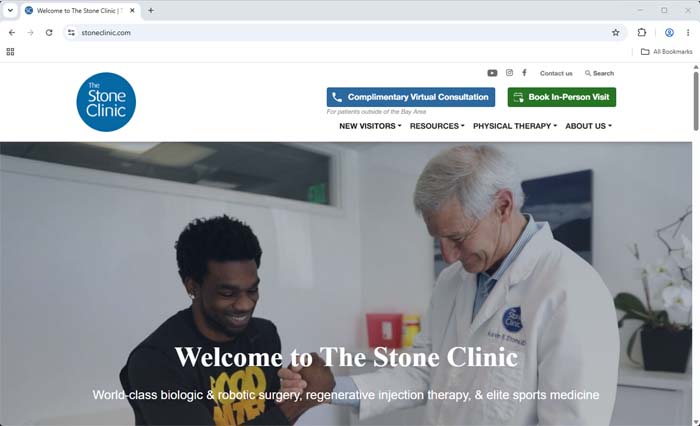
Sure. So 2 ways. One, individually, whenever I can help, I'm happy to help. We do a complimentary consult. If you go to stoneclinic.com, uh, /consults and upload your X-rays and MRI, we get on the phone with people every week to try to guide them on what the possibilities are that they could do with their injury. So One-on-one, I can— I'm glad to help. It's part of my mission in life, and, and that's what we do globally. I think the information about how to deal with injuries, how to avoid them, how to train, it's just getting so much better with the information explosion that I think it's worth it to put the effort in to look online, to ask the questions, to talk to a lot of people in, in Find the people that resonate with you because you'll do so much more and so much better if the doctor you're talking to, if the trainer you're talking to, if the coach you're talking to just resonates with you.
Dr. Kevin Stone [00:32:13]:
And so one thing I would say that we didn't mention as much before is we've talked about trainers and we've talked about nutrition and fitness and other things. Think about a coach, and a coach— by that I mean a life coach. You know, we all had great coaches and teachers in high school and college and other stages of our life. And then we got to be 50 and all of a sudden we didn't have any coaches anymore. We sort of forgot about those people. And yet, if you could reengage with a coach, with somebody who's looking not just at how many reps you can do, but hey, where are you in life? How are you thinking? How are you going to work? What, you know, what are your goals? What's your, what are your new goals? What's your new life like? What's 50 to 100 going to be like? You might find that there's things you just never thought about, and somebody else can help you get there, even if you might not be able to do it on your own.
Mike Capuzzi [00:33:03]:
I love it. I'll tell you, one of the biggest takeaways I've just taken away from just listening to you during our conversation is the permission to, you know, find a physician, a health team That does align with your bias. I think oftentimes we just go to the local doctor regardless, and maybe he or she resonates with you and has that same bias or doesn't. But I think that's really coming through, and I appreciate that. Dr. Stone, can you share, you've already done it, but if you don't mind just sharing again, where can my audience learn more about you, your nonprofit, your book? Just, you know, if you don't mind just listing the various avenues.
Dr. Kevin Stone [00:33:42]:
Sure. So I'm based at the Stone Clinic in San Francisco. So that's stoneclinic.com. Public Research Foundation at stoneresearch.org. The book Play Forever on Amazon, where everything else seems to be today. Um, yeah, those are the easiest places to find us, I think.
Mike Capuzzi [00:34:00]:
Very good. Very good. And Dr. Stone, before we leave, I have my Unstoppable After 50 trifecta. It's 3 quick questions, 3 quick answers. And I'm gonna tailor it for your specialty. So what's one hard truth that men over 50 need to hear about their joint health?
Dr. Kevin Stone [00:34:17]:
That motion is lotion. If you don't move 'em, they'll get stiffer and stiffer.
Mike Capuzzi [00:34:21]:
What is one thing guys are doing over 50 that's silently wrecking their joint health?
Dr. Kevin Stone [00:34:29]:
Alcohol. Alcohol is an incredible toxin that we just, We never really appreciated it. We all had cocktails, we all drank, we all had beers. We all loved, you know, the fun sociability of alcohol and how much lighter it made us feel or whatever. It turns out it's a really significant toxin and we're only appreciating it even though we've been told in the past, we just didn't listen. A guy over 50 will find that their heart rate and their heart rhythm is incredibly sensitive to alcohol. And anybody who has a, an atrial fibrillation, an atrial irregularity, any of the things that the cardiologists focus on, even small amounts of alcohol will upset those rhythms. And so what we're learning to a lot of our dismay is that even small amounts of alcohol are significant toxins.
Mike Capuzzi [00:35:27]:
And finally, Doctor, what's one thing, uh, every guy listening or watching us can do this week to be unstoppable?
Dr. Kevin Stone [00:35:36]:
Design your daily program to have daily exercise, not 3 days a week, every day. In that way, you'll become addicted to the endorphins, the testosterone, the adrenaline, and never ever exercise with a TV on, a book in front of you. Listen to your body, feel your sweat, feel your heart rate. Notice when you got to your limit and then push a little bit past it. And if you're distracted by other things, you won't notice.
Mike Capuzzi [00:36:07]:
Well, Dr. Stone, very enlightening conversation. I definitely appreciate it. Again, I appreciate your wisdom and all that you shared today. So thank you very much.
Dr. Kevin Stone [00:36:17]:
My pleasure. Great to talk with you.
Mike Capuzzi [00:36:18]:
Hey, I hope you enjoyed that conversation with Dr. Kevin Stone. I found it Very enlightening, very compelling, and I learned a lot. So by all means, check out his book. If you're in the San Francisco area, check out his practice or take him up on his consultation, his free consultation if you have joint issues. And by all means, you know, take advantage of that. And if you like what I'm doing here with Unstoppable After 50, please make sure you like and subscribe to the show. Go check out the YouTube channel.
Mike Capuzzi [00:36:48]:
Appreciate you subscribing there. And also make sure you check out unstoppableafter50.com and sign up for my weekly playbook. Every week I send a recap to my group of men who've asked for it, a PDF that's designed to be printed and saved. And it's a recap of that previous week's episode. So check out unstoppableafter50.com.


 Apple Podcasts
 Spotify
 Amazon Music
 YouTube
 iHeartRadio
 CastBox
 PocketCasts
 Deezer
 Podcast Addict
 Listen Notes
 Podchaser
 Player.fm
 Castro
 Goodpods
 RSS