Dr. Erik Schraga [00:00:27]:
And done in an exciting way. And so we don't need to necessarily look at something that no one else has been doing and it's something really novel, but rather what is it that we know works and how can we do it in a way that is sustainable and interesting to patients?
Mike Capuzzi [00:00:45]:
This is Unstoppable After 50, the podcast for men who refuse to slow down. Each week I share smart strategies and expert insights to help you stay strong, healthy, and unstoppable in the second half of life. Welcome back to Unstoppable After 50. This week's guest is Dr. Eric Schraga, a primary care physician who's also a concierge doctor based out of the Silicon Valley in California. And this is a very interesting conversation because Eric works with some very high-performing men, and we discuss what he sees in working with those types of guys, what he's seeing out there when it comes to longevity and performance. Topics that are important to both you and me. So stay tuned for an interesting conversation with Dr.
Mike Capuzzi [00:01:31]:
Eric Schraga. Dr. Schraga, welcome to the show.
Dr. Erik Schraga [00:01:35]:
Thanks, Mike Capuzzi. It's good to be on.
Mike Capuzzi [00:01:38]:
Eric, I appreciate your time today, and I appreciate what you're going to bring to my audience. Now, you are a primary care physician based out of California, and you see a lot of high-performing men that are, you know, trying to do everything right, you know, improve their longevity, improve their healthspan, But in your opinion, what are most men getting wrong, even the ones who think they figured it out?
Dr. Erik Schraga [00:02:06]:
Well, I think a lot of us, particularly as we approach 40 and then after 50, we find that, we find that we get stuck, right? We, whether or not that is in some health measurement or performance, fitness, weight, you feel stuck and you feel that your doctor is not really doing you any service to improve on that. And of course, so many of us have a hard time getting in with our doctor and everything that is done is relatively cookbook. And so we're not taking as much effort in speaking up for ourselves and what we need to do. And so taking some control and and having knowledge of what is important to be able to discuss with your doctor, I think, is key. And then the other part is that when you are feeling stuck is thinking that there's going to be an easy fix. And maybe it's the latest thing you heard about on Instagram, it's a fad, and that you think that the easy fixes are going to be significant when we know that— we all know what it is that works. It's just about doing it And, uh, and enjoying it and enjoying the journey.
Mike Capuzzi [00:03:23]:
Well, there's a couple things I want to unpack there, Eric. And first of all, I should clarify, you're a concierge physician, correct?
Dr. Erik Schraga [00:03:31]:
That's right.
Mike Capuzzi [00:03:32]:
Yeah, so I just had a CEO of a concierge medical practice out of Texas. So, you know, I think my listeners are at least— they're aware of what that means and the higher level of service you bring to your patients. Hey, Eric, ironically, Maybe 15 minutes before our interview today, I just got my box of advanced release copies of my latest book, which I titled Resilience Rituals. And the concept is it's 50 things that I do either on a daily or, you know, weekly basis that have really moved the needle for me. And to your point, a lot of them are very simple things. Like one of my daily rituals is waking up, the very first thing I put in my body is room temperature water, a little squeeze of lemon, and a dash of good quality minerals. salt just before I do anything else, right? Something simple. I've been doing it for a while now.
Dr. Erik Schraga [00:04:22]:
That's great.
Mike Capuzzi [00:04:23]:
Yeah, and it just, you know, it helps. And so I believe in simplicity. I think it's really important for guys to be consistent. They need simple things. So let's— we'll talk about that. And I want to open up with the idea of cardiovascular evaluations, cholesterol panels, because I know you've, you know, you have something to say about, you know, those 2 things as sort of starting points.
Dr. Erik Schraga [00:04:46]:
Yeah, I do. Um, but I, I just want to mention what you're saying about rituals in terms of advice. I think rituals are so important because when you think about working out, for example, my goal for people is that you, if you're not doing that ritual, that it feels harder to not do it than it is to do it. Right. So if feeling like getting into the gym is a struggle, then you're at the wrong point. It should feel to you that if you haven't gone in a couple of days and you don't go, you're— you just don't feel right. And, and look, it sounds like you have a lot of rituals yourself, but you could take that to dietary, is keep it simple. That if your breakfast is the same every day and you're not thinking, what am I going to eat today? You, you're going to do a better job of making good choices.
Dr. Erik Schraga [00:05:38]:
And so, um, sometimes boring is, is a good thing. Um, if We, we can find other ways of being exciting.
Mike Capuzzi [00:05:45]:
Yeah.
Dr. Erik Schraga [00:05:45]:
Right.
Mike Capuzzi [00:05:46]:
Well, let, let's dive into this a little bit deeper if we could, Eric. Yeah. Because my background is in marketing and copywriting and stuff like that for decades. And in copywriting world, in the marketing advertising world, we always say words matter. So just by that sort of mental shift, now I'm not saying it's like, you know, it's a profound concept that, you know, changing your wording to rituals, but it does convey something to you individually. A ritual is something you look forward to doing. It's something you wanna do, whereas a routine routine, even a habit, sort of doesn't have that connection. And to your point, you know, a lot of my rituals are simple rituals.
Mike Capuzzi [00:06:25]:
I mean, I eat chia seed pudding every morning. I make it fresh with my own fresh almond milk, my own homemade Greek yogurt. Again, these are other rituals I do, and I look forward to it. It's crazy. Whatever, you know, my big, my big difference is what berry am I— what berries am I putting it in that day. So You know, this concept in your own experience, Eric, why do you think— and again, we're going to focus on guys— why do you think guys tend to have— most guys have this challenge or this roadblock when it comes to adopting, let's call them rituals? Quick pause. If you're not getting my Unstoppable After 50 Playbook, you're missing out. Every week I send a 1-page playbook with my key interview takeaways and simple actions to help you stay strong, and in control.
Mike Capuzzi [00:07:13]:
Get it free each week at unstoppableafter50.com. Now back to the show.
Dr. Erik Schraga [00:07:18]:
Well, I think it's just our lives. It's our busy lives. And, you know, some of the people that I see that are the highest performance— or performers— are the most ritualistic. And to the degree that, you know, as I said, you, you have to have some fun, and there's other ways of making your life exciting. There's some people that are such high performers That, that is their excitement is just that performance as opposed to doing some fun things and cheating. And I think that we all should allow ourselves the ability to cheat, but in the areas that are important and that are hardest to maintain, that's where we need to be really ritualistic. And it's hard because life changes. And if you are traveling, That's a perfect example of an area where people struggle.
Dr. Erik Schraga [00:08:08]:
If you travel, you lose your rituals and you fall out of your routine. And, um, so it takes extra effort. And it may not be travel, it may be something else about your life, but we all have those. And if you're able to maintain those rituals 80 to 90% of the time, then the times that you aren't maintaining them are okay. You just get back on track. And getting back on track is the key.
Mike Capuzzi [00:08:40]:
Amen to that too. And that is the key, right? And get back on track as quick as possible because we both know once days become weeks, it gets harder and harder. And I am, you know, I've been through that many times over my 6 decades. Yeah, for sure, for sure. You know, I have unfortunately cardiovascular disease in my family. My dad, his brothers, you know, 2 younger brothers have passed away. He's still alive, but he's had a heart attack. He's actually getting some more stents put in shortly.
Mike Capuzzi [00:09:10]:
So I'm really— that's, you know, part of the impetus for myself really getting serious. I'd like to understand what a proactive cardiovascular evaluation looks like according to you.
Dr. Erik Schraga [00:09:24]:
Yeah, you bet. Well, first of all, it starts with your history, and family history is so important, knowing what your individual risks are. Luckily, we live in an age where now people aren't smoking, and that's nearly eliminated from the picture. But in those that have risk factors, that alone will change the picture of where your risk assessment should be. Okay, it's not all about cholesterol or imaging. It's largely that branch point of if you have risk factors of, say, diabetes, family history of heart disease, it completely changes how alert you need to be. And so in someone that has that known heart disease in the family, for example, it's very important that you are aggressive. And I listened to a recent podcast of yours where you had a guest that was talking about lowering cholesterol and what are the potential harms of that.
Dr. Erik Schraga [00:10:32]:
Well, we always have to weigh what the risks and the benefits are, and it is individualized. And that's a discussion that you have to have with your doctor about, let's not make this cookbook, but rather based on my history, What is it that I should do and how is that different than looking at a population? And I have the benefit as a concierge doctor of doing this with patients and really looking into it. Often the problem isn't your doctor, it's the system in which your doctor has to operate, which is that there are really quick appointments. They only have so much time to look into your history. And that goes back to taking ownership of your own health. So how does someone do that? How do you do that when you don't have a medical background? Look, we're in the age of AI, and the fact is that we— you could get a tremendous amount of knowledge and smarter questions. Okay, these are smarter questions you could take in with your doctor saying, look, I have put in all of my information. I have put that into, say, ChatGPT, and this is what ChatGPT says that I should do.
Dr. Erik Schraga [00:11:45]:
And if your doctor is threatened by that, then you might need a new doctor. Why? Because you are making yourself more self-aware. You're not telling your doctor how they should do things, but you have better questions. And these are great prompts for you to, from which to start.
Mike Capuzzi [00:12:04]:
First of all, I love that idea. You know, and I use AI all the time for various things. And I've got my annual physical coming up in September. And I hadn't even thought of that, to be honest with you, because my first reaction is he's going to be— he would be offended. And I'm not saying he would. But that was my first reaction. Like, you know, this is Dr. AI telling you this, you know.
Mike Capuzzi [00:12:27]:
So it's refreshing to hear your openness.
Dr. Erik Schraga [00:12:30]:
Yeah, you know, I think we have to be humble. And look, doctors often have a tendency to think that, that by being by you bringing information in that they're being threatened by it. My own experience is just what I said. People are coming with better questions. They're not coming from Dr. Google that gave them the list of the 20 bad things that could be happening to you. They're thoughtful questions. They are based on good data.
Dr. Erik Schraga [00:12:58]:
They're not always right, but they don't need to be right. They just need to be a starting point. And quite frankly, they They often are right.
Mike Capuzzi [00:13:07]:
You know, I— you may have heard on a past episode, because I've talked about it, you know, ad nauseam, that I've gotten very proactive about my own blood work. I just pay for my own blood work. Um, I joined Function Health, which is one I recommend. I'm not sure if you're familiar with it or not, but Dr. Mark Hyman. But, uh, it's, it's 2 extensive blood panels, uh, once a, you know, twice a year, and like 160 biomarkers is the first one. So I did that initially because I knew that the traditional cholesterol panels, in a lot of respects, is sort of antiquated data. And there's much better biomarkers you should be checking when it comes to cardiovascular health cholesterol.
Mike Capuzzi [00:13:47]:
Can you share some of those, Doctor?
Dr. Erik Schraga [00:13:50]:
Yeah, well, and even before I share those in particular, I will say that I was impressed with Function Health. One of my patients came in with Function Health. And when I looked at the readings, my concern was the same concern I have that the more tests you do, the more things that you have that are going to be abnormal just by chance alone. Okay. These, these values vary day to day. And if you do 200 tests just by chance alone, you're going to have some abnormalities. And so if you find out that your serum, serum magne— magnesium level is low, does that mean, oh gosh, that's the source of all my problems? Probably not. Um, but I was really impressed with how it did not overstate any abnormalities.
Dr. Erik Schraga [00:14:36]:
Clearly, the impressions that it gave were done by AI. These— and but yet it actually did a good job of putting them in perspective and saying this is slightly abnormal, but this is not likely the sign of disease. It may just be a mild deficiency and you could recheck this. And so I was impressed by that. When you're talking about lipids in particular, this is a really important area that I've seen blow up in the last 5 to 10 years, which is recognition that not all lipid tests are the same. Usually what you're getting is you're getting estimates, and you're getting estimates that are based off of your HDL levels, and you're looking at the serum concentration. Um, as opposed to the particle size, the type of particles that you're dealing with. Without getting into too much details, the type of particle we, we know about HDL and LDL, and what these are is these are not themselves cholesterol, but rather the containers that carry around cholesterol.
Dr. Erik Schraga [00:15:44]:
Those containers can be atherogenic, they can cause disease, or they can be helpful. And there's a spectrum there. The ApoB test is one that I'm sure you're familiar with from the testing that you've done, is a fantastic test that everyone should do, at least everyone over the age of 50. Why does it matter? Because that is an actual calculation of the atherogenic, the pathologic particles. And just by that one test alone, you have a much better idea of what of whether or not you have the, quote, bad cholesterol. Cholesterol itself is not bad, but the, the containers for it can be, uh, when too high. And the other one that I recommend that everyone do once in their life is the Lp. Again, this is an independent, uh, risk factor for coronary disease.
Dr. Erik Schraga [00:16:38]:
I will see patients that have borderline high cholesterol, but high Lp, and will have very early coronary disease. If your test is normal, you never have to check it again. And if it is high, why do we care? Well, unfortunately, we don't currently have a medication that could specifically treat that, but we can target the areas that are actionable to reduce the overall risk. And soon we will have a medication to target that.
Mike Capuzzi [00:17:10]:
Yeah, I've gotten, I've gotten those tests. And I think, you know, to your point, you're 100% Right. I mean, there's so much data with Function Health, it can get intimidating. And you're right, just by the sheer number, the odds of you being 100% in the green, which is the positive results, is pretty slim. But what I've noticed, and I think what you'd probably concur with, is it's about trends, right? I think I'm going into my 4th year with Function Health. I joined at the very beginning. So now I have years of data that I can see the trends. Um, and, and really kind of watch that.
Mike Capuzzi [00:17:47]:
And just by my own nature, I, I like data. I like having the numbers. It's fairly inexpensive and it's something I just keep beating because I still think there's a lot of guys don't realize you can. Now, if they're working with a, you know, a concierge physician like you who's aware of this, they're probably getting it as part of that package that you offer. But for a guy to go out and just, you know, get his own through Function Health or someone else, it's pretty simple. So. Yeah.
Dr. Erik Schraga [00:18:12]:
Yeah, it really is. And it's, it's relatively inexpensive. It's certainly less expensive than a concierge physician. And so, if you, if you are able to use that as a starting point of, um, of introducing this information to your doctor, I think it should be welcomed.
Mike Capuzzi [00:18:31]:
Yeah, for sure. And, and there, there's, first of all, there's, again, I know you live and breathe it, but there have been more and more of these testing companies opening up, some with AI back, you know, backends like Function Health. I think Function Health is now off— I just got something recently. They're, I think they're offering some real live doctor input now. So, but yeah, obviously working with someone like yourself who has the awareness, has the testing, and then obviously the most important part, which is being able to analyze that because I'm pretty smart with this stuff and it's still pretty confusing.
Dr. Erik Schraga [00:19:03]:
So, uh, Well, again, that's, that's another good place for AI. You can upload that there. There are systems now. I'm going to put myself out of business here, Mike Capuzzi, aren't I? The, the, the— but there are HIPAA-compliant versions now of the popular LLM models. And so you can upload that data. In fact, you could upload all of your data. And so when you have these discussions, it'll be based on whatever it is that you upload, and it's quite intelligent on, on how that works.
Mike Capuzzi [00:19:37]:
Can we go down there, just down that path for a moment? Because I know ChatGPT, I signed up for the beta test. I have not heard back, but there's something called ChatGPT Health that they're going to start beta testing. I, maybe you're okay, so you might be aware of it. I haven't gotten anything back yet about it being opened, but, um, I was very hesitant to even upload my data. I'm still a little weird like that, even though I use it all the time, AI. Are you yourself using it, at least for yourself, Eric? Or like, it sounds like you really are open-minded and you embrace the technology for what it is. What it just— what do you, what do you foresee? You know, here it is, 2026, the next couple of years. What do you think is coming when it comes to consumer-level help and advancement regarding health?
Dr. Erik Schraga [00:20:20]:
Well, I think it'll bring more thoughtful it'll bring more thought to some of the harder questions that we deal with. And part of why I'm pushing for this is because not everyone can have a concierge doctor, and we're only being strained more and more in the health system. And so you can, by using these models, I think that you could be much more informed And you can have better questions and access to taking control of your own health. And so I think that that is a big part of how the average person can get higher quality health is by doing just that. Obviously, that doesn't mean that you're going to get a physical exam by AI anytime soon, and you're not going to get surgery anytime soon. AI. But when it comes to knowledge, there's much more there. And it can also be translated both to your level of understanding and even to your language.
Dr. Erik Schraga [00:21:38]:
And so I think it's really just broadening how many people we can reach. And I think that's wonderful.
Mike Capuzzi [00:21:47]:
Yeah, yeah, for sure. Eric, I know you You know, there's a lot of high-caliber patients, and again, we'll— let's— we'll focus on guys. I'd love to hear some of your real-world experience. What are you seeing, whether they're rituals, whether they are belief systems? What do you see characterize some of your best patients when it comes to, you know, really being unstoppable and living that second half of life?
Dr. Erik Schraga [00:22:22]:
Well, I think that even though my patients are, are what you may call the, the Silicon Valley elite, they're really no different in what they've been through compared to any of us, which is that we worked our butts off and we went through our 20s having fun, 30s building a family, 40s saying, where did my 30s go? And you hit 50 and you say, oh shoot, this is when my dad had so-and-so problem. Oh wait, my blood pressure's high. Oh, that's right. I remember when I was a kid, my mom having this problem and it just jumps up on, on you and you realize what you'd been doing over the last 20 years was not likely the best. for your health, and did you blow it, right? Did you lose all of this time? And hopefully you didn't, but even if you did, you can make some dramatic changes. You can stop heart disease in its track. You could start— you could stop worsening your risk of stroke, and 50 is not too late. And so I think that's what's important is recognizing that it is never too late to get started with good rituals and taking control of your health.
Dr. Erik Schraga [00:23:45]:
And that's really what I'm seeing on a day-to-day basis, are people saying, okay, I'm ready for my health now. And hopefully some people listen before age 50. But hey, we're all in the same boat, including myself, where, you know, you, you have to take time for yourself and make sure you're there for your kids and your grandkids.
Mike Capuzzi [00:24:07]:
You know, I've shared this, um, again, probably more, more often than I probably should, but my primary care physician who I went to since I was in high school retired a few years ago. And he was great. I was so upset he had to retire. He would write every, on every physical that I would do, annual physical, he'd write, cut the carbs. Nope. Less pasta, less bread. Right? And he would just handwrite it on there. And he's like, 'cause he, you know, he knew my background, my family background, and probably my numbers too.
Mike Capuzzi [00:24:38]:
And I kept like, okay, okay. And boy, wasn't he right? You know, going back to that simple— that just that simple advice, you know, cutting the carbs, cutting the bread, cutting the pasta, which for someone who's half Italian, it's not the easiest. And, uh, gosh darn, I can just remember him handwriting that all the time to me. Um, so what about the inverse of that, Eric? Uh, in this day, you know, you mentioned, you know, thankfully most people aren't smoking these days. But where do you, where do you see guys kind of messing up? Like, you know, what are some of the fundamental things you, you know, guys should be aware of or reminded of not to do or shouldn't do as much of?
Dr. Erik Schraga [00:25:20]:
Well, the first thing is, is doing all of this now. It's not waiting until you have problems before you, before you really look into this. It's do it now. I don't care what age you are. It's do it now. And then be consistent with it, whether or not that's with your doctor's appointments or your labs, but with the rituals that you talk about. In fact, I— you've already converted me. I was going to say habits, but I'm going to say rituals.
Dr. Erik Schraga [00:25:51]:
It is to start and not be afraid of what starting looks like. I was just talking to a patient about this, in fact, about the idea that they are lucky to be in the place that they don't lift weights. Why are they lucky? Because their gains could be so much more percentage-wise. How exciting it is. You're going to feel that. You're going to feel the pain. Skip the embarrassment. Who cares that you aren't lifting the bar initially or whatever it is? Just go in and do it.
Dr. Erik Schraga [00:26:21]:
And how exciting that is that you can gain 40% in strength in the early days. Those of us that have been doing this for years and years, you're pretty excited to get a 5% increase if you're doing it 4 days a week. You're not going to get that. And so this is the exciting period. And so think about it in those terms, get excited about it and do it and get a trainer. Do it in a way that, yeah, there may be pain there. It may be hard initially. But that's part of the journey, and to see yourself transform is exciting, and that should be part of the excitement.
Dr. Erik Schraga [00:27:00]:
But do it in a way that it's fun for you. If that means Pilates, if that means CrossFit, find your place that will draw you back in to keep doing it, and then you'll be consistent. And I truly believe that. And don't, don't let your busy life be an excuse.
Mike Capuzzi [00:27:18]:
And I think the other thing that's really important about that, Eric, and this is, again, I'm just talking about my own experience. I used to walk with a buddy of mine. He would walk 6 miles every day, rain, snow, it didn't matter. Every day he was doing 6 miles.
Dr. Erik Schraga [00:27:32]:
Mm-hmm.
Mike Capuzzi [00:27:32]:
And I would walk maybe 2 or 3 days with him. This is like 10 years ago. And I, and I'm like, his name was Matt. I'm like, Matt, I don't know how you do it. Like, you're like Superman. I could never, I would say I could never do this. Well, here we are in 2026. I've, I've walked 10,000 steps a day for 5 years.
Mike Capuzzi [00:27:50]:
I think I've missed under 10 days of missing 10,000 steps in 5 years. My point is, don't let head trash like, oh, I could never do that. I could never lift 3 days a week, or I could never walk every day or whatever. From my own experience, I said that kind of stuff. And if you told me 5, 6 years ago, I was walking every day. And most of the time with my wife, which is enhancing our marriage and our dog. Um, not my marriage to my dog, but my dog's health. But, uh, you know, I would've never guessed it.
Mike Capuzzi [00:28:23]:
And I think, again, I think guys, it's so easy for us to say, well, you know, I can do that. I can't do that. But, um, great advice. Yeah.
Dr. Erik Schraga [00:28:31]:
And also just often we talk about, hey, doing something's better than not doing anything. And I do think that's true. You do have to start somewhere. But set goals that are realistic and that, that will drive you. Don't set your goal as being, okay, I'm just going to start walking. No, that could be the first step, but going on walks is not going to be enough. You— I want you to have higher goals, and, and everyone within their capabilities should have those goals. And believe in yourself.
Mike Capuzzi [00:29:02]:
For sure. That's, again, again, these are all like individual conversations we could have, but just going Right. Starting is one thing. And I made the mistake even relatively recently about not being intense enough. Now I'm doing incline walking on a treadmill a couple times a week. I've added an air bike, which, I don't know if you've ever used one of those, that's a whole other level.
Dr. Erik Schraga [00:29:20]:
Those are rough.
Mike Capuzzi [00:29:21]:
Oh my, it's a torture device I love now.
Dr. Erik Schraga [00:29:24]:
Yeah, they're brutal.
Mike Capuzzi [00:29:25]:
Again, a couple months ago, oof. One of the things personally I'm still working on, and I know you've talked about it, is sleep. and the importance of sleep and really sleep as a performance tool, I think is what you said, which I really like that kind of terminology. You also mentioned there's some newer generations of sleep medication. So I'm not sure, I'd like to go a little deeper there. I'm not, I hate even taking an over-the-counter, you know, once in a while, like a Unisom once in a while, but, you know, I try supplements, you know, I try more the more natural way, but why don't we talk about sleep, the importance of it, which I think we all are aware of, but then what is going on in your world of sleep sleep as far as what you're seeing?
Dr. Erik Schraga [00:30:05]:
Yeah, well, you know, when it comes to pills, um, in the article I wrote regarding these newer class, uh, of sleep medications, it is largely to get away from what we're already doing with pills, um, with medications. And the reason for that is that we're seeing that it— these medications aren't just having immediate side effects in terms of feeling groggy in the morning, having a dry mouth, or forgetting that you ordered $500 of junk on Amazon, but rather the, the long-term effects of cognitive decline. And nearly any medication that you might mention is likely to be in, in that boat. So whether or not it's Benadryl, Unisom, Zolpidem, which is Ambien, you name it, these are contributing to cognitive decline. We have good evidence of that now. So the newer class of medications, the DORAs, they are not having that effect. There's some thought that it actually has a neuroprotective effect. Now, I don't mean that to be, wow, it has a neuroprotective effect, everyone should be on it.
Dr. Erik Schraga [00:31:22]:
No, we still want you to have the best sleep architecture that you have. The best sleep architecture you could have is by not being on medication. And so the foundation for better sleep should be habits. And when it comes to habits, it is again the basics, but you may not be doing them, of not being on your screen before sleep. It's not eating before sleep, reducing if not eliminating alcohol. Even if you're drinking 3 hours, 4 hours before, it's going to have effects on your sleep. And then beyond that is cognitive behavioral therapy. Now, it's— I often like to quote one of my favorite books, The Hard Things About Hard Things, is that, look, we don't want to seek the measures that we know are going to be hard.
Dr. Erik Schraga [00:32:21]:
But the hard things are hard for a reason, and that's that they work. And so if you are taking the measures of improving your sleep by using something like cognitive behavioral therapy, it is lasting and it's effective. And nowadays there's apps that you could use that are inexpensive to help with that. But getting a bit more into why this does matter, you mentioned the idea of what is it that we're now doing? What have we been doing wrong? What we've been doing wrong is wearing it as a badge of honor to not sleep. Right? That if you didn't sleep before and you woke up early, um, to get to work and you went to bed late, that means that you were pushing harder. That means that you are stronger and better. Well, I'm here to tell you that you're not stronger. You're not better because of it.
Dr. Erik Schraga [00:33:10]:
You're making yourself weaker. Okay? This is— sleep is a non-negotiable. You have to sleep well. Otherwise, you will not perform as well. You're more likely to eat more and gain weight. The effectiveness of your workouts isn't as good. You're not going to be sharp. So in no ways does that make you a stronger person.
Dr. Erik Schraga [00:33:30]:
So sleep needs to be absolutely one of the top 4 or 5 foundations of better health.
Mike Capuzzi [00:33:37]:
Gosh, again, I just, I just had a sleep expert on. The episode hasn't dropped yet. It's something that can be so elusive, as we all know. And it— and that particular foundation principle, and then the other one that I actually— I'll just ask this question. Something I'm seeing more and more of, Eric, as far as this concept of longevity, right? We know strength, diet, sleep— is relationships, the quality of relationships. Any, any comments on that before we wrap up?
Dr. Erik Schraga [00:34:08]:
Uh, such a good point. Um, I— especially as we get older, um, speaking of cognitive decline, I think it's one of the key components of avoiding not just cognitive decline, but decline in general, is losing those social outlets. Mental health, we have treated as a weakness for too long, and it is not a weakness. It is something that so many of us deal with, whether or not it's depression, anxiety. They've become rampant, and those social networks are so key in reducing the effects of it. It doesn't mean it's going to eliminate anxiety, It doesn't mean that it's going to eliminate the declines that will happen to our minds over decades, but it'll significantly reduce them. And quite frankly, it just makes life better. So, I applaud you for bringing that up because it is so important.
Mike Capuzzi [00:35:01]:
Well, again, I think it's so easy. Again, I'm speaking to myself here as guys over 50 to sort of say, you know, focus on the weightlifting and focus on the things that we grew up with. But relationships, you know, kind of like sleep, it's not something we can think about. But it is part of the longevity equation. And I appreciate, Eric, you know, the insights that you bring and have brought to this conversation. Before we wrap up, can you share with my audience if they want to learn more about you, if they happen to be in California and want to, you know, potentially work with you, describe how they can connect with you and any ways they can get more from you?
Dr. Erik Schraga [00:35:38]:
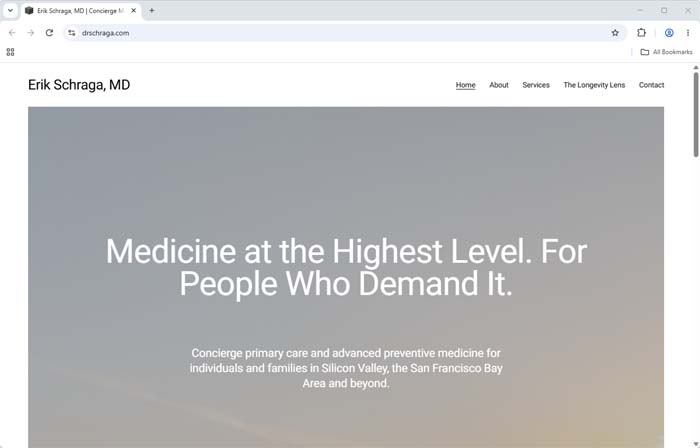
Yeah, you bet. The best way to connect with me is on my website at drshiraga.com, and that's because it really covers the broad range of what I do. And my practice here at Crescendo MD in Portola Valley is, is my actual practice. We are a very small practice with a limited number of patients, but I love to have these discussions and, and talk to people about their own lives and going through Dr. sharga.com is a good way of doing that. And also I have a blog on that, uh, on that website. And, um, uh, also on LinkedIn, I do smaller, um, tidbits of, of ways to improve your life and just general thoughts I have on medicine.
Mike Capuzzi [00:36:26]:
And Eric, before we leave, we have my, uh, Unstoppable After 50 trifecta. It's 3 quick questions, 3 quick answers. So what is one cold hard truth guys over 50 need to hear from you?
Dr. Erik Schraga [00:36:38]:
That you're aging and you're not stopping it. Um, the, the concept of anti-aging, I think, is a, is, um, an interesting one. Um, we're using things like time clocks and this and that. Look, the, the idea is not whether or not we're aging, but whether or not we're aging well and whether or not we are reversing the damage that we have done, whether or not we are taking the right measures to stay strong, to minimize the effects of aging. And you just, you do your best and, um, and stay well as long as you can. And, uh, you've got this.
Mike Capuzzi [00:37:12]:
What's one thing you think most men are doing right now that's quietly wrecking their future?
Dr. Erik Schraga [00:37:19]:
They're not looking at their future. Um, they're, they're waiting there that next year is the right time to do it. There is no right time to get started with healthy habits and rituals. Start now and create new rituals. Make yourself a new person. I don't care where you are in your health and fitness journey. You can always make another step forward at improving yourself and make it fun for yourself. Make it exciting and, uh, and believe in yourself.
Mike Capuzzi [00:37:50]:
And finally, what's one thing guys can do starting this week to be unstoppable?
Dr. Erik Schraga [00:37:56]:
So I think the first thing is Of the areas that we talked about, where is it that you are lacking? We all have one. None of us are truly bulletproof, and we have an area where we just don't want to do it. We don't think we can do it. And, and take it on as a challenge. Make it your, your short-term goal and, and also have your long-term goals, but set those goals, write them down. And tell your friends, tell your family that you're doing it. So, make sure that someone is holding you to it. Things that you want for yourself are the things that you announce.
Dr. Erik Schraga [00:38:35]:
And by sharing with others, I think that you'll get nothing but encouragement.
Mike Capuzzi [00:38:41]:
Very good. Well, Eric, thank you for the wisdom. Thank you for the advice and definitely appreciate your time today.
Dr. Erik Schraga [00:38:48]:
Absolutely, Mike Capuzzi. It was really a pleasure getting to talk with you.
Mike Capuzzi [00:38:50]:
Hey, I hope you enjoyed that conversation with Dr. Eric Schrock. I hope you found some useful advice. If you're in California, by all means check out his concierge practice. And if you like what I'm doing here with Unstoppable After 50, please make sure you like and subscribe to the show. Go check out the YouTube channel. Appreciate you subscribing there. And also make sure you check out unstoppableafter50.com and sign up for my weekly playbook.
Mike Capuzzi [00:39:17]:
Every week I send a recap to my group of men who've asked for it, a PDF that's designed to be printed and saved, and it's a recap of that previous week's episode. So check out unstoppableafter50.com.


 Apple Podcasts
 Spotify
 Amazon Music
 YouTube
 iHeartRadio
 CastBox
 PocketCasts
 Deezer
 Podcast Addict
 Listen Notes
 Podchaser
 Player.fm
 Castro
 Goodpods
 RSS