Dr. David Phelps [00:00:00]:
What I realized was that success doesn't automatically create what I call freedom. And freedom for me is having choices. It's having optionality. It doesn't mean you're retired. It doesn't mean you don't have responsibilities. It really means you get to choose. And we work many times so hard in our lives for trying to reach some definition of success. But many times reaching that success creates a lot of dependency on us and dependency that restricts our freedom and optionality.
Mike Capuzzi [00:00:27]:
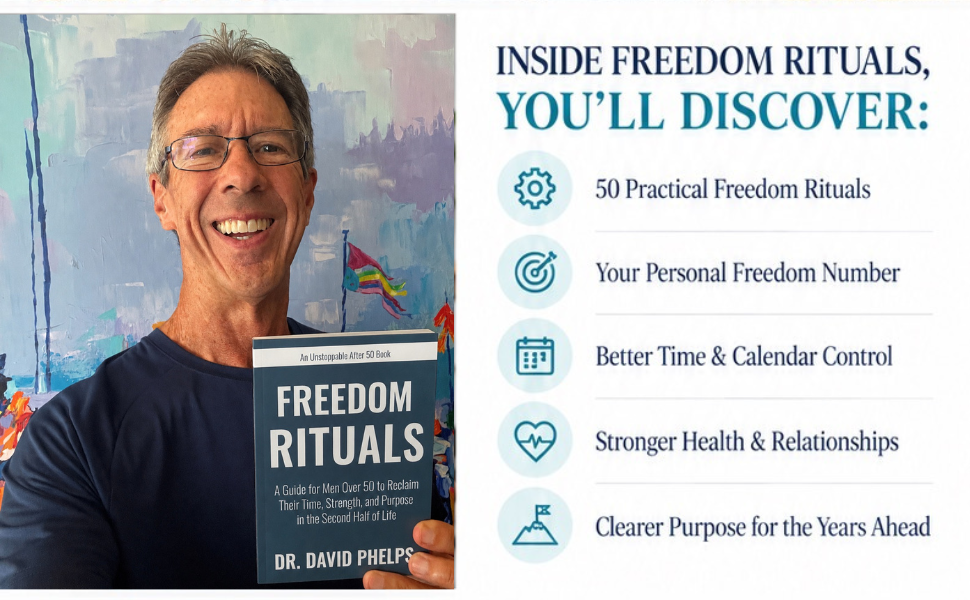
This is Unstoppable After 50, the podcast for men who refuse to slow down. Each week, I share smart strategies and expert insights to help you stay strong, healthy, and unstoppable in the second half of life. Welcome back to Unstoppable After 50. Today's episode is a bit different. It's a shorter episode. It's with my friend, Dr. David Phelps. And I'm— I've asked David to come on today because he just published his book, Freedom Rituals, which is the 3rd book in my Unstoppable After 50 series.
Mike Capuzzi [00:00:58]:
And hopefully there'll be more in the future. Now, Freedom Rituals is 50 rituals David has created for himself that he's sharing with men over 50 to create more freedom and more what he calls optionality in the second half of life. It's really a different way of thinking, not about retirement, but what is next in your life. So stay tuned for a short but powerful conversation. with Dr. David Phelps. Hey, David, welcome back to Unstoppable After 50.
Dr. David Phelps [00:01:29]:
Mike Capuzzi, it's a pleasure. It's great to be back with you.
Mike Capuzzi [00:01:31]:
Congratulations. Last time we spoke, this was just an idea. In passing, I made mention of a book I was working on, Resilience Rituals. You liked the concept, and here a couple months later, Freedom Rituals exists. So congratulations, and I truly appreciate you know, what you've shared in this book, because it's just so important. So thank you again.
Dr. David Phelps [00:01:56]:
Well, it was a pleasure. And as we've spoken previously, it brought forth a lot of the concepts and aspects of life that I didn't figure out all at once, but just an accumulation, right, of things that I see in my own life. And giving this back to other people is, I think, a real honor, real privilege. It is.
Mike Capuzzi [00:02:15]:
It is. And it's important, right? I mean, listen, you are known, you've built this brand, Freedom Founders. Your goal at this phase in your life is helping people who are, you know, kind of in that second half of life create more freedom. And I'd love you to share, David, with my audience, why is this such an important topic for you? I mean, you don't have to be doing this. You want to be doing this. Why?
Dr. David Phelps [00:02:43]:
Well, Mike Capuzzi, I spent the first half of my life, like I think most ambitious men, you know, starting a family, building a family, a career. businesses, accumulating assets, investments, just being a prodigious person. And there's nothing wrong with that. But what I realized was that success doesn't automatically create what I call freedom. And freedom for me is having choices. It's having optionality. It doesn't mean you're retired. It doesn't mean you don't have responsibilities.
Dr. David Phelps [00:03:14]:
It really means you get to choose. And we work many times so hard in our lives, for trying to reach some definition of success. But many times reaching that success creates a lot of dependency on us and dependency that restricts our freedom and optionality. And I really figured this out big time when my daughter Jenna, this is over 20 years ago, was very sick in the hospital. And I realized that all of the wisdom I'd accumulated through academics and my career and just building up investments in real estate and my practice, None of that made any difference if I couldn't spend time with her. And that's when I realized that success doesn't breed freedom automatically. So I think really it's really about, can your success allow you to be present, really present, not just physically, but emotionally also present at times with the people when you really want to be? And to me, that was one of the keys.
Mike Capuzzi [00:04:11]:
In working with you for the book and even knowing what you did prior to that, I was a guest on your podcast. You were a guest on my podcast previously. This concept of optionality, it just makes so much sense. And it's, you know, at first blush, you kind of think, what does he mean by that? But that really is, in my— and I agree 100%, like that is the definition of freedom. When you have the option of whether it's writing a book, donating time, whatever it might be, to have that optionality, it's such a, such a, you know, strong and important goal. And, You've made it your life's mission at this point to help people, men and women, and you've helped hundreds, if not thousands of them. David, share for my audience some of the mistakes you see people making as they start entering this phase of life and maybe not really having this concept of optionality and freedom front and center.
Dr. David Phelps [00:05:09]:
I think one of the biggest mistakes, and Mike Capuzzi, I was making it all along, is never defining how much is enough. How much is enough? How much do I need to provide the lifestyle, the security for my family? Now, that number is going to change. It will change. But not having a target for certain points in life, for us that are drivers, and I had a small group this weekend I was working with, and it was so fun because I got to see through the eyes of some younger people, couples, but again, drivers. And just giving them the essence that if you don't have a target for how much is enough during different points in your life, you'll keep driving. You'll just keep pushing and pushing it, what I call someday syndrome. Well, someday when I get to this point where my business is a certain size, a certain revenue stream, maybe I have a certain net worth, whatever it might be, but we hit these targets and then we just push it further. We just, we push the finish line further.
Dr. David Phelps [00:06:03]:
So, not defining how much is enough. is a critical aspect. And few of us do it. Few of us do it until we get to the time when we think we're going to retire. So, that's the first one. The second one is, as I said a minute ago, it's really confusing one's net worth with freedom. Someone can have a large balance sheet, but if that balance sheet is not producing what I call replacement income, then that equity, that balance sheet, you're trapped. So, it's one thing to accumulate, But turning that into replacement income so you have the optionality is the other aspect.
Dr. David Phelps [00:06:37]:
Something you and I talked a lot about, Mike Capuzzi, because we both are very fervent about this, but putting off maintaining our health. You can have all the freedom in the world and have enough money to do what you want to do, but if you don't have your health, what good is all that? And so, a big part of my life, but also trying to help younger people who maybe don't have health problems today is the rituals. And I want to use that word ritual because the rituals we develop early in life are what's going to carry the flag for us down the road. And we don't realize that when we're young because when you're young, your body's usually pretty adaptable and you can get by with low sleep and eating fast food and all the stuff that we typically do. But again, a ritual is more than a habit. And that's something I want to talk a little bit to you about too. I think the last piece, Mike Capuzzi, is a mistake is not designing what's going to come next after you evolve or transition. Again, I hate the word retirement.
Dr. David Phelps [00:07:33]:
I'm all about evolving in life, evolving in business, evolving in the responsibilities and who you do those with and why you do them. And if you're not designing what those next stages look like, you can come to an impasse and think, well, all my identity has been tied up in this long business or career I've had, and it's been wonderful in many respects, but Gee, I'll be lost without it. So, you've got to be designing ahead because that's a place where people get stuck many, many times.
Mike Capuzzi [00:07:58]:
Yeah, I would think, and I know people, and I'm probably trying to watch the trap myself, is yes, especially guys, right? We so wrap ourselves up. I mean, like you mentioned, for decades, we're hard charging, providing for our family, whatever it might be, building a business. Being a great employee, climbing the corporate ladder, whatever it might be. And then all of a sudden, you realize, like, whether they're retired or they're just thinking about that next phase of life, and so much of their identity is wrapped up in what they do. And another phrase that I've heard recently, and I'm sure you've heard it ad nauseam, is you never retire from something, you retire to something.
Dr. David Phelps [00:08:43]:
To something, right.
Mike Capuzzi [00:08:44]:
Right. And again, it's a subtle wordplay, but it makes so much sense. David, if you could go back, and you mentioned young people, and you're right, both of us have a heart for young folks and really trying to guide them. If you could go back, you know, 30, 40 years ago, and you're talking to young David Phelps, even before he was Dr. David Phelps, how would you share this concept of freedom? What would you say to him?
Dr. David Phelps [00:09:19]:
What I find is really important, assuming that most of us marry, we have partners for life that we commit to. It's very important to get on the same page with that partner. It's easy to start a life as an early man, as a couple. and have the excitement of what that's gonna be with family and careers. But it's so easy to get off track from what the real purpose is. And I saw it in my own life, I see it in others. Again, good people with good intentions, but not having the conversation with a spouse. And many times that has to be facilitated.
Dr. David Phelps [00:10:01]:
It's just, it's not an easy thing to do. And I'm not necessarily talking about counseling per se, but there's a form of just having facilitated conversations when you're young, with that person that you've chosen to spend your life with, to create that family. And if you don't do that, then it's easy to get off track. So, that's probably a primary. And doing it with some— doing that conversation with somebody else who has the experience and the wisdom of decades ahead. We talk about mentors, people that we've learned from. And I think that's another aspect that maybe at a young age, we don't put as much time in that because we're working on a specific goal for education or licensing or certification. And that has certain metrics to it, but it doesn't paint the big picture.
Dr. David Phelps [00:10:42]:
So, I think just being in a place where you're having conversations with the person who's most important in your life and doing that with other people, it could be other couples, but other facilitators who have taken that path already and can just see back into you and give you some constructs, some rituals that you can start to practice. early on and build a pathway that's built on really design that you and your spouse had from the very beginning.
Mike Capuzzi [00:11:12]:
Yeah. Just out of curiosity, one of the things I share with a lot of young folks, it's sort of my slogan when I'm walking, when I meet them at a restaurant and a young waiter or waitress, I just can't help myself. This idea, and I think both of you and I can appreciate this given where we are in life, like it goes fast. I mean, it really goes fast. And I can recall having wisdom shared with me 30 years ago, and I'm thinking, okay, whatever. I've got decades ahead of me. I'm okay. I'm okay.
Mike Capuzzi [00:11:49]:
And then you blink and you're there, right? Just any practical advice, David? I know it's a little off topic, but I just, I'd love to hear because, you know, you mentor a lot of folks, you work with a lot of folks that mentor others. What would be sort of a, you know, just your experience with the reality that time goes fast and now wherever you are is the time to start?
Dr. David Phelps [00:12:16]:
Yeah, that's, that's exactly right. It's never too late to start putting in some practices that will provide you the freedom maybe you always aspire to have. So, Again, I think looking through the lens of how much is enough for a particular season, I don't want to reduce the ambition or the aspirations of young people, not at all, not at all. But I look through the lens of the 5 freedoms, which is in the book. And the financial aspect is what we all focus on early on in life. We have debt to pay off. We're trying to build something and build for our family. So, the financial aspect is important, but the other 4 freedoms, Which are time freedom, relationship freedom, health freedom, and freedom of purpose.
Dr. David Phelps [00:12:59]:
They're all interconnected. And many times I think we focus so hard on the financial aspect that we don't realize that we're abdicating some focus at the same time on the other 4. And that's just my lens. But if you look at that lens, it's pretty comprehensive because relationships can go into spiritual and faith. And I'm hugely a part of that. But for each person, the lens of those 5 freedoms, If they can be worked on simultaneously while still feeling like you're on good progress with the financial, that's where I believe that a more holistic life can be imparted even at a young age, not waiting for this mystical someday when I get all these things right because, again, I rarely see that happen. There has to be intention behind the purpose and mission. And I just want more people to be able to have that for themselves, for the family, for the people they care about.
Dr. David Phelps [00:13:47]:
In the long run, the memories are really about the people, the people in our families, our spouses, and the people we serve in whatever capacity we did. That's where the real feeling of satisfaction comes from. The money is necessary. It's a side effect of all this. But really, as I look at my life, and I know you do the same thing, I look back, really, it's about being present for the key moments in life. Was I able to be there? And where was I not? And what can I do better going forward?
Mike Capuzzi [00:14:17]:
Amen to that. So, you've mentioned rituals. And, of course, that's the title of your book, Freedom Rituals. And, my book is Resilience Rituals. And, I had this concept. It was funny because, again, we were having— I was either on your podcast, I think it was when I was on your podcast, I had just in passing mentioned this concept of rituals and why I was such a fan of sort of the shift in my own language and the way I think about either habits or routines or workouts, very traditional language, and trying to up my game by creating rituals, right? A habit's something you do, a ritual is part of who you are. And it's a really great concept when you think about it. And just hearing you talk now, Dave, I'm like, shoot, there's a perfect book.
Mike Capuzzi [00:15:00]:
Like, I'm targeting guys over 50, but shoot, how cool would it be to have a book for the 20-year-old You know, guy or gal and trying to encourage them to create rituals, because I don't think you're really thinking that way at that age. So what was it about this concept of rituals? And why do you think, you know, why did you go through the effort? Because it was an effort, not a huge one, but it was still an effort to share the 50 freedom rituals that you write about in your book.
Dr. David Phelps [00:15:27]:
Well, as you said, I thought very quickly when we had that conversation, Mike Capuzzi, What is the difference between a ritual and a habit or practice? And I think this is the key. Habits are things that we do that could be good or bad. Someone could just have a habit of biting their fingernails.
Mike Capuzzi [00:15:47]:
Well, right.
Dr. David Phelps [00:15:48]:
I mean, or just a habit of maybe waking up in the morning and just quickly going to their phone. Now, I'm not saying that's good or bad, but a habit is just something we just get into a routine of just doing. Okay. A practice is something that we do typically to improve. And that's usually a good thing, right? I want to improve my tennis game, right? I want to improve it. So, I practice to improve something. But you just said it, ritual has to do with our identity. I think a ritual is something that we— it is a habit, it's a routine, but it's based on who we want to become.
Dr. David Phelps [00:16:26]:
I think becoming A person that we, we feel like we, we speak about, like our values, right? We all speak about values, but a ritual is really what I think connects what values we want to really live our life out and actually connecting it to doing it. For example, I could say family is the most important thing in my life, but go look at the calendar. Does my calendar prove that? If it doesn't, then maybe a ritual. is blocking certain times on the calendar for different people that are important in my life that I haven't been doing. I've been talking about it. I want to do that. It seems like the right thing to do, but I haven't been doing it. So, that's where I think a ritual comes into play.
Dr. David Phelps [00:17:07]:
And it's not just a habit and it's not a practice to improve, but it's about our identity. What are really the values that we want to connect to who we are and how do we make those happen?
Mike Capuzzi [00:17:19]:
Yeah. And, you know, as I've kind of gone through my own evolution of thinking this way, It becomes, it's like part of your fabric, right? It's just part of you, who you are as a person. And that's the goal. And that's why, and I, I like it. I thank you, David. You just gave me another little nugget, which is you're right. I never, I've written about, you know, habits and how I've kind of moved on to rituals where I can, but I never thought about there are bad habits, right? There aren't really, I would hope there's no bad rituals because a ritual is really something different. Right.
Mike Capuzzi [00:17:49]:
But yes, there are bad habits. And, um, You can call 'em bad. Biting your nails is one of 'em. Um, but anyway, you know, it, it is a concept that you and I believe in. You shared 50, what we call freedom rituals. You, you're getting ready and I, I can't spend too much time with you cuz you're getting ready for a big, one of your big events and you're sharing your book with your audience at that event. Now listen, you and I both know you're giving it as a gift at that event. You know, a lot of people will look at it and say, that's cute.
Mike Capuzzi [00:18:18]:
Uh, maybe I'll, I'll read it. David, if you had 30 seconds to tell somebody about Freedom Rituals— guy, gal, 50, 60, 30, whatever— what would you say to that person? And why is it so important? Because it's a quick read. It's an hour, maybe 2 hours if you're a slow reader. But why is it so important that they read this book and really understand the rituals you've created and that you're sharing?
Dr. David Phelps [00:18:46]:
My goal is not to say these are David's rules for life. I don't want anybody to think they have to go copy 50 rituals because just because David said so. What I wanted to do is to prompt the thinking. There may be some rituals there that prompt a thought of somebody who says, that's one I would like to work on. Great. I would say, go through the book. As you said, it's a fast read and check off dog-ear or just put a checkmark on the ones that may resonate initially. And that might be just a handful.
Dr. David Phelps [00:19:17]:
Don't try to do 50. That's too much. I can't do 50 of anything at one time. You got to focus. Focus on some that are important to you. Focus on some areas that you say, well, that's a value that I also believe in. And David's given me a prompt to maybe create a ritual around that. I would say do it that way.
Dr. David Phelps [00:19:35]:
Start with a few that could really make a difference in your life. And maybe also talk to, again, the people that are most important to you. Your spouse. Maybe, maybe it's share some thoughts with your spouse and see what resonates with him or her. In this case, it's for her because I wrote this for Ben. We wrote this for men. But, but again, that's a place to, I think, come back together again, because as I've gone on in life, I realized that again, the people in my life are the most, most important. And how can I better be a better person for them and serve them in a way that I look back in my life and I don't want to have regrets? I just don't wanna have regrets to the best of my ability.
Dr. David Phelps [00:20:13]:
I don't want regrets.
Mike Capuzzi [00:20:15]:
David, before we wrap up, I want you to just share a, a, a little tease of Freedom Founders, the organization you've created. It's not for everyone, but you know, maybe someone's watching or listening to this and we've piqued their interest. And then is there just any last thoughts that you'd wanna share, whether it was specific to the book, freedom rituals, or just life in general?
Dr. David Phelps [00:20:35]:
Well, Freedom Founders is, is something that came out of, uh, the optionality that I found in my life. When I said my daughter Jenna was very, very sick, I, I, I found that I, had created enough margin. I just never had focused on margin to do what? Again, always ambition. There's never enough, never enough. So I was just doing the thing. And Jenna's health crisis when she was 12 years old forced me to make some decisions. And as I looked and made an accountability at that season of my life, I had enough to reclaim some time. Time freedom being one of the sections of the book on time rituals.
Dr. David Phelps [00:21:10]:
To reclaim that time so I could be present with her. That, that was a, that was a gift, really. Her health crisis was a gift to me because it changed everything in my life, all for the positive, Mike Capuzzi, all for the positive. I never went back to being a dentist. I could have, I could have, but it gave me an opportunity to evolve and change my lifestyle so I could be present with her. Fortunately, she lived through all of her health crises and she's, uh, you know, beautiful young lady today, but I didn't know at that time. So, Freedom Founders was really built on that concept overall, the overarching concept of hardworking, ambitious, in this case, many times doctors because that's where I came from, but just helping them again identify some of the key aspects of the freedoms that they can create, not when they get to a certain point in life, not when they get to retirement or selling the business or practice, But living a life with freedom and optionality all along, that can be defined, but it has to be defined and then rituals created around that, doing it in concert with the person, the people that are most important in your life, your spouse and your family. And that's what really Freedom Founders does.
Dr. David Phelps [00:22:16]:
We encompass really all aspects of the 5 freedoms. Many people think that Freedom Founders is all about the financial side and all about investments. That's a piece. That's a piece, piece of the 5 freedoms. So that's in essence what we do. I think overall with Freedom Rituals, the book that you helped frame and gave me the impetus to create along with your Unstoppable series, Mike Capuzzi, is just I want to be able to give back to other people. I'm just at that point in my life where, as you said, you're the same. I don't have to do anything, but gosh, I always have been purposeful in my life and having the opportunity and hopefully some wisdom that can pass on and keep other people from maybe taking as many hard turns or twists and turns as I did, that's a gift I want to give.
Dr. David Phelps [00:23:04]:
And that's a big part of it. So, I just, again, want to thank you for the prompt to do this. You're a great person to work with. I've always enjoyed our friendship, always will. And I've appreciated the opportunity to do this with you.
Mike Capuzzi [00:23:17]:
Well, David, I appreciate it. And again, there is a lot of wisdom and there's a lot of wisdom just in this conversation today. Thank you. Real quick, where can someone learn about Freedom Founders in case they are interested?
Dr. David Phelps [00:23:27]:
freedomfounders.com is a good place. I have a podcast, Freedom Founders Podcast, and a YouTube blog post, but several places people can connect if they just want to hear more about some of my philosophy and how I look at life.
Mike Capuzzi [00:23:42]:
Very good. Well, David, again, thank you very much. Appreciate it. Again, I know you're quite busy, so we'll wrap up today. Again, thank you for sharing and writing and sharing Freedom Rituals.
Dr. David Phelps [00:23:53]:
Thank you, Mike Capuzzi.
Mike Capuzzi [00:23:54]:
Hey, I hope you enjoyed that short conversation with Dr. David Phelps. And by all means, check out his brand new book, Freedom Rituals. It's a short read. These books are all designed to be read in about an hour. But they're very practical, ton of great advice. Check out Freedom Rituals. It's actually the 3rd book in a series.
Mike Capuzzi [00:24:11]:
My book, Resilience Rituals, is the first. And then my friend Bill Parlamon wrote Built by Rituals. And there's going to be more books coming out in the future. But again, these are all short reads. They all contain 50 one-page rituals. So you can literally open up the book, spend 60 seconds, and maybe learn something new or maybe think about something differently. You can go to 50rituals.com and see all 3 books. To get David's book, go to 50rituals.com/fr.
Mike Capuzzi [00:24:41]:
And if you like what I'm doing here with Unstoppable After 50, please make sure You like and subscribe to the show, go check out the YouTube channel. Appreciate you subscribing there. And also make sure you check out unstoppableafter50.com and sign up for my weekly playbook. Every week I send a recap to my group of men who've asked for it, a PDF that's designed to be printed and saved. And it's a recap of that previous week's episode. So check out unstoppableafter50.com.


 Apple Podcasts
 Spotify
 Amazon Music
 YouTube
 iHeartRadio
 CastBox
 PocketCasts
 Deezer
 Podcast Addict
 Listen Notes
 Podchaser
 Player.fm
 Castro
 Goodpods
 RSS