Dr. Laurence Quinn [00:00:00]:
Mike, I'm going to surprise you here. And I'm going to say yes, yes, you can. But that's the short answer. The slightly longer answer is, can you trust that blood pressure to be representative of what you are outside the office? That's the main question. So long as it was done properly in the office, is it that that matters? Or is it what's outside the office that matters?
Mike Capuzzi [00:00:24]:
This is Unstoppable After 50, the podcast for men who refuse to slow down. Each week, I share smart strategies and expert insights to help you stay strong, healthy, and unstoppable in the second half of life. Welcome back to Unstoppable After 50. This week's guest is Dr. Laurence Quinn, a UK-based physician who I invited specifically to be on today because I found him through his YouTube channel. I love his content and specifically the information he's sharing about accurate blood pressure measurement and white coat syndrome. White coat syndrome is something I personally experience So I wanted to do some more research, find out, you know, what I can do about it, and hopefully help other men who experience the tension of visiting a doctor's office. This is a very important conversation, so stay tuned.
Mike Capuzzi [00:01:12]:
And before we get into it, I'd really appreciate it if you would subscribe. It will help other men find the content I'm sharing. So let's get into this conversation. Dr. Quinn, welcome to the show.
Dr. Laurence Quinn [00:01:25]:
Thanks for having me. It's a pleasure to be here.
Mike Capuzzi [00:01:28]:
Well, Laurence, and you've given me permission to use your— go by a first-name basis. Laurence, I've got to tell you, I'm really excited. And I don't say that lightly because I reached out to you because I am such a huge fan of your YouTube channel and the content that you're creating. And I found you a little while ago, and I've been consuming all your content on YouTube. And I finally said, you know what, I've got to see if he'd be willing to come on my podcast. And you were kind and gracious enough to say yes. And here we are today. So Laurence, thank you very much.
Mike Capuzzi [00:02:02]:
If you wouldn't mind, I don't typically ask this, but I think it's important for today's episode. Can you share a little bit about your experience and what you do on a regular basis and where you do it, please?
Dr. Laurence Quinn [00:02:13]:
Yeah, so thanks for having me here, Mike Capuzzi, like you said. So I basically grew up in the west of Ireland. I became a doctor there and then I sort of traveled all around. I worked in Ireland as a doctor, worked in Australia as a doctor, worked in the UK as a doctor, tried a little bit of everything. And then I found myself ending up in general practice or primary, as a primary care physician, where it has allowed me to create relationships with patients and follow them over time to see how they get on. And the main goal of that is actually to prevent people getting unwell in the first place, as opposed to the hospital doctors I found is, you know, fix them when something is wrong. So day-to-day, my job is just primary care, all sorts of things, but I found myself having a little bit more of an interest in hypertension, which is high blood pressure.
Mike Capuzzi [00:03:05]:
Yeah, well, that's how I found you. Specifically, I found you because I was doing some research on part of today's topic, which is white coat syndrome. We'll jump into that in a minute. But Laurence, you're a busy physician and you are creating some great content on YouTube. I'm going to encourage every one of my listeners, my audience members, you don't have a podcast, But right now you've got the YouTube channel. And it is very, very good. Again, I don't say that lightly. Just out of curiosity, how did you get into that game?
Dr. Laurence Quinn [00:03:39]:
I guess what I found is our appointments day to day are quick, right? I'd love to spend 20, 30 minutes with every single patient explaining things to them. And I find myself saying the same things over and over again. and quicker than I should really. Now, YouTube gives the perfect platform to reach so many people and to take that time as a once-off, 10, 15 minutes to actually educate people about what they need to know about their health condition to empower them with the information, the time that I don't actually get in my day-to-day job.
Mike Capuzzi [00:04:17]:
Well, it's a very smart strategy and you're starting to build a following, right? So now that has even, you know, gives you additional credibility, it gives you additional opportunities. So congratulations, and again, excellent, excellent content. It's short, it's practical, you're funny at times, so it's all good. So Laurence, I was just at a medical lab yesterday getting a stress test, and it was a proactive test. My doc— I actually asked my doctor for it. I've got coronary disease in my dad's side of the family, and I'm trying to be as proactive as possible and really watch myself. I have known for years, and I'm, you know, I'm a very very calm guy day in and day out. You know, I'm very relaxed.
Mike Capuzzi [00:05:00]:
I go into a doctor's office, or like yesterday, and before I got on this, on the treadmill, the woman's like, are you nervous? I'm like, I know exactly where she was going. My blood pressure was, you know, pretty darn high. And I'm like, yeah, this happens. And no matter what, I try to meditate, I try to calm myself down, but for some reason, when I'm in that scenario, medical office, etc., I can't control it. So at a very basic level, what is white coat syndrome, white coat hypertension? You know, what, what does it really mean? Quick pause. If you're a man over 50 who wants to stay strong, healthy, and independent, I wrote Resilience Rituals for you. It shares 50 simple rituals I personally use to be resilient and unstoppable. Get your copy at 50rituals.com or scan the QR code.
Mike Capuzzi [00:05:50]:
Now back to the show.
Dr. Laurence Quinn [00:05:52]:
Well, the proof is in the pudding there, right? Hypertension just means high blood pressure. Raised blood pressure is all that means. White coats are the things that doctors wear, not so much in the UK anymore, but it's doctors. So the short answer is white coat hypertension is a high blood pressure in the clinical setting, but a normal blood pressure outside the clinical setting.
Mike Capuzzi [00:06:13]:
So that's exactly what happens to me. I test my blood pressure, though after watching your YouTube videos, I think I'm not going to do it as much as I do because one of your things you said is You shouldn't be consistently testing it all the time, right? I like that 7-day model that you recommend on your YouTube channel and then put it in the drawer. So I do test it, right? And I test it correctly. I take my time, I calm down for 5 minutes, I'm in a chair with a back. I, you know, all the things that you recommend that I know we should be doing, which they don't typically do in a doctor's office. What is happening? Like, what is going on? Why am I No matter what I try to think, once I step in there, it's up.
Dr. Laurence Quinn [00:06:52]:
Let me ask you a question first, Mike Capuzzi. Did you feel nervous while you were in there?
Mike Capuzzi [00:06:56]:
In like the waiting room?
Dr. Laurence Quinn [00:06:57]:
Yeah, just when you went in and they did your blood pressure. Were you anxious? Were you worked up? Were you feeling—
Mike Capuzzi [00:07:02]:
I walk in there and I go, you know what, I'm in here, my blood pressure is going to go up. That's exactly what I tell myself. And I try not to tell myself that, but that's what I tell myself.
Dr. Laurence Quinn [00:07:10]:
Yeah, I know. It's like telling yourself, go to sleep, go to sleep. That doesn't make you go to sleep, right? So it does pretty much the exact opposite.
Mike Capuzzi [00:07:17]:
Yes.
Dr. Laurence Quinn [00:07:17]:
So look, Mike Capuzzi, I see this all the time. I have, I try to be friendly with my patients, try to make it a nice relaxing atmosphere. And then I'll get a man come in and I'll find, I'll say, your blood pressure is high. You must be nervous, right? And he'll go, no, but I feel fine. I'm not nervous at all. Your body doesn't lie, right, Mike Capuzzi? So you being in the doctor's office, it might be a lovely doctor like me that you're coming in to see, to talk to. Who might try and make you feel relaxed, right? But your body knows you're not sat on the couch watching Netflix with your wife, right? Your body knows something could happen here. You could get a response from the doctor.
Dr. Laurence Quinn [00:07:54]:
What are they going to say? Are they going to say that you've got cancer? Are they going to say that you need another medication? Are they going to say this or that? What's going to happen? It is a dangerous situation. It may not seem it, but it is slightly low level of danger, maybe even subconscious. And what happens in your body is you get activation of your sympathetic nervous system, of a little bit of adrenaline, just a touch of it, enough to keep your blood pressure just go up a little bit, maybe not so high you don't feel it, you don't know that it's doing it, but enough that the cuff can pick it up. And in a way, in a way lie to you. It's a correct blood pressure, but it's a blood pressure in a stressful situation.
Mike Capuzzi [00:08:32]:
Yeah, that's exactly it. I mean, I can make it go up just sitting at my own desk where I do it and just start thinking about it, right? And you say that in your YouTube channels also, it's not ever— it's always just sort of that snapshot, right? That moment in time, because it goes up and down constantly. Now, the other thing, Laurence, and I'd like you to address this, because again, in other research I've done over the years, and I think this is a really big issue. So not so much yesterday, but if I go into my general physician, right, I'm in the waiting room, they call me back right away, you know, they slap the cuff on, you know, they don't— you know, my arm might be hanging, they don't typically, in a doctor's office, do it the right way. Now, I don't know what your thoughts are on that, but I gotta believe that also is, you know, kind of adding to the, you know, the reality of sort of this misdiagnosis— not misdiagnosis, but having high blood pressure when it's not necessarily the normal way you are.
Dr. Laurence Quinn [00:09:30]:
So what are your thoughts about that, about doctors' offices not typically Yeah, sadly, I'd say that's probably the norm, that it's not taken perfectly. And I can't really speak for everyone and why that is the case, but I would say there's probably a human element to it. I'll be honest with you, Mike Capuzzi, that I'm no saint myself when it comes to checking blood pressure. And I am someone who advocates for taking blood pressure properly, right? So just speaking from experience, I know that I will, be 20 minutes behind, trying to get through the next patient. Do I give this person 5 minutes of helping them calm down and relaxation? No, quite often I don't. I know that clinicians are stressed, they're pushed. And sometimes you go to see a nurse who's behind, they take the blood pressure, they give the number to the doctor. The doctor says that that's golden, and that's what I go by.
Dr. Laurence Quinn [00:10:25]:
And it's incorrect. But here's the important thing, Mike Capuzzi. When I do it less than perfect, if it's normal, generally I can be reassured, right? But it's when it's abnormal, that's when you should— when your doctor or your nurse should go back and go, hey, hey, this was high. Was there any reason that it might have been high? And that's when added emphasis should be put on checking it properly, if that makes sense.
Mike Capuzzi [00:10:51]:
Yeah, for sure. You mentioned again, in one of your YouTube videos, you talk about, you know, there's maybe there's a certain number where no matter what, it's a real issue. But oftentimes, if it's sort of just like the specific what's going on, you know, that's, that's, you know, something you just need to talk about with your physician. You also mentioned, and I found this, right? So my general physician now knows this, it must be in my notes, right? So he will take my blood pressure, he'll wait a couple minutes, and then he'll actually take it, you know, 10 minutes into the— after we've talked a little bit. And without a doubt, Laurence, it's Much more closer to normal because I've had that time to sort of relax and get it out of my own head that this is an issue. Is that something you see also?
Dr. Laurence Quinn [00:11:35]:
Yeah, lots of times, right? And that's exactly what we're talking about is if you get that high blood pressure, the right thing to do is to check it again properly. But Mike Capuzzi, even in that situation, if you get a high blood pressure, then it's still about taking it easy, relaxing, not overreacting to that high blood pressure because the goal here right, isn't to get a pretty number today. That's not why you're getting your blood pressure checked, Mike Capuzzi. The reason you're getting your blood pressure checked is to stop heart attacks and strokes years and years down the line. So this is a decision that's important to get right. And the fact of the matter is you don't live in your doctor's office, right? You don't live with the constant little fear of what might happen in your doctor's office. You live at home where you're much more relaxed. So should you really treat someone's blood pressure based on what it is in the doctor's office as a snapshot? or should you go by what it's like in general at home? So by and large, what most doctors, I think, would try, and me too, was try our best to get more accurate readings.
Dr. Laurence Quinn [00:12:37]:
That is readings at home rather than readings at the surgery, so long as it's safe.
Mike Capuzzi [00:12:42]:
I can tell you a personal story. So this doctor that I just mentioned, he's relatively new. My general physician retired after decades, and he was very much old school. And I liked him. This doctor came recommended, and he's a younger guy, and he's— well, he's older than me, but he's fit and all that. And when I— very first appointment I had with him, Laurence, I walk in, you know, they do the blood pressure, you know, and within 5 minutes, he's like, you know what, you should be on a blood pressure medicine. And I just— I was like, a slap in the face. And this— at that time, I wasn't even really aware of white coat syndrome necessarily, and, you know, how taking the blood pressure right when you walk into the exam room can affect it.
Mike Capuzzi [00:13:26]:
And I pushed back, and then I got very serious about my blood pressure and started monitoring myself. So before we leave the topic of white coat syndrome, are there any practical recommendations you have? I know it's a challenge because I find it a challenge, but the next time I go to my doctor's office, is there any kind of things you can recommend I do Either before or during?
Dr. Laurence Quinn [00:13:47]:
Yeah, I'm sorry to hear that you had that experience with that doctor, but it's good that you had the guts to sort of challenge it, really. You shouldn't have to, of course, but I'm glad that you did. There are certain things that you can do, yeah, for sure, to bring your blood pressure down and get it a more stable, lower, you know, relative reading. And that would be, I would stop in the waiting room, show up at least 5, 10 minutes before your appointment. You don't want to be parking the car, running in, jumping into the doctor's seat, your seat and saying, blood pressure, please. You know, of course your blood pressure is going to be high, right? So show up a bit early. And one of the biggest things you can do is go to the toilet, have a wee before you go in, sit down and relax. Okay? Then when you go in to get your blood pressure checked, and again, you shouldn't have to do this, but it's worth knowing for your own sake, is don't get your blood pressure checked for another 5 minutes until you've sat down, you've got what you were thinking in the waiting room, you've got that out of you, you've got it off your chest, you've let that off onto the doctor.
Dr. Laurence Quinn [00:14:48]:
You've had 5 minutes, your feet are on the ground, your arm is up at the same level as your heart, and then your blood pressure checked without you talking. That's the best way to get an accurate blood pressure reading. But even then, it's trying to decide whether that blood pressure being a bit high, is it so high that you really need to do something right now? today, or is it high enough to ask a question of, we should look into it further? And I'd be more towards the second kind of doctor than the first. There are differences. I don't know what your blood pressure was when you saw that doctor, but sometimes it's just so high you have to say, look, it's dangerous right here, right now. We need to get you on a blood pressure tablet. But most of the time you'll manage to say, let's actually do it away from the surgery.
Mike Capuzzi [00:15:39]:
And you share that number on some of your YouTube videos, so I'm going to ask you to share it now. No, it wasn't that high. Thank goodness. But, um, uh, you know, I could see that. So you obviously, and you stress this in your, your videos, that if there's a certain number that you see in the office, or more importantly, probably at home, then it's probably, you know, a real issue. What, what is that number, Laurence?
Dr. Laurence Quinn [00:16:03]:
So the number is 180, okay? Or if you have symptoms of high blood pressure, this is the pipes in your house, you know, getting, you know, they're starting to shake because the blood pressure is so high, rather than the 20 years of slightly low So that number of 180, I mean, it's just, we have to pick somewhere, a line in the sand to say, okay, now is the time where we take it a little bit more serious. It doesn't mean you definitely treat with tablets after that, but you want to be thinking, hey, I don't want to see you in 6 months after checking your blood pressure. At 180, you start thinking of treating it. Or if you have symptoms of that high pressure, and that tends to be especially chest pain, really bad headaches, weakness down one side, they're reasons to get to the ER rather than just waiting. So the 180, That's just the line in the sand I'd put is like, don't just keep waiting and checking, actually ask for help sooner rather than later.
Mike Capuzzi [00:16:53]:
Another thing I found interesting in your content, which is something I was not aware of, you talk about, you know, there's 3— so we're going to shift to monitoring your blood pressure at home, even though, you know, the numbers could still be what you'd get at the office. And you mentioned there's 4 numbers where typically you see 3 numbers on your monitor, right? Can you just go through and just You know, at a high level, what the traditional 3 numbers are, and then that 4th number, and why that number, you know, can be important, what is important.
Dr. Laurence Quinn [00:17:24]:
So the 3 numbers that you'll see, you'll see the one at the bottom, usually it's smaller, that's your heart rate, how much, how many times per minute your heart is beating. Then you've got the 2 numbers, the blood pressure numbers. The top number is the systolic. That's when your heart beats against your blood vessels. That's the maximum pressure. That's the top number, right? But then your heart relaxes, okay? And your vessels relax too. And then, but the blood keeps moving. That's the bottom number.
Dr. Laurence Quinn [00:17:48]:
So you've got the top number, the highest pressure, and the bottom number when the heart's relaxing. Now, the 4th number, the secret number, is your pulse pressure. Your pulse pressure is essentially just taking away the bottom number from the top number. And it can seem a bit arbitrary, but there's a reason for checking it, right? It's a little bit academic, but it can tell you something A secret about your arteries, actually. So to go back to what's happening with that top number and that bottom number, when your heart squeezes against your blood vessels, if you've got nice elastic blood vessels, the blood vessels will almost take some of the shock out of that, right? So the top number will be a little bit lower. And then when the heart relaxes, the blood vessels themselves will relax and push the blood forward. So the bottom number goes up a little bit. So with elastic blood vessels, the top number comes down, the bottom number goes up.
Dr. Laurence Quinn [00:18:41]:
So it's good to have a small gap between the top and the bottom number. Now, if you're pushing against stiff, hard arteries, the top number will go higher because it's squeezing against something high. And the arteries can't relax to push blood further, so the bottom number goes down. So you get a bigger difference between the top and the bottom number. And that typically happens as you get older. Your arteries just tend to get stiffer. Now, it's a nice thing to know it does have a slightly higher risk of problems, but it should never trump the 2 numbers themselves. So if you have, say, if I have 2 men here and I have one man who has a blood pressure of 180/120, that's a difference of 60, right? And then I've got another man who has a blood pressure of 120/60, also a difference of 60.
Dr. Laurence Quinn [00:19:29]:
Are they both the same risk? Absolutely not, right? It's the top number for this guy that matters more. So pulse pressure is an interesting thing to find out, that your artery is a little bit stiffer. It puts you at a slightly higher risk, but you wouldn't treat that. You'd treat the numbers themselves.
Mike Capuzzi [00:19:44]:
And was there a number— do I recall a number, sort of a, you know, a number you said, oh, if it's that number, you might want to get, you know, be concerned, or no, on one of your videos?
Dr. Laurence Quinn [00:19:54]:
So with the pulse pressure, you're looking for around about the 40 mark is normal. I wouldn't get overly concerned about it if it was high. It just tells you something interesting about your blood vessels. It's more about that top number if it's too high, really the top number in particular, but also the bottom number. It's what they actually are rather than the gap in between them, although that is an interesting little telltale sign about your arteries.
Mike Capuzzi [00:20:18]:
So I want to move to home monitoring. You know, I've— since I've gotten very serious about my health over the last 5 or 6 years, you know, I have my wearables. I'm sort of that person now that's become, you know, hyper-aware of everything, good, bad, or, you know, otherwise. But I, you know, being a former engineer, I appreciate data. And investing in a decent quality home blood pressure cuff, I think makes sense. Maybe some of my audience has not done that, and maybe they should. So can you share, Laurence, Like, you know, what should they be looking for if someone is listening or watching us right now and they want to start monitoring their blood pressure, maybe just for that 7-day window? And you can talk about that too, what you're encouraging there. But what should they look for in a device? I know there's now— I'm seeing rings, I'm seeing watches that potentially measure blood pressure.
Mike Capuzzi [00:21:16]:
You did a video of a very interesting technology where you, you look at your phone and there's an app out there now. But But what do you recommend men should be looking for for home monitoring?
Dr. Laurence Quinn [00:21:29]:
So they need to get a trustworthy device that's an upper arm cuff. That's the gold standard. Because if you think of what that does, that device, it literally closes your artery, all right, and finds out what the pressure it was to close that artery. It's directly measuring what your blood pressure is. Well, as direct as possible without sticking something inside your artery, right? But if you think of other devices, whether they be watches, rings, or even apps, they can't check that pressure. What they look for is potential clues, breadcrumbs that are left behind from the pressure. So the devices like watches and rings, they are getting more and more accurate, but they are still classified, unless I'm incorrect about this, something else there I don't know, they're still classified as wellness devices, wellness apps, rather than medical devices. And that's the difference.
Dr. Laurence Quinn [00:22:22]:
So I wouldn't ignore anything you get on your watch or your ring, but consider it raising a question rather than giving you an answer. It's raised the question, I really need to look for high blood pressure. I need to look for it properly, usually with a cuff on your arm. And like you said, you watched one of my videos recently about a phone app which was Lifelight Technology, which I have no affiliation with, but I found it really interesting because it is actually crossed from wellness to medical device. So it's the sort of thing that in the next few years, we're going to see these alternatives to the blood pressure cuff. That one looks at your blood vessels in your face, the slight changes in color, and actually fairly accurately can establish what your blood pressure is by reading those breadcrumbs. But there is no— there is nothing better than the device on your upper arm. And they're relatively cheap because they're actually fairly simple devices.
Dr. Laurence Quinn [00:23:17]:
So as long as you have one from a trustworthy company, and Mike Capuzzi, I can give you— there is a website that you can go to to check your own blood pressure monitor. I'll give you that so you can put it in the description down below. As long as you've got a reputable device, you can be fairly confident you're getting an accurate blood pressure. But the devices, other devices, use them to raise questions rather than to give answers.
Mike Capuzzi [00:23:38]:
I think the future is bright. I mean, that was a fascinating video. I was on the treadmill watching it. I was like, this is amazing. And I hadn't even heard of that, the app where it's measuring the blood vessels in your face. Yeah, I think the future is bright. I think obviously AI is going to add, you know, do all kinds of things. But you're right, it's sort of at this level, this technology, it's estimating, if you will.
Mike Capuzzi [00:23:59]:
And the cuff, and even the home monitoring cuffs are not as good as the cuff in the way they do it in the doctor's offices, based on the research I've done. But it's still a good opportunity. It's a good tool in your better health toolkit. And yes, definitely don't go chintz, you know, on Amazon and get just some junk because it's cheap. That's what I did the first time. And then I went back and invested in an Omron, which is one of the, you know, best brands for home blood pressure monitors. So, Just, yeah, get a good one. So Laurence, I get a home monitoring blood pressure system.
Mike Capuzzi [00:24:40]:
Can you just, again, just give a quick overview of how I should use it and then describe that process that you like where you use it for 7 days and why that?
Dr. Laurence Quinn [00:24:51]:
So remember, blood pressure is so reactive to everything and snapshots don't tell us that much, as we've sort of seen with the clinic reading of a blood pressure. If I were to ask you, how fast is your car? Well, it depends, right? If I'm on the highway, it's 60 miles an hour. If I'm going around the town, it's 20. Right now, as we're talking, it's 0 miles per hour. What I'm interested in isn't what the one-off reading is. I'm interested in the average, overall what it is. But to measure it, we have to find Times that can be reproduced to measure it, right? That's sort of the scientific way to do it, is to find a morning and an evening time and to do it at both those times for 7 days in a row. You want to do the important things that we've sort of already touched on to get an accurate blood pressure, which is to sit down quietly for at least 5 minutes, breathe normally, no talking, just relaxing, arm up at the same level.
Dr. Laurence Quinn [00:25:54]:
At the same height as your heart, having emptied your bladder, then put the blood pressure cuff on and press go. Then write down that. And a couple of minutes later, do it again and write that one down too. You do that in the morning, that in the evening, and you do that for 7 days. So you'll have a whole bunch of readings then, right? And you'll find that no 2 are the same. I don't think I've ever seen 2 blood pressures the same, to be honest. And that's just blood pressure by its But what that can do is to give you a good idea of what your average blood pressure is, and that's what we go by. The alternative way to do it, if you have access to it, is an ambulatory blood pressure monitor.
Dr. Laurence Quinn [00:26:32]:
That's the one that you wear for 24 hours, which also gives you a very accurate reading too.
Mike Capuzzi [00:26:37]:
Very good. So we're now measuring and, you know, writing it down. Mine has an app, so it captures it in the app and then kind of gives you an average, etc. For guys over 50, Laurence, and again, I know this is very subjective, but that number of 120/80 that we're constantly hearing about, is that realistic as we get into our 50s, 60s, and beyond? Is that the goal we should be going for?
Dr. Laurence Quinn [00:27:07]:
Look, we have to pick a number somehow, somewhere, right? So guidelines will look at The evidence for what's worked on a population scale. So we've seen that if we reduce your blood pressure, that top number, by 5, we reduce your risk of heart attacks and strokes by 10%, which sounds excellent, right? So let's get it as low as we possibly can. That sounds great. But what matters to me is the individual in front of me. Okay? So that might be great for lowering your chances of heart attack and stroke. But what if we go too low and you fall over and you break your hip and you can't stand up? Well, that's not a good thing. Or what if your risk of having a heart attack and stroke is extremely small, right? Or you're very old. Well, maybe we can allow it to be a little higher.
Dr. Laurence Quinn [00:27:54]:
Or what if you have a very high risk, like you've got diabetes, you've had heart attacks, you've got high blood pressure, you've got all these things? Well, maybe we want it a little bit tighter. So we have ballpark figures, and the ballpark figure is actually 130/80 in the States. It's 135/85 here. On average. But everybody saw that 120/80, and that's in our heads. So it's not a have to be 120/80. It's about roughly around there based on the man who's in front of you. But as you get older, as in we're talking maybe beyond 50 into 60, 70, you actually become— the lower numbers actually can become more dangerous and put you at risk of falls.
Dr. Laurence Quinn [00:28:37]:
So you have to be thinking of this with the person in front of you all the time. What's the lowest I can get for this man that's also safe and acceptable to him? Like maybe he doesn't want to be on 5 different tablets to get 120/80. Maybe a couple of tablets to get 130/80 is good enough, right? So I think it should be individualized, but the guidelines have to pick a number somewhere for everybody to sort of to shoot at, if that makes sense.
Mike Capuzzi [00:29:02]:
For sure. And before we kind of go to that medication, you know, route, because obviously there's times when medication is, you know, necessary, you have a video where you talk about some simple strategies to do it, you know, naturally, if you will. I've got books over here on— just entire books on blood pressure and, and lowering it naturally. But there was, you know, 3, um, 3 tips you Specifically recommend it, which I am a fan of and I do myself. Can you share diet, strength training, isometrics as strategies for trying to lower your blood pressure naturally?
Dr. Laurence Quinn [00:29:44]:
Yeah, so I would say that, you know, it's not a matter of, well, do I try to lower it naturally or do I take tablets? The answer is you always try to do it naturally, and sometimes you need tablets on top of And there's lots of different, lots of different changes you can make to your lifestyle. So we know that smoking, alcohol, that raises blood pressure, salt for certain people, stress, lack of exercise, obesity, and exercises like isometric exercises, like you said, which is keeping muscles tense for periods, can all contribute to lowering blood pressure for people to varying extents. We can see them coming down by as much as 10, the top number. But I want to get this across as well, because if I were to say to you, you do all that and you reduce it by 5, that can seem a bit underwhelming to people whose blood pressure is a little higher than that, right? But again, you have to go back to is why are we lowering your blood pressure in the first place? Are we aiming for that pretty number of 120 over 80? Is that what you want? No, what we want is we want to live longer. We want to remain independent. We want to be happy and healthy, right? That's what we want. It's not the numbers. That's what we want.
Dr. Laurence Quinn [00:30:57]:
And all those interventions, yes, they help blood pressure a little bit, but guess what? They also get rid of your weight. They lower the risk of diabetes. They improve mental health. So it does help you live longer, not just by sorting out your blood pressure a little bit, but through all the different things, which is why I'd say go for lifestyle first and medications after if needed.
Mike Capuzzi [00:31:18]:
I think the emphasis you have is, it's so spot on because a personality like myself, My 84-year-old dad's the same way. We get hyperfixated on numbers. Like, you know, I've done 10,000 steps a day for 5 years, 6 years in a row, missing a handful of days in 5 years. Again, that's just the way I'm wired. I know it's not the most important number by any stretch, but it's a number I try to go for. Having the blood pressure number, whatever it might be, and exercise intensity numbers. But I think your practical assessment of kind of stepping beyond the number, because once the number becomes the focus, it really kind of— it's incorrect. It's like you're saying, it's about living longer, living healthier, living better.
Mike Capuzzi [00:32:06]:
And I think that's just such an important point you make there. So thank you for that. Laurence, you know, when it does come to medication, I'm not on any medication at this point in my life. And I'm doing everything I can just because I'm one of those people that resists that. If a guy, you know, a guy's doctor says, listen, we got to put you on there, are there any questions he should be asking? Or, you know, just what is your advice if somebody is now for the first time, you know, they're, they're, they have to take blood pressure medication?
Dr. Laurence Quinn [00:32:41]:
Yeah, I, I think most men are probably like you, Mike Capuzzi. They'd like to avoid tablets. In fact, most people would like to avoid tablets if possible. And believe it or not, I think, I would hope most doctors would like to avoid them too if they could. But there are just times where it just makes more sense that the benefit just completely outweighs the risk. You should be really strongly considering taking a tablet. So if you're that man, you're in front of the doctor, and the doctor says, here's a prescription, off you go. I mean, I want to know, I'd want to know a thing or two first, right? I'd want to know what's being prescribed.
Dr. Laurence Quinn [00:33:14]:
I'd want to say, do I really need these tablets? What's the benefit of them for me? Is my— I'm going back to the blood pressure here as well. If your blood pressure was just done in the office, hey, can we maybe decide to check it outside the office first? Do I have to start these tablets right away today? And the other thing you should be told as well is side effects. Because at the end of the day, Mike Capuzzi, you are the man who stood in front of the bathroom mirror every night putting a tablet into your body. And if you're not comfortable with it, you're not going to take it. If it causes side effects you don't like, you're not going to take it, right? So you have to be told these things. Some blood pressure medications will have side effects that you might actually welcome, and some will have ones that are like an absolute no for you personally, and it's a personal thing. So the medication has to be chosen based on that. So knowing, is the medication necessary in the first place? Can you do anything else to avoid the medication? And if you do, what are the side effects?
Mike Capuzzi [00:34:16]:
And I've read that blood pressure medication tends to be very effective for lowering blood pressure. Is it something, once you're on blood pressure medication, are you typically on it for life, or is it just like, what does that look like?
Dr. Laurence Quinn [00:34:31]:
Yeah, so unfortunately, most causes of high blood pressure, the most common cause of high blood pressure is there sort of is no cause, right? It's called essential hypertension. It's just the cards you're dealt. You're going to get it. Sure, there's all the lifestyle things that we've mentioned, but what can be disheartening for people is, hey, look, I eat this diet, I don't smoke, I do all of this, but my blood pressure is still on the high side. And sadly, for some people, they just have to take tablets. Now, blood pressure isn't like a chest infection. You don't take it for a week or two and your blood pressure is sorted, it's fixed. It just has to be, rather than cured, it has to be controlled.
Dr. Laurence Quinn [00:35:11]:
So for that reason, blood pressure tablets are usually long-term, but it shouldn't be a case of, here's a prescription for the rest of your life, bye-bye. It should be reviewed from time to time. As you get older, your blood pressure does change, right? It tends to actually drop a little bit as you get older. So sometimes you can reduce your medication or in some cases come off it. Or maybe you start accumulating other medications that interact and also lower your blood pressure as side effects. So I wouldn't say to you, Mike Capuzzi, that if you get prescribed a tablet, that's it, sentenced for the rest of your life. But really, it is long-term. It's not the sort of thing you take for a few months or even for a year or two, and that, that's it.
Mike Capuzzi [00:35:51]:
So, Laurence, before we wrap up, is there any question I did not ask you, or is there anything that you want to share with my audience that you feel is important in the context of either white coat syndrome, blood pressure for men over 50, hypertension, etc.?
Dr. Laurence Quinn [00:36:09]:
This is more interesting than anything else, but there's a condition called masked hypertension as well, which is the opposite of white coat hypertension. It's where you actually go to your doctor's office and your blood pressure is okay, but outside your doctor's office, your blood pressure is high. So, so yeah, I don't, I don't know if that happens that often, to be honest with you. But the reason I'm telling you this, Mike Capuzzi, is another, another way of saying that what you get in your doctor's office shouldn't determine what happens for the rest of your life. It's what happens outside your doctor's office. So even if you're a man and you've been to your doctor and they've done your blood pressure 6 months ago and it was normal, consider getting a blood pressure machine anyway and checking Because it's just so important and it can have long-term repercussions for you if you don't get it checked.
Mike Capuzzi [00:36:58]:
Excellent advice. Excellent advice. Laurence, can you share your contact information? Maybe there's somebody who's listening who's in the UK. So if you can share your local practice information and then obviously share your YouTube channel information.
Dr. Laurence Quinn [00:37:14]:
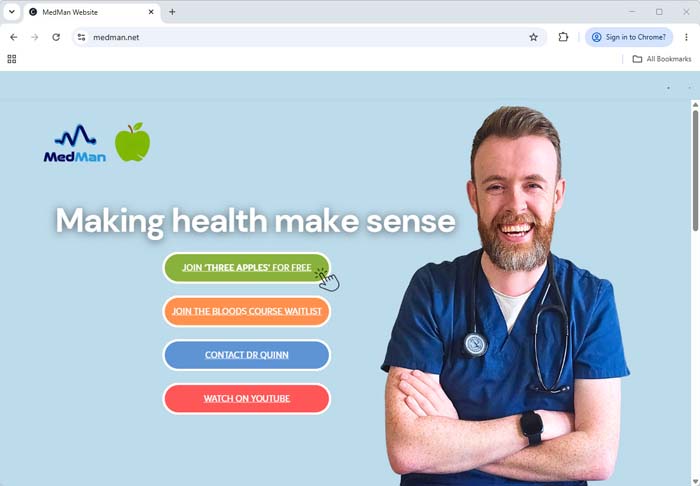
Yeah. So I'm a doctor in the UK. I'm working in Somerset. The best way to get in touch with me would be via the Med Man website. That's medman.net. You can send me a message like that. I'd also be delighted to welcome you aboard to the Med Man channel. So you just go to YouTube and subscribe.
Dr. Laurence Quinn [00:37:34]:
Or also I have a 3 Apples newsletter, which would be great if you could subscribe to that too. And I'll send you some information every week and often touching on blood pressure.
Mike Capuzzi [00:37:43]:
And that's also excellent. information, by the way. I, I get that too. So I'm a, I'm a fan of, uh, Dr. Quinn.
Dr. Laurence Quinn [00:37:49]:
Thank you.
Mike Capuzzi [00:37:50]:
So, you know, again, and I, again, I don't say that lightly. It's just your, your style, the, the practicality, um, the brevity. I appreciate all of that. So, uh, you know, really nice job there. And, uh, just, you know, keep it up. And, and, and know, I will tell you firsthand, because I've been in this, you know, not as a medical doctor, but in the sharing of information game, if you will, for decades. And oftentimes you'll, you'll never know just how many people you're impacting, but it's happening, Laurence. They may not be emailing you, they may not be commenting on YouTube, but it's definitely, you know, it's happening.
Mike Capuzzi [00:38:23]:
So just, you know, keep up the good work because I know it's, it's a huge amount of effort.
Dr. Laurence Quinn [00:38:27]:
It is a lot of effort, but when you get, when you get comments that you've changed someone's life or they've made some difference because of it, it just makes it all worthwhile, Mike Capuzzi. And it's great to hear that positive feedback that it, that it, that it helps you as well. Thank you.
Mike Capuzzi [00:38:39]:
For sure. So Laurence, before we wrap up, I have my Unstoppable And I'm going to tailor these questions to blood pressure, hypertension, white coat syndrome. You can share whatever you'd like. So, um, I know you've shared a lot, but is there any other cold hard truth about any of the topics that we discussed today that you think men need to hear?
Dr. Laurence Quinn [00:39:02]:
The big problem with hypertension is that you can't feel it. 40% of the people who have high blood pressure are walking around and they don't know it. And in a way, I wish it would make your fingers go blue. I wish it would do something so that you could see it and you could come in. Because we know hypertension has its fingerprints on 11 million deaths around the world, right? And if we could sort out all those blood pressures, imagine the amount of deaths we could prevent. I think as fellas, we are more likely to say, don't fix it if it's not broken. I feel fine. Don't need to do anything.
Dr. Laurence Quinn [00:39:38]:
But this is why blood pressure can just sneak up on men and they can completely ignore it. So the hard truth is hypertension is extremely common. A lot of people don't know they have it, but if you sort it out, you could lead— it could lead to a happier, healthier, longer life.
Mike Capuzzi [00:39:56]:
Excellent advice. What is something you think most men are doing today that's I would say ignoring things.
Dr. Laurence Quinn [00:40:11]:
So why I make an effort when a man comes into me, especially when it's with a mental health problem, I make an effort to say, well done coming in, because I know men just have such an aversion to going to see the doctor. Now, I know it's hard to get a doctor. Maybe you don't have a doctor, but I think so many men are guilty of thinking maybe they're a bit invincible, not wanting to hear what the doctor has to say, not wanting to go to the doctor. to say. So I would say if, if you can get yourself out of that mindset and get to your doctor, that would be wonderful.
Mike Capuzzi [00:40:41]:
Yeah, so the head-in-the-sand method is not a good one, huh?
Dr. Laurence Quinn [00:40:45]:
I wouldn't recommend it, no.
Mike Capuzzi [00:40:47]:
Oh my gosh, you're speaking directly at me. And finally, Laurence, what's one thing every guy watching or listening to us right now can do within the next week to be unstoppable?
Dr. Laurence Quinn [00:40:59]:
First of all, to be unstoppable, sometimes you can't do that on your own, right? We all want to be unstoppable, but sometimes you need help. So to be unstoppable, I would say just for a moment, consider that you can't be unstoppable on your own. Get your blood pressure machine, check it at home, check it regularly doing the way— with the way that we've said it. And if you find that your blood pressure is high, on average over 130 over 80, talk to your doctor. Get help, get your blood pressure under control. That's how you become unstoppable.
Mike Capuzzi [00:41:31]:
Awesome. Well, Laurence, again, it was, you know, a pleasure meeting you. I am a fan. I will be staying connected and just, you know, learning from you and hopefully, you know, just getting those little tidbits that I've already found useful. So thank you very much for your time today.
Dr. Laurence Quinn [00:41:46]:
It was an absolute pleasure, Mike Capuzzi, and you're doing a wonderful job. As I said, before we went on air, we're trying to achieve the same thing, aren't we? We're trying to make men over 50 healthier and happier.
Mike Capuzzi [00:41:57]:
Hey, I hope you enjoyed that conversation with Dr. Laurence Quinn. I hope you found it helpful, insightful, and really important for your own health journey. And by all means, I highly recommend you check out his YouTube channel. I highly recommend you subscribe to his email newsletter. And if you like what I'm doing here with Unstoppable After 50, please make sure You like and subscribe to the show. Go check out the YouTube channel. Appreciate you subscribing there.
Mike Capuzzi [00:42:26]:
And also make sure you check out unstoppableafter50.com and sign up for my weekly playbook. Every week I send a recap to my group of men who've asked for it, a PDF that's designed to be printed and saved, and it's a recap of that previous week's episode. So check out unstoppableafter50.com.


 Apple Podcasts
 Spotify
 Amazon Music
 YouTube
 iHeartRadio
 CastBox
 PocketCasts
 Deezer
 Podcast Addict
 Listen Notes
 Podchaser
 Player.fm
 Castro
 Goodpods
 RSS